Galois main summand
Also known as: main summand, lift trace decomposition, inverse-cyclotomic string, Hodge-Tate jump window, Hodge–Tate jump window, lift setting.
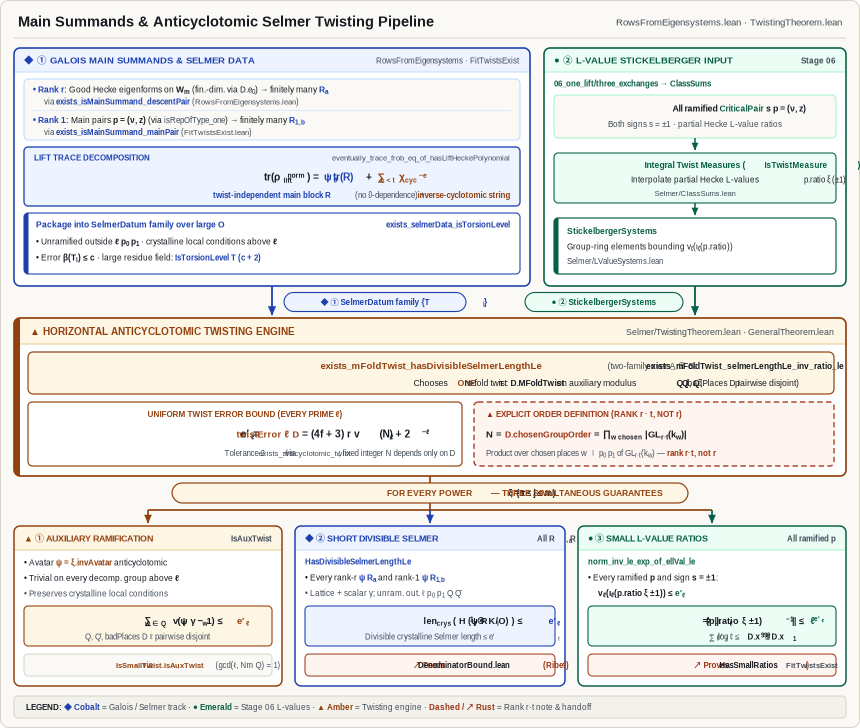
The fixed, twist-independent rank-r (or rank-1) l-adic Galois representation R extracted from a Hecke eigensystem whose trace, after twisting by theta^(-1) and adding the inverse-cyclotomic string sum_{e < t} chi_cyc^(-e), matches every twisted theta lift.
Level 1 — First-Principles
When Stage 07 studies congruences between lifted modular forms and non-lifted modular forms on the target unitary group
Instead, the unramified dual-pair theta lifttheta correspondence from a smaller unitary space
where New/Congruences/—is the Galois main summand (New.Selmer.IsMainSummand). Crucially,
To keep local
- Admissible local labels (
IsLiftSetting): At the chosen places above the two level primes, the local polynomial labels form a lift setting—degree- squarefree polynomials with at least one primitive label above each level prime and no twisted label vanishing at . - Separated Hodge–Tate jump windows (
IsMainSummandWeights): At every complex embeddingof (with CM-type sign ), each Hodge–Tate jump falls either in a narrow low band or inside a high Hodge–Tate jump window within distance of , with at most small jumps and at most negative jumps across any conjugate pair .
Limits of the intuition
Treating the lift trace decomposition as a ready-made direct-sum decomposition of matrices over the RowsFromEigensystems.lean establishes the identity first for Frobenius traces along the dense filter mostFrobenii D.E after scaling by normalizingAvatar V, and verifies that IsMainSummandLike (conjugate self-duality FirstOrder/TraceRelations.lean (exists_blockDiagonal_lattice).
Level 2 — Undergrad Bridge
In src/New/Congruences/GaloisRepresentations/RowsFromEigensystems.lean (15 declarations, 0 stub truncations) and src/New/Congruences/FitTwistsExist.lean, Stage 07 builds both rank-
- Linear-term extraction (
apply_one_eq_of_heckePolyEval_eq,neg_coeff_eq_of_hasLiftHeckePolynomial): Ifsatisfies HasLiftHeckePolynomialfor a descent pairof ranks ( ), comparing linear coefficients in heckePolyEval n w s X = qPochhammer w.q t (α X) * heckePolyEval r w z (β X)giveswhere and . - Frobenius trace identity (
eventually_trace_frob_eq_of_hasLiftHeckePolynomial): Multiplying bynormalizingAvatar V x.frob(the-adic avatar of of weight ) and transferring complex numbers via ι.ιℓ : ℂ ≃+* PadicAlgCl ℓyields, alongmostFrobenii D.E,where is the avatar of and is the avatar of ( ). - Jump-window verification (
isMainSummandWeights_descentPair,isMainSummandWeights_mainPair):- For the
-th descent pair ( ), the jumps split into high jumps ( , with ) and exactly low jumps ( , with ), satisfying IsMainSummandWeights D D.r D.t(countP_low_weights_descentPair). - For a main pair
( , ), the single jump satisfies and obeys IsMainSummandWeights D 1 (2 * p.z - 1).
- For the
- Existence for descent pairs and main pairs (
exists_isMainSummand_of_isRepOfType,exists_isMainSummand_descentPair,exists_isMainSummand_mainPair): Twisting an attached representation( IsRepOfType O r J c ∅ R) byO.hasWeight.inv.toAlgebraic 0 ashifts its jumps intoIsMainSummandWeights(isMainSummandLike_twistByChar) and matches lifted Frobenius traces (exists_isMainSummand_of_isRepOfType). Applying this to every eigensystem occurring inD.goodForms (D.spaceW D.m)givesexists_isMainSummand_descentPair, while applying it to the trivial rank-representation ( isRepOfType_one) givesexists_isMainSummand_mainPairinFitTwistsExist.lean.
Level 3 — Formal Lean Contract
All six anchored declarations extract completely untruncated across skeleton/07_congruences/rows_from_eigensystems.lean (15 declarations, 0 truncations) and skeleton/07_congruences/fit_twists_exist.lean:
07_congruences/rows_from_eigensystems.lean#New.Selmer.isMainSummandWeights_descentPair(upstreamRowsFromEigensystems.lean:146-174) and07_congruences/rows_from_eigensystems.lean#New.Selmer.isMainSummandWeights_mainPair(upstreamRowsFromEigensystems.lean:196-226).07_congruences/rows_from_eigensystems.lean#New.Selmer.eventually_trace_frob_eq_of_hasLiftHeckePolynomial(upstreamRowsFromEigensystems.lean:329-381):leanlemma New.Selmer.eventually_trace_frob_eq_of_hasLiftHeckePolynomial (ι : PadicIso ℓ) [DecidableEq n] {c : (i : O.ChosenIndex) → (ResField (O.chosenPlace i))[X]} (hO : IsLiftSetting O c 1) {a : ℤ} (ha : (Fintype.card r - O.rankDiff : ℤ) = 2 * a) {ϑ : D.TameChar} {V : DescentPair D.E r n} (hμ : V.u1Char = O.u1Char * ϑ.toAutChar) {y : V.FormV} {b : FinPlace D.E → ℕ → ℂ} (hy_lifts : V.HasLiftHeckePolynomial y b) {H : FinPlace D.E → ℂ[X]} (hy_eig : IsEigenform (y : Gf D.E n → WeylIndex n V.columnCount → ℂ) H) : ∀ᶠ x : FrobeniusDatum D.E in mostFrobenii D.E, -((normalizingAvatar V x.frob).val * ι.ιℓ ((H x.place).coeff (Fintype.card n - 1))) = ((ϑ.hasWeight.inv.toAlgebraic 0 0).avatar x.frob).val * (((O.hasWeight.inv.toAlgebraic 0 a).avatar x.frob).val * ι.ιℓ (b x.place 1)) + ∑ e ∈ Finset.range V.rankDiff, cyclotomicInv ℓ D.E (PadicAlgCl ℓ) x.frob ^ e07_congruences/rows_from_eigensystems.lean#New.Selmer.exists_isMainSummand_of_isRepOfType(upstreamRowsFromEigensystems.lean:383-436),07_congruences/rows_from_eigensystems.lean#New.Selmer.exists_isMainSummand_descentPair(upstreamRowsFromEigensystems.lean:476-561), and07_congruences/fit_twists_exist.lean#New.Selmer.exists_isMainSummand_mainPair(upstreamFitTwistsExist.lean:293-318).
See the page's live <VerificationBanner /> (audit/verification-status.json) for the pinned upstream commit and local Lean build status (build_status: unverified-locally).
Where this analogy breaks
Picturing a Galois main summand as a single fixed direct summand inside a fixed matrix representation oversimplifies two subtleties: the decomposition is certified first at the level of Frobenius traces along a dense filter (mostFrobenii) up to normalizingAvatar V, and the full lift representation splits block-diagonally over an integral lattice only after Ribet's method and non-degeneracy of the trace form assemble a common lattice.
Formal Lean Anchors
lemma New.Selmer.isMainSummandWeights_descentPair — Upstream source (src/New/Congruences/GaloisRepresentations/RowsFromEigensystems.lean L146-L174)
/-- Let `1 ≤ j ≤ m` (`D.LiftIndex`, `m = D.m`). At a complex embedding `σ`, over the infinite place
`v`, take as jumps (Hodge–Tate weights) the `r = D.r` integers `t / 2 - ε (λ_q + w_j)`, `q < r`, of
the `j`-th descent pair. Here `t = D.t`, `ε = cmSign σ` is `1` on the CM type and `-1` off it,
`λ_q = D.targetParameter v q` is the fixed parameter of the rank `r` group, and
`w_j = D.liftWeight j v` is minus the weight of the character of the lift. These jumps satisfy
`IsMainSummandWeights D r t`. -/
lemma New.Selmer.isMainSummandWeights_descentPair {j : ℕ} (hj : j ∈ D.LiftIndex) :
IsMainSummandWeights D D.r D.t fun σ : D.E →+* ℂ ↦ (Multiset.range D.r).map fun q : ℕ ↦
D.t / 2 -
cmSign σ * (D.targetParameter (InfinitePlace.mk σ) q + D.liftWeight j
(InfinitePlace.mk σ)) := by
sorry -- [EXTRACTED_STUB upstream=src/New/Congruences/GaloisRepresentations/RowsFromEigensystems.lean:146-174 commit=41c2716658c42ba08eb0648994a2efe83082a95c body_lines=19 body_sha256=22cd7dbb4d02d3e2e87e292d2293e3412fad06ae6b95d4c5d739f025d751088f]lemma New.Selmer.isMainSummandWeights_mainPair — Upstream source (src/New/Congruences/GaloisRepresentations/RowsFromEigensystems.lean L196-L226)
/-- Let `p` be a main pair for `j` (`IsMainPair`): an integer `z = p.z` and a character of `U(1)` of
weight `-c`, `c = p.negWeight`, with in particular `m < z ≤ r` and `w_j + r - t ≤ c ≤ w_j`, where
`w_j = D.liftWeight j` is minus the weight of the character of the `j`-th lift. At a complex
embedding `σ` over the infinite place `v`, take the single jump (Hodge–Tate weight)
`z - 1 - ε c v`, with `ε = cmSign σ` equal to `1` on the CM type and `-1` off it. These jumps
satisfy `IsMainSummandWeights D 1 (2 z - 1)`, the conditions on the jumps of a rank one
representation that is paired with `2 z - 1` consecutive powers of the inverse cyclotomic character:
each is low or within `t` of `-ε w_j`, few are small, and at most one at `σ` and its conjugate is
negative. -/
lemma New.Selmer.isMainSummandWeights_mainPair {p : D.CriticalPair} {j : ℕ} (hp : p.IsMainPair j) :
IsMainSummandWeights D 1 (2 * p.z - 1) fun σ : D.E →+* ℂ ↦
{(p.z - 1 - cmSign σ * p.negWeight (InfinitePlace.mk σ) : ℤ)} := by
sorry -- [EXTRACTED_STUB upstream=src/New/Congruences/GaloisRepresentations/RowsFromEigensystems.lean:196-226 commit=41c2716658c42ba08eb0648994a2efe83082a95c body_lines=20 body_sha256=a179e7a9d0337cacdfd02141bb048abdeb5e6a09da4fc84fa9dc5bfe497f5343]lemma New.Selmer.eventually_trace_frob_eq_of_hasLiftHeckePolynomial — Upstream source (src/New/Congruences/GaloisRepresentations/RowsFromEigensystems.lean L329-L381)
/-- The identity of traces at Frobenius elements. Let `O` be a descent pair over `D.E` of ranks
`r < n` with character `μ = O.u1Char`, let `c` be admissible labels for it and the trivial twist
(`IsLiftSetting`), and let `r - (n - r) = 2 a`. Let the descent pair `V` have character `μ ϑ`, with
`ϑ` tame, and let the eigenform `y` on `V` with Hecke polynomials `H` lift the system `b` of Hecke
eigenvalues. Then for most Frobenius elements `g = x.frob` at places `w = x.place`, minus the
coefficient of `X ^ (n - 1)` in `H w`, times `normalizingAvatar V g`, equals `θ₀(g) θ(g) b w 1`
plus the sum of the first `n - r` powers of the inverse cyclotomic character at `g`. An avatar is
the `ℓ`-adic Galois character of an algebraic Hecke character; `θ₀` and `θ` are those of
`ϑ.hasWeight.inv.toAlgebraic 0 0`, that is `ϑ⁻¹(x / x̄)`, and of `O.hasWeight.inv.toAlgebraic 0 a`,
that is `μ⁻¹(x / x̄) |x| ^ a`; `normalizingAvatar V` is the one made in the same way from the
inverse of the character `V.charW` of the space of rank `r`, with weight `-r`. Complex numbers are
carried to `ℓ`-adic ones by the isomorphism `ι.ιℓ`. -/
lemma New.Selmer.eventually_trace_frob_eq_of_hasLiftHeckePolynomial (ι : PadicIso ℓ) [DecidableEq n]
    {c : (i : O.ChosenIndex) → (ResField (O.chosenPlace i))[X]} (hO : IsLiftSetting O c 1) {a : ℤ}
    (ha : (Fintype.card r - O.rankDiff : ℤ) = 2 * a) {ϑ : D.TameChar} {V : DescentPair D.E r n}
    (hμ : V.u1Char = O.u1Char * ϑ.toAutChar) {y : V.FormV} {b : FinPlace D.E → ℕ → ℂ}
    (hy_lifts : V.HasLiftHeckePolynomial y b) {H : FinPlace D.E → ℂ[X]}
    (hy_eig : IsEigenform (y : Gf D.E n → WeylIndex n V.columnCount → ℂ) H) :
    ∀ᶠ x : FrobeniusDatum D.E in mostFrobenii D.E,
      -((normalizingAvatar V x.frob).val * ι.ιℓ ((H x.place).coeff (Fintype.card n - 1))) =
        ((ϑ.hasWeight.inv.toAlgebraic 0 0).avatar x.frob).val *
            (((O.hasWeight.inv.toAlgebraic 0 a).avatar x.frob).val * ι.ιℓ (b x.place 1)) +
∑ e ∈ Finset.range V.rankDiff, cyclotomicInv ℓ D.E (PadicAlgCl ℓ) x.frob ^ e := by
sorry -- [EXTRACTED_STUB upstream=src/New/Congruences/GaloisRepresentations/RowsFromEigensystems.lean:329-381 commit=41c2716658c42ba08eb0648994a2efe83082a95c body_lines=31 body_sha256=884b3511954e185a0f14a3e23f243bdf9984eb401dea7181acd90fbf671db788]lemma New.Selmer.exists_isMainSummand_of_isRepOfType — Upstream source (src/New/Congruences/GaloisRepresentations/RowsFromEigensystems.lean L383-L436)
/-- Let `O` be a descent pair of ranks `r < n`, with weight `w` and `t = n - r`. Assume that the
labels `c` are admissible for `O` and the trivial twist (`IsLiftSetting`), and that `R` is a
representation with these labels, jumps `J` and empty level (`IsRepOfType`) whose trace at each `g`
is the limit of the Hecke eigenvalues `b v 1` along most Frobenius elements tending to `g`, at
places `v`, carried to `ℓ`-adic numbers by the isomorphism `ι.ιℓ : ℂ ≃+* ℚ̄_ℓ`. Assume also that the
jumps `J σ`, lowered by `(r - t) / 2 - cmSign σ * w v` with `v` the infinite place of `σ` and
`cmSign σ` equal to `1` on the CM type and `-1` off it, obey the numerical conditions
`IsMainSummandWeights`. Then there is a `T` with `IsMainSummand O b T`: a main summand that gives
the traces of the representations attached to the lifts of `b` for all tame twists of `O`. -/
lemma New.Selmer.exists_isMainSummand_of_isRepOfType (ι : PadicIso ℓ) [DecidableEq n]
    {c : (i : O.ChosenIndex) → (ResField (O.chosenPlace i))[X]}
    (hO : IsLiftSetting O c 1) (b : FinPlace D.E → ℕ → ℂ) (J : (D.E →+* ℂ) → Multiset ℤ)
    (R : GalRep ℓ D.E r) (hR : IsRepOfType O (Fintype.card r) J c ∅ R)
    (h_trace : ∀ g : Gal(Ω/D.E), Tendsto (fun x : FrobeniusDatum D.E ↦ ι.ιℓ (b x.place 1))
      (mostFrobeniiAt D.E g) (nhds (R g).val.trace))
    (hJ : IsMainSummandWeights D (Fintype.card r) O.rankDiff fun σ : D.E →+* ℂ ↦
      (J σ).map fun u : ℤ ↦ u - ((Fintype.card r - O.rankDiff) / 2 -
        cmSign σ * O.weight (NumberField.InfinitePlace.mk σ))) :
    ∃ T : GalRep ℓ D.E r, IsMainSummand O b T := by
  sorry -- [EXTRACTED_STUB upstream=src/New/Congruences/GaloisRepresentations/RowsFromEigensystems.lean:383-436 commit=41c2716658c42ba08eb0648994a2efe83082a95c body_lines=36 body_sha256=96183547bd21a962e040f79d9fab9562adb278eb2b383e78885b767ab74d3916]
theorem New.Selmer.exists_isMainSummand_descentPair — Upstream source (src/New/Congruences/GaloisRepresentations/RowsFromEigensystems.lean L476-L561)
/-- Let the Hecke eigenvalues `p (w, i)` occur in a nonzero good form on `D.spaceW D.m`: a form of
principal level at the chosen places, in the image of the idempotent `D.e₀`. Let `O` be the `j`-th
descent pair of the trivial twist, `1 ≤ j ≤ m = D.m`: its two spaces have dimensions `r = D.r` and
`r + t`, `t = D.t`, and its character has weight `-D.liftWeight j`. Then some `r`-dimensional
`ℓ`-adic Galois representation `T` of `D.E` has `IsMainSummand O` for `p`. -/
theorem New.Selmer.exists_isMainSummand_descentPair {ℓ : ℕ} [ThePrime ℓ] (ι : PadicIso ℓ)
    {p : FinPlace D.E × ℕ → ℂ}
    (h_ne_bot : D.goodForms (D.spaceW D.m) ⊓ D.eigenPart (D.spaceW D.m) p ≠ ⊥) (j : D.LiftIndex) :
    ∃ T : GalRep ℓ D.E D.RowIndex,
      IsMainSummand (D.descentPair TameChar.one j) (fun (w : FinPlace D.E) (i : ℕ) ↦ p (w, i))
        T := by
  sorry -- [EXTRACTED_STUB upstream=src/New/Congruences/GaloisRepresentations/RowsFromEigensystems.lean:476-561 commit=41c2716658c42ba08eb0648994a2efe83082a95c body_lines=76 body_sha256=433888dcb6e7eac0982f75f276fecde9af1ecf47fd18f9a9481e1fa69f67707f]
lemma New.Selmer.exists_isMainSummand_mainPair — Upstream source (src/New/Congruences/FitTwistsExist.lean L293-L318)
/-- A critical pair `(ν, z)` is a main pair for an index `1 ≤ j ≤ m` if `m < z ≤ r`, the tame part
of `ν` is `D.chiMLocal ^ j`, and the weight `-c` of `ν` has `w + r - t ≤ c ≤ w` at each infinite
place, for `w = D.liftWeight j`. Here `m` is the number of lifts, `r = D.r`, `t = D.t`, and
`D.chiMLocal` is the fixed family of residue characters that is trivial off the chosen places. The
data `lValueData` describe the theta lift of `ν`, untwisted, from `U(1)` to `U(2 z)`. Then there is
an `ℓ`-adic representation `T` of rank one that is a main summand (`IsMainSummand`) for this lift
and the constant system `1` of Hecke eigenvalues: `T` satisfies `IsMainSummandLike`, and for every
twist of the lift the Galois representations attached to lifted eigenforms have, up to
normalisation, the trace of the twisted `T` plus a string of characters. -/
lemma New.Selmer.exists_isMainSummand_mainPair {P : Parameters} {D : Data P} {ℓ : ℕ} [ThePrime ℓ]
    {ι : PadicIso ℓ} (p : {p : D.CriticalPair × D.LiftIndex // p.1.IsMainPair p.2}) :
    ∃ T : GalRep ℓ D.E Unit,
      IsMainSummand (p.val.1.lValueData p.prop.hasLiftRank (1 : D.Twist)).descentPair 1 T := by
  sorry -- [EXTRACTED_STUB upstream=src/New/Congruences/FitTwistsExist.lean:293-318 commit=41c2716658c42ba08eb0648994a2efe83082a95c body_lines=14 body_sha256=b969fb62b2eb3d33771318d7ae3f9e34ac5c46074c6d6f1afcacdc2a0af2bd77]
Related Concepts
- Hecke operator — An averaging operator that sums values of an automorphic form over neighboring sublattices—indexed by cosets of a parahoric subgroup—which Stage 03 scales by powers of a prime to eliminate collision losses in the composite theta lift.
- central idempotent — A class-function element of a finite group algebra satisfying z² = z that acts as a G-equivariant orthogonal projection, splitting good cuspidal types from rare bad types across two level primes.
- theta correspondence — An integral transform built from a two-variable theta kernel that carries automorphic forms from one unitary group to another, iterated along a ladder of Hermitian spaces and packaged via admissible chain data.
- regular twist family — A prime-by-prime family of m-fold anticyclotomic twists theta(iota) with modulus coprime to l, inverse L-value ratios of height at most x_1, and lift/projection denominators summing within fa(log b)^3 / (m*k).
- prime number — A whole number greater than 1 whose only positive whole-number divisors are 1 and itself; every integer above 1 factors uniquely into a product of them.
Referenced By
- Stage: Crystalline Lifting, Kummer Charts, and Local Dual Defect
- Stage: First-Order Ribet Denominator Bounds and Existence of Regular Twist Families
- Stage: Galois Main Summands and the Anticyclotomic Selmer Twisting Theorem
- Stage: Stage 07 — Lower Bound: Congruences & Galois Representations (Theorem C, Part 3)
- Concept: anticyclotomic Selmer twisting
- Concept: crystalline dual defect
- Concept: Kummer chart cup orthogonality
- Concept: Taylor–Wiles prime triangle
Authoritative Sources
- Langlands' functoriality and the Weil representation (paper) — S. Rallis, Amer. J. Math. 104 (1982), 469–515.
- Functoriality and the inverse Galois problem (paper) — C. Khare, M. Larsen & G. Savin, Compos. Math. 144 (2008), 1197–1217.
- Compatible systems of symplectic Galois representations and the inverse Galois problem III (paper) — S. Arias-de-Reyna, L. Dieulefait, S. W. Shin & G. Wiese, Math. Ann. 361 (2015), 909–925.
Page Glossary
- Hecke operator
- An averaging operator that sums values of an automorphic form over neighboring sublattices—indexed by cosets of a parahoric subgroup—which Stage 03 scales by powers of a prime to eliminate collision losses in the composite theta lift.
- prime number
- A whole number greater than 1 whose only positive whole-number divisors are 1 and itself; every integer above 1 factors uniquely into a product of them.
- regular twist family
- A prime-by-prime family of m-fold anticyclotomic twists theta(iota) with modulus coprime to l, inverse L-value ratios of height at most x_1, and lift/projection denominators summing within f*a*(log b)^3 / (m*k).
- theta correspondence
- An integral transform built from a two-variable theta kernel that carries automorphic forms from one unitary group to another, iterated along a ladder of Hermitian spaces and packaged via admissible chain data.
- central idempotent
- A class-function element of a finite group algebra satisfying z² = z that acts as a G-equivariant orthogonal projection, splitting good cuspidal types from rare bad types across two level primes.
- Hecke L-value ratio
- The ratio |L^S(z, (nu * theta^s)^-1)| / |L^S(z, nu^-1)| of twisted to untwisted partial Hecke L-values at a critical pair (nu, z), tracking how Siegel–Weil exchange constants scale under twisting across chain quotients and grid turns.