idle direction repayment
Also known as: idle direction, single-lift cost, lift volume height.
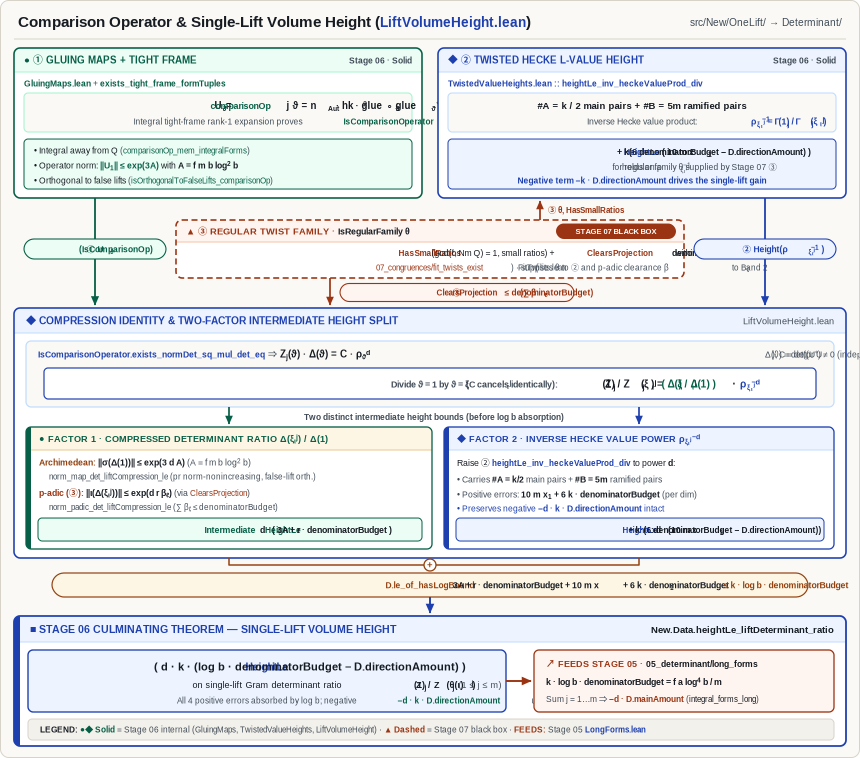
The exact negative-height accounting on Z_j(1) / Z_j(xi_iota^j) where k/2 squared main-pair L-value ratios repay k idle directions at cost d * k * (log b * denominatorBudget - directionAmount), overcoming the naive 2/3 barrier to produce -d * D.mainAmount inside Theorem C.
Level 1 — First-Principles
Why did Levent Alpöge's roadmap flag the single-lift cost (Step 14) as the barrier separating an elementary
Idle direction repayment is the exact negative-arithmetic heightarithmetic height budget established by Stage 06 (New.Data.heightLe_liftDeterminant_ratio): across a regular twist familyregular twist family
Because LongForms.lean) yields
How does Stage 06 assemble that exact coefficient
- Compressed determinant ratio
: At infinity, eigenvalue bounds on the untwisted lift compression give where ( norm_map_det_liftCompression_le). At each prime, ClearsProjectiongives( norm_padic_det_liftCompression_le). Together, the intermediate height ofis at most . - Inverse Hecke value ratio
: Factoring over the three exchange pairs from the three-exchange reductioncarrier form ( exists_heckeValueProd_eq_mul_prod_ratio) splits the squared-value factors into exact pair counts: main pairsHecke L-value ratio (with , sign ), squared to give copies of the negative main-pair heightcharacter theta lift ; ramified pairs ( at sign , at sign , and at sign ), squared to give copies of the HasSmallRatiosbound. Raising to the -th power yields height ( heightLe_inv_heckeValueProd_div).
- Final absorption (
D.le_of_hasLogBound): Adding both intermediate heights givesBecause towers over , , and , the scale bound D.le_of_hasLogBoundfolds all four positive error terms cleanly into, leaving .
Limits of the intuition
Do not conflate the intermediate height denominatorBudget is not produced by any single determinant bound, but is the slack needed by D.le_of_hasLogBound to absorb LongForms.lean,
Level 2 — Undergrad Bridge
In Hida (1981), Prasanna (2006), and Böcherer–Dummigan–Schulze-Pillot (2012), congruence numbers link special
- Exact pair counts in
exists_heckeValueProd_eq_mul_prod_ratio(TwistedValueHeights.lean:1025-1062): The threeexchangePair j icutoffs are, , and . Since and are even: - Main pairs
on i = none(all sign): , so . Every satisfies IsMainPair j(isMainPair_lowerPoint_exchangePair_none). - Remaining ramified pairs
: on some (-1)(sign), on some 1(sign), and on none(sign). Total cardinality: , so . Every satisfies IsRamified(isRamified_lowerPoint_exchangePair). - Conductor power:
with is a rational integer coprime to at every , contributing to the height via hθ.heightLe_of_eq_zpow_mul. - Resulting bound (
heightLe_inv_heckeValueProd_div):HeightLe (10 * D.m * D.x₁ + D.k * (6 * D.denominatorBudget - D.directionAmount))on(heckeValueProd j ((θ ι).powTwist j) / heckeValueProd j 1)⁻¹.
- Main pairs
- Eigenvalue bounds on
liftCompression(LiftVolumeHeight.lean:648-716):- Archimedean (
norm_map_det_liftCompression_le): For any eigenpairof , false-lift orthogonality gives , forcing . Multiplying across eigenvalues gives . -adic ( norm_padic_det_liftCompression_le): GivenClearsProjectionat, an operator on with maps integral forms orthogonal to false lifts into integral forms. Hence preserves integrality, so its eigenvalues have -norm , giving and thus .
- Archimedean (
- Final assembly (
heightLe_liftDeterminant_ratio,LiftVolumeHeight.lean:726-783): Takingas the multiplier in HeightLe.of_mul_leyieldsHeightLe (d * (3 * A) + d * (D.r * D.denominatorBudget))on. Multiplying by (heightLe_inv_heckeValueProd_div hθ j).pow dand applyingD.le_of_hasLogBound:proves HeightLe (D.targetDim * (D.k * (D.logB * D.denominatorBudget - D.directionAmount)))on, where D.targetDim_eq_finrank_goodForms_spaceW jidentifies.
Level 3 — Formal Lean Contract
All five anchors extract completely untruncated across skeleton/06_one_lift/lift_volume_height.lean and skeleton/06_one_lift/twisted_value_heights.lean:
06_one_lift/twisted_value_heights.lean#New.Data.exists_heckeValueProd_eq_mul_prod_ratio(upstreamTwistedValueHeights.lean:1025-1062) and06_one_lift/twisted_value_heights.lean#New.Data.heightLe_inv_heckeValueProd_div(upstreamTwistedValueHeights.lean:1064-1095):leantheorem New.Data.heightLe_inv_heckeValueProd_div {θ : PrimePadicIso → D.MFoldTwist} (hθ : D.IsRegularFamily θ) (j : D.LiftIndex) : HeightLe (10 * D.m * D.x₁ + D.k * (6 * D.denominatorBudget - D.directionAmount)) fun ι : PrimePadicIso ↦ (heckeValueProd j ((θ ι).powTwist j) / heckeValueProd j 1)⁻¹06_one_lift/lift_volume_height.lean#New.Data.IsComparisonOperator.norm_padic_det_liftCompression_le(upstreamLiftVolumeHeight.lean:648-691) and06_one_lift/lift_volume_height.lean#New.Data.IsComparisonOperator.norm_map_det_liftCompression_le(upstreamLiftVolumeHeight.lean:693-716).06_one_lift/lift_volume_height.lean#New.Data.heightLe_liftDeterminant_ratio(upstreamLiftVolumeHeight.lean:726-783):leanlemma New.Data.heightLe_liftDeterminant_ratio {θ : PrimePadicIso → D.MFoldTwist} (hθ : D.IsRegularFamily θ) (j : D.LiftIndex) : HeightLe (D.targetDim * (D.k * (D.logB * D.denominatorBudget - D.directionAmount))) fun ι : PrimePadicIso ↦ D.liftDeterminant 1 j / D.liftDeterminant (θ ι) j
See the page's live <VerificationBanner /> (audit/verification-status.json) for the pinned upstream commit and local Lean build status (build_status: unverified-locally).
Where this analogy breaks
Speaking of each lift as 'paying back k idle directions' is a helpful accounting metaphor, but the repayment does not cancel error terms directly inside a single determinant: it combines two separate height bounds—the compressed comparison determinant ratio (height <= d * (3A + r * denominatorBudget)) and the d-th power of the inverse Hecke product ratio (height <= d * (10 m x_1 + k * (6 * denominatorBudget - directionAmount)))—and then absorbs all positive errors into d * k * log b * denominatorBudget via D.le_of_hasLogBound.
Formal Lean Anchors
lemma New.Data.heightLe_liftDeterminant_ratio — Upstream source (src/New/OneLift/LiftVolumeHeight.lean L726-L783)
/-- The cost of one lift: for a family of twists `ξ_ι = θ ι` as in `IsRegularFamily`, the ratio
`Z_j (1) / Z_j (ξ_ι ^ j)` has height at most `d k (log b · denominatorBudget - directionAmount)`.
Here `d = D.targetDim` is the dimension of the good forms, `k = D.k = D.r + 1 - D.m`,
`log b = D.logB` is a parameter, `denominatorBudget = D.denominatorBudget` is the budget for
denominators and `directionAmount = D.directionAmount` is the sum over the infinite places `σ`, of
weight `κ = D.weight σ`, of `D.jetSize κ = log κ! + κ log (M / Ω)`, the size of a derivative of
order `κ`, less the prime sum `D.primeSum κ σ` that measures its divisibility. -/
lemma New.Data.heightLe_liftDeterminant_ratio {θ : PrimePadicIso → D.MFoldTwist} (hθ : D.IsRegularFamily θ)
(j : D.LiftIndex) :
HeightLe (D.targetDim * (D.k * (D.logB * D.denominatorBudget - D.directionAmount)))
fun ι : PrimePadicIso ↦ D.liftDeterminant 1 j / D.liftDeterminant (θ ι) j := by
sorry -- [EXTRACTED_STUB upstream=src/New/OneLift/LiftVolumeHeight.lean:726-783 commit=41c2716658c42ba08eb0648994a2efe83082a95c body_lines=48 body_sha256=091d2acb5fa81d008440a1b0f92caeff14ddf688a41bc0d8a7f6168d0cfe5b97]lemma New.Data.IsComparisonOperator.norm_padic_det_liftCompression_le — Upstream source (src/New/OneLift/LiftVolumeHeight.lean L648-L691)
/-- Let `ϑ` be a twist, ramified at a finite set `Q` of places with product of norms `ϑ.normQ`, and
`ι` an isomorphism of `ℂ` with `ℚ̄_l` for a prime `l` that does not divide `ϑ.normQ`. Let `U` be a
comparison operator: `U_ϑ` takes lifts to forms orthogonal to the false lifts and keeps integrality
at `ι`. Let `ClearsProjection` hold with `β`: for some operator `Λ` on the lifts with
`|ι (det Λ)| ≥ exp (-d r β)` and the orthogonal projection `pr` to the lifts, `Λ (pr y)` is integral
at `ι` for all integral `y` orthogonal to the false lifts. Then `det (pr U_ϑ)`, with
`pr U_ϑ = liftCompression U ϑ`, has norm at most `exp (d r β)` at `ι`, with `d` the dimension of the
good forms on `W_j = D.spaceW j` and `r = D.r` the rank of `W_j`. -/
lemma New.Data.IsComparisonOperator.norm_padic_det_liftCompression_le {j : D.LiftIndex}
{U : ∀ ϑ : D.Twist, End ℂ (D.descentPair ϑ j).FormV} (hU : IsComparisonOperator j U)
(ϑ : D.Twist) (ι : PrimePadicIso) (hι : (ι.prime : ℕ).Coprime ϑ.normQ) {β : ℝ}
(h_clears : D.ClearsProjection ι.iso ϑ j β) :
‖ι.iso (liftCompression U ϑ).det‖ ≤
exp (finrank ℂ (D.goodForms (D.spaceW j)) * (D.r * β)) := by
sorry -- [EXTRACTED_STUB upstream=src/New/OneLift/LiftVolumeHeight.lean:648-691 commit=41c2716658c42ba08eb0648994a2efe83082a95c body_lines=31 body_sha256=a86ad540d362faf72b87d6e63ed7229680d77be865474a2a89c7f4811283ddcd]lemma New.Data.IsComparisonOperator.norm_map_det_liftCompression_le — Upstream source (src/New/OneLift/LiftVolumeHeight.lean L693-L716)
/-- Let `U` be a comparison operator on the forms on `V_j`, the target of the `j`-th lift, and
`pr U_1 = liftCompression U 1` its compression to the range of the untwisted lift. The image of
`det (pr U_1)` under every ring automorphism `σ` of `ℂ` has modulus at most
`exp (3 d f m b log² b)`. Here `d` is the dimension of the good forms on `W_j = D.spaceW j`,
`f = D.f` the number of infinite places, `m = D.m` the number of lifts in the chain and `b = D.b`,
with `log b = D.logB`, the weight at the infinite places in `D.bPlaces`. -/
lemma New.Data.IsComparisonOperator.norm_map_det_liftCompression_le {j : D.LiftIndex}
{U : ∀ ϑ : D.Twist, End ℂ (D.descentPair ϑ j).FormV} (hU : IsComparisonOperator j U)
(σ : ℂ ≃+* ℂ) :
‖σ (liftCompression U 1).det‖ ≤
exp (finrank ℂ (D.goodForms (D.spaceW j)) * (3 * (D.f * D.m * D.b * D.logB ^ 2))) := by
sorry -- [EXTRACTED_STUB upstream=src/New/OneLift/LiftVolumeHeight.lean:693-716 commit=41c2716658c42ba08eb0648994a2efe83082a95c body_lines=14 body_sha256=26a50b327c8c6c278d610c3f00fe7c97dbac91f189a9f56384b755f3af1d88aa]lemma New.Data.exists_heckeValueProd_eq_mul_prod_ratio — Upstream source (src/New/OneLift/HeckeValues/TwistedValueHeights.lean L1025-L1062)
/-- Let `heckeValueProd j ϑ` be the product of the squared `L`-values at `1 ≤ z ≤ z_i` of the three
pairs `(ν_i, z_i) = exchangePair j i`, twisted by `ϑ` or its inverse, with powers of the norms of
the omitted places. It is the untwisted value times a power `e` of the norm `ϑ.normQ` of the modulus
of `ϑ` and the square of a product of ratios `(ν, z).ratio ϑ s = |L(z, (ν ϑ ^ s)⁻¹)| / |L(z, ν⁻¹)|`.
Of these `k / 2` belong to main pairs `p a` for `j` (`IsMainPair`), with `s = 1`, and `5 m` to
ramified pairs `q b`, with signs `s b`. Here `m = D.m` is the number of lifts and `k = D.r + 1 - m`.
The exponent, the pairs and the signs do not depend on `ϑ`. -/
lemma New.Data.exists_heckeValueProd_eq_mul_prod_ratio (j : D.LiftIndex) :
∃ (e : ℕ) (A : Finset ℕ) (B : Finset (Σ _ : Option ℤˣ, ℕ)) (p : ℕ → D.CriticalPair)
(q : (Σ _ : Option ℤˣ, ℕ) → D.CriticalPair) (s : (Σ _ : Option ℤˣ, ℕ) → ℤˣ),
2 * #A = D.k ∧
#B = 5 * D.m ∧
(∀ a ∈ A, (p a).IsMainPair j) ∧
(∀ b : Σ _ : Option ℤˣ, ℕ, (q b).IsRamified) ∧
∀ ϑ : D.Twist, heckeValueProd j ϑ = ϑ.normQ ^ e *
((∏ a ∈ A, (p a).ratio ϑ) * ∏ b ∈ B, (q b).ratio ϑ (s b)) ^ 2 * heckeValueProd j 1 := by
sorry -- [EXTRACTED_STUB upstream=src/New/OneLift/HeckeValues/TwistedValueHeights.lean:1025-1062 commit=41c2716658c42ba08eb0648994a2efe83082a95c body_lines=23 body_sha256=023260355b2d97e2a543256f0232c7a9e437132eaf2d84b4d3d0dd9196a00742]theorem New.Data.heightLe_inv_heckeValueProd_div — Upstream source (src/New/OneLift/HeckeValues/TwistedValueHeights.lean L1064-L1095)
/-- Let `θ ι` be `m`-fold twists, one for each prime `l` and isomorphism `ι : ℂ ≃ ℚ̄_l`. Let them
form a regular family (`IsRegularFamily`): the modulus is prime to `l`, the inverse ratios of
`L`-values of ramified pairs have height at most the second cut-off `x₁ = D.x₁`, and the logarithmic
denominators of projections to lifts add up over `l` to at most `denominatorBudget`. Let
`1 ≤ j ≤ m`, and let `heckeValueProd j ϑ` be the product of the Hecke values `lValueProd` of the
three pairs `exchangePair j i`, twisted by `ϑ` or its inverse: the pair made from the character of
the `j`-th lift, and two flat pairs of tame parts `D.chiMLocal ^ (± j)` at the points `m` and
`m / 2`. Then the family over `ι` of the inverse ratios of its value at `(θ ι) ^ j` to its value at
`1` has height (`New.HeightLe`) at most `10 m x₁ + k (6 denominatorBudget - directionAmount)`. -/
theorem New.Data.heightLe_inv_heckeValueProd_div {θ : PrimePadicIso → D.MFoldTwist}
    (hθ : D.IsRegularFamily θ) (j : D.LiftIndex) :
    HeightLe (10 * D.m * D.x₁ + D.k * (6 * D.denominatorBudget - D.directionAmount))
fun ι : PrimePadicIso ↦ (heckeValueProd j ((θ ι).powTwist j) / heckeValueProd j 1)⁻¹ := by
sorry -- [EXTRACTED_STUB upstream=src/New/OneLift/HeckeValues/TwistedValueHeights.lean:1064-1095 commit=41c2716658c42ba08eb0648994a2efe83082a95c body_lines=20 body_sha256=e2a0adc8fae00255a652d077a1f7f6002f4954a8883f340bf24cd32c674dbffd]Related Concepts
- arithmetic height — A logarithmic measure combining ordinary archimedean size with prime-by-prime p-adic divisibility, locked together by the product formula so a nonzero algebraic quantity cannot be simultaneously small at every place.
- Gram determinant — The determinant of the matrix of pairwise inner products of a family of vectors, measuring the squared volume of the parallelotope they span and controlled by Hadamard's and Fischer's inequalities.
- lift comparison operator — A family of self-adjoint integral operators U_theta = n_Aut * hk^2 * glue_theta * glue_theta^* on V_j whose compression pr U_theta onto the lift subspace satisfies Z_j(theta) * det(pr U_theta) = C * rho_theta^d, turning the lift determinant ratio into a ratio of compressed determinants times inverse Hecke values.
- character theta lift — Lifting a main-pair character nu * theta from U(1) to U(2z), where a four-block seesaw (12 + 4 + 4 + (2z - 20)) builds a rank-one test form whose p-adic pairing bound combines with the untwisted lift norm to yield negative height 6 * denominatorBudget - directionAmount on (p.ratio)^-1.
- regular twist family — A prime-by-prime family of m-fold anticyclotomic twists theta(iota) with modulus coprime to l, inverse L-value ratios of height at most x_1, and lift/projection denominators summing within fa(log b)^3 / (m*k).
Referenced By
- Stage: Stage 06 — Lower Bound: One Lift (Theorem C, Part 2)
- Stage: The Lift Comparison Operator and Single-Lift Volume Height
Authoritative Sources
- Congruences of cusp forms and special values of their zeta functions (paper) — H. Hida, Invent. Math. 63 (1981), 225–261.
- Yoshida lifts and Selmer groups (paper) — S. Böcherer, N. Dummigan & R. Schulze-Pillot, J. Math. Soc. Japan 64 (2012), 1353–1401.
- Integrality of a ratio of Petersson norms and level-lowering congruences (paper) — K. Prasanna, Ann. of Math. 163 (2006), 901–941.
Page Glossary
- Gram determinant
- The determinant of the matrix of pairwise inner products of a family of vectors, measuring the squared volume of the parallelotope they span and controlled by Hadamard's and Fischer's inequalities.
- arithmetic height
- A logarithmic measure combining ordinary archimedean size with prime-by-prime p-adic divisibility, locked together by the product formula so a nonzero algebraic quantity cannot be simultaneously small at every place.
- regular twist family
- A prime-by-prime family of m-fold anticyclotomic twists theta(iota) with modulus coprime to l, inverse L-value ratios of height at most x_1, and lift/projection denominators summing within f*a*(log b)^3 / (m*k).
- lift comparison operator
- A family of self-adjoint integral operators U_theta = n_Aut * hk^2 * glue_theta * glue_theta^* on V_j whose compression pr U_theta onto the lift subspace satisfies Z_j(theta) * det(pr U_theta) = C * rho_theta^d, turning the lift determinant ratio into a ratio of compressed determinants times inverse Hecke values.
- carrier form
- The fixed, nonzero, full-level holomorphic theta lift of 1 from U(0, m) to U(2m, m) onto which the first two Siegel–Weil exchanges collapse a twisted class sum, letting a third exchange turn the entire twist dependence into a scalar c(theta) controlled by the raw Hecke value product Gamma_j(theta).
- Hecke L-value ratio
- The ratio |L^S(z, (nu * theta^s)^-1)| / |L^S(z, nu^-1)| of twisted to untwisted partial Hecke L-values at a critical pair (nu, z), tracking how Siegel–Weil exchange constants scale under twisting across chain quotients and grid turns.
- character theta lift
- Lifting a main-pair character nu * theta from U(1) to U(2z), where a four-block seesaw (12 + 4 + 4 + (2z - 20)) builds a rank-one test form whose p-adic pairing bound combines with the untwisted lift norm to yield negative height 6 * denominatorBudget - directionAmount on (p.ratio)^-1.