The Lift Comparison Operator and Single-Lift Volume Height
This page explains src/New/OneLift/LiftVolumeHeight.lean (06_one_lift/lift_volume_height, 29 declarations, 0 stub truncations): the culminating Stage 06 theorem New.Data.heightLe_liftDeterminant_ratio, which converts divided-lattice gluing and negative twisted 05_determinant/long_forms). Return to the Stage 06 Overview, or revisit Three Exchanges, the Carrier Form, and Divided-Lattice Gluing and Vanishing Periods of False Lifts and Negative Heights of Twisted L-Values.
Level 1 — First-Principles
Everything in Stage 06 converges inside LiftVolumeHeight.lean. From Gluing Maps we have the linear map
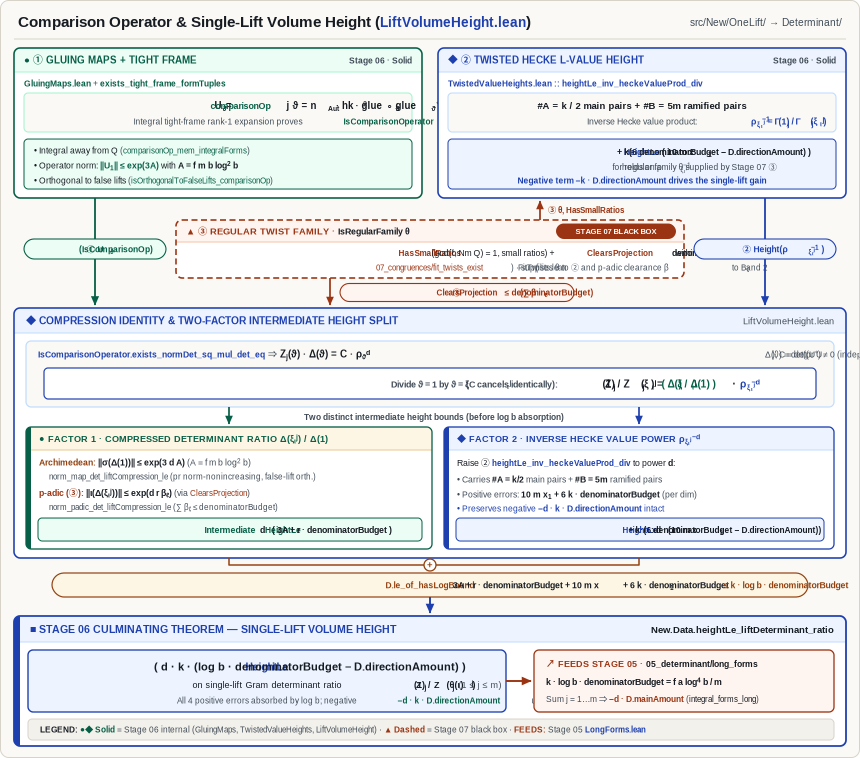
The argument runs in four clean steps:
- Abstract compression identity (
normDet_sq_mul_det_compression): For any injective linear mapbetween finite-dimensional inner-product spaces and any operator on , compressing onto via the orthogonal projection satisfies Applying this to relates the lift Gram determinant directly to the determinant of the lift compressionlift comparison operator. - Concrete comparison operator (
comparisonOp,exists_tight_frame_formTuples,isComparisonOperator_comparisonOp): Stage 06 setswhere and . Expanding on using a tight frame of integral tuplestight frame ( exists_tight_frame_formTuples) rewritesas a finite sum of rank-one operators . This proves all five axioms of IsComparisonOperator:ratio_ne_zero:; exists_inner_eq:with positive definite and independent of ; isOrthogonalToFalseLifts:maps lifts to forms satisfying false-lift orthogonalityfalse-lift period; mem_integralForms:preserves integrality at every primeprime number ( comparisonOp_mem_integralForms);normSqAt_le:multiplies squared norms by at most ( normSqAt_comparisonOp_le), meaning its operator norm is at most.
- Determinant cancellation and intermediate height bounds (
exists_normDet_sq_mul_det_eq,norm_map_det_liftCompression_le,norm_padic_det_liftCompression_le): Applying the compression identity giveswith independent of . Dividing by cancels identically: Now we bound the two factors separately—keeping the intermediate bounds strictly distinct from the final absorbed bound: - Compressed determinant ratio
: At infinity, false-lift orthogonality keeps norm-nonincreasing, so every eigenvalue of has modulus ( ), giving ( norm_map_det_liftCompression_le). At each primeof a regular twist familyregular twist family , ClearsProjectionproducesclearing denominators of with , forcing ( norm_padic_det_liftCompression_le). Together, these yield the intermediate height - Inverse Hecke value power
: Raising Stage 06's twisted -value heightcharacter theta lift ( heightLe_inv_heckeValueProd_div) to the-th power yields the intermediate height
- Compressed determinant ratio
- Error absorption and handoff to Stage 05 (
heightLe_liftDeterminant_ratio): Adding both intermediate heights and invoking the scale boundD.le_of_hasLogBound:delivers the single-lift volume heightidle direction repayment New.Data.heightLe_liftDeterminant_ratio:Handed directly to Stage 05 — Regular Twist Families and the Assembly of Theorem C ( 05_determinant/long_forms), the identityturns this into , which sums over to and closes Theorem C.
Where this analogy breaks
It is tempting to conflate the intermediate height heightLe_liftDeterminant_ratio. They play different roles: norm_map_det_liftCompression_le and norm_padic_det_liftCompression_le know nothing about D.le_of_hasLogBound uses the extra
Level 2 — Undergrad Bridge
Walkthrough of all 29 declarations in src/New/OneLift/LiftVolumeHeight.lean (0 stub truncations):
| Section | Declarations (Count) | Mathematical Role |
|---|---|---|
| Linear algebra & valuation scaling | normDet_sq_mul_det_compression, norm_map_det_le_pow, normSqAt_smul, normSqAt_nonneg, normSqAt_pos, exists_smul_mem_integralForms_maximal (6) | Proves $\det(u^* u)\det(\mathrm{pr},T |
| Comparison-operator contract & pullback | IsComparisonOperator, comparisonOp, heckeValueProd_div_eq, adjoint_glue_goodLift, inner_goodLift_comparisonOp, isOrthogonalToFalseLifts_comparisonOp (6) | Defines the 5-axiom structure IsComparisonOperator and comparisonOp j ϑ = n_Aut · hk² · glue_ϑ ∘ glue_ϑ^*, proving |
| Tight-frame expansion & arithmetic | TightFrameIndex, exists_frame_weightRep_eq_intCast, exists_tight_frame_formTuples, comparisonOp_eq_sum, comparisonOp_mem_integralForms, card_prod_mul_card_tightFrameIndex_mul_sq_le, normSqAt_comparisonOp_le, isComparisonOperator_comparisonOp (8) | Builds an integral tight frame of FormTuples j with frame constant comparisonOp_mem_integralForms) and squared norm factor normSqAt_comparisonOp_le, where isComparisonOperator_comparisonOp j. |
| Compression, eigenvalue bounds & final height | finrank_range_goodLift, range_goodLift_le_range_inf_ker, normSqAt_starProjection_range_goodLift_le, liftCompression, IsComparisonOperator.exists_normDet_sq_mul_det_eq, IsComparisonOperator.norm_padic_det_liftCompression_le, IsComparisonOperator.norm_map_det_liftCompression_le, mFoldTwist_one_pow, heightLe_liftDeterminant_ratio (9) | Proves normSqAt_starProjection_range_goodLift_le and ClearsProjection + exists_smul_mem_integralForms_maximal, forms HeightLe (d * (3 * A) + d * (D.r * D.denominatorBudget)) on (heightLe_inv_heckeValueProd_div hθ j).pow d, and applies D.le_of_hasLogBound to prove heightLe_liftDeterminant_ratio. |
Exact Handoff into Stage 05 (LongForms.lean)
Inside src/New/Determinant/Twist/LongForms.lean:142–154 (exists_hasSmallRatios_heightLe_liftDeterminant_div), Stage 05 receives hθ : D.IsRegularFamily θ from Stage 07 (exists_isRegularFamily), invokes heightLe_liftDeterminant_ratio hθ j for each
Summing across HeightLe (d * (b + f * a * logB ^ 4 - D.mainAmount)) on New.Data.integral_forms_long).
Level 3 — Formal Lean Contract
The extracted skeleton skeleton/06_one_lift/lift_volume_height.lean (29 declarations, 0 stub truncations) mirrors src/New/OneLift/LiftVolumeHeight.lean at pinned upstream commit 41c2716658c42ba08eb0648994a2efe83082a95c. Every declaration extracts completely untruncated.
Headline Signatures
-- skeleton/06_one_lift/lift_volume_height.lean (upstream LiftVolumeHeight.lean:548-783)
theorem New.Data.isComparisonOperator_comparisonOp (j : D.LiftIndex) :
    IsComparisonOperator j (comparisonOp j)

lemma New.Data.IsComparisonOperator.exists_normDet_sq_mul_det_eq {j : D.LiftIndex}
    {U : ∀ ϑ : D.Twist, End ℂ (D.descentPair ϑ j).FormV} (hU : IsComparisonOperator j U) :
    ∃ C : ℂ, C ≠ 0 ∧ ∀ ϑ : D.Twist,
      (D.goodLift ϑ j).normDet ^ 2 * (liftCompression U ϑ).det =
        C * (heckeValueProd j ϑ / heckeValueProd j 1) ^ finrank ℂ (D.goodForms (D.spaceW j))

lemma New.Data.IsComparisonOperator.norm_padic_det_liftCompression_le {j : D.LiftIndex}
    {U : ∀ ϑ : D.Twist, End ℂ (D.descentPair ϑ j).FormV} (hU : IsComparisonOperator j U)
    (ϑ : D.Twist) (ι : PrimePadicIso) (hι : (ι.prime : ℕ).Coprime ϑ.normQ) {β : ℝ}
    (h_clears : D.ClearsProjection ι.iso ϑ j β) :
    ‖ι.iso (liftCompression U ϑ).det‖ ≤
      exp (finrank ℂ (D.goodForms (D.spaceW j)) * (D.r * β))

lemma New.Data.IsComparisonOperator.norm_map_det_liftCompression_le {j : D.LiftIndex}
    {U : ∀ ϑ : D.Twist, End ℂ (D.descentPair ϑ j).FormV} (hU : IsComparisonOperator j U)
    (σ : ℂ ≃+* ℂ) :
    ‖σ (liftCompression U 1).det‖ ≤
      exp (finrank ℂ (D.goodForms (D.spaceW j)) * (3 * (D.f * D.m * D.b * D.logB ^ 2)))

lemma New.Data.heightLe_liftDeterminant_ratio {θ : PrimePadicIso → D.MFoldTwist} (hθ : D.IsRegularFamily θ)
    (j : D.LiftIndex) :
    HeightLe (D.targetDim * (D.k * (D.logB * D.denominatorBudget - D.directionAmount)))
fun ι : PrimePadicIso ↦ D.liftDeterminant 1 j / D.liftDeterminant (θ ι) j- Handoff to Stage 05:
New.Data.heightLe_liftDeterminant_ratiois consumed directly by05_determinant/long_forms(New.Data.exists_hasSmallRatios_heightLe_liftDeterminant_divin Regular Twist Families and the Assembly of Theorem C). - Verification status (
audit/verification-status.json): Local Lean compilation and kernel replay remainbuild_status: unverified-locallyat pinned commit41c2716658c42ba08eb0648994a2efe83082a95c(41c2716658c4). Static token scanning hasscan_scope: entry, covering onlyChallenge.lean,src/Main.lean, andsrc/Statements.lean.LiftVolumeHeight.leanhas not been locally compiled, kernel-checked, or statically scanned here.
lemma New.Data.normDet_sq_mul_det_compression — Upstream source (src/New/OneLift/LiftVolumeHeight.lean L52-L72)
/-- Let `u : U → V` be an injective linear map of finite-dimensional complex inner product spaces,
`pr` the orthogonal projection of `V` to the range of `u`, and `T` an operator on `V`. The
determinant of `pr T` on the range of `u`, times `u.normDet ^ 2 = det (u* u)`, is `det (u* T u)`. -/
lemma New.Data.normDet_sq_mul_det_compression {U V : Type}
    [NormedAddCommGroup U] [InnerProductSpace ℂ U] [Module.Finite ℂ U]
    [NormedAddCommGroup V] [InnerProductSpace ℂ V] [Module.Finite ℂ V]
    (T : End ℂ V) {u : U →ₗ[ℂ] V} (hu : Injective u) :
    u.normDet ^ 2 * (u.range.orthogonalProjectionOnto.toLinearMap ∘ₗ T.domRestrict u.range).det =
      (u.adjoint ∘ₗ T ∘ₗ u).det := by
  sorry -- [EXTRACTED_STUB upstream=src/New/OneLift/LiftVolumeHeight.lean:52-72 commit=41c2716658c42ba08eb0648994a2efe83082a95c body_lines=13 body_sha256=53aa8a3105052f1f356f8cf77d50aafc26c4c2d77a483eb01fbf6b07bb00744c]
lemma New.Data.norm_map_det_le_pow — Upstream source (src/New/OneLift/LiftVolumeHeight.lean L74-L88)
/-- A determinant is the product of the eigenvalues. So if `‖f α‖ ≤ B` for every eigenvalue `α` of
`u` (`h_eigen`), then `‖f u.det‖ ≤ B ^ finrank ℂ L`, for the ring map `f : ℂ →+* K` into a normed
field. -/
lemma New.Data.norm_map_det_le_pow {K L : Type} [NormedField K] [AddCommGroup L] [Module ℂ L]
    [Module.Finite ℂ L] (f : ℂ →+* K) (u : End ℂ L) {B : ℝ}
    (h_eigen : ∀ (α : ℂ) (z : L), u.HasEigenvector α z → ‖f α‖ ≤ B) :
    ‖f u.det‖ ≤ B ^ finrank ℂ L := by
  sorry -- [EXTRACTED_STUB upstream=src/New/OneLift/LiftVolumeHeight.lean:74-88 commit=41c2716658c42ba08eb0648994a2efe83082a95c body_lines=9 body_sha256=0552b967af484de1ba94fee91afa8eaec2eb7c3063e61a351cbd2c40f2ad3512]
lemma New.LevelPlaces.LevelForm.normSqAt_smul — Upstream source (src/New/OneLift/LiftVolumeHeight.lean L90-L97)
/-- Multiplying a form on the space `V` of a descent pair `O` by `c` multiplies its squared norm
`normSqAt` at an automorphism `σ` of `ℂ` by `‖σ c‖ ^ 2`. -/
lemma New.LevelPlaces.LevelForm.normSqAt_smul {E r n : Type} [Field E] [CMType E]
    [Fintype r] [DecidableEq r] [Fintype n] [DecidableEq n] {O : DescentPair E r n}
    (c : ℂ) (φ : O.FormV) (σ : ℂ ≃+* ℂ) :
    (c • φ).normSqAt σ = ‖σ c‖ ^ 2 * φ.normSqAt σ := by
  sorry -- [EXTRACTED_STUB upstream=src/New/OneLift/LiftVolumeHeight.lean:90-97 commit=41c2716658c42ba08eb0648994a2efe83082a95c body_lines=3 body_sha256=5a83bfd95d56dd521d442056cef44bf78829479f207fe25b4dda4bff36789a69]
lemma New.LevelPlaces.LevelForm.normSqAt_nonneg — Upstream source (src/New/OneLift/LiftVolumeHeight.lean L99-L106)
/-- The squared norm `φ.normSqAt σ` of a form (the weighted sum over classes of the squared norms
of the values after applying `σ`) is not negative. -/
lemma New.LevelPlaces.LevelForm.normSqAt_nonneg {E r n : Type} [Field E] [CMType E]
    [Fintype r] [DecidableEq r] [Fintype n] [DecidableEq n] {O : DescentPair E r n}
    (φ : O.FormV) (σ : ℂ ≃+* ℂ) :
    0 ≤ φ.normSqAt σ := by
  sorry -- [EXTRACTED_STUB upstream=src/New/OneLift/LiftVolumeHeight.lean:99-106 commit=41c2716658c42ba08eb0648994a2efe83082a95c body_lines=3 body_sha256=778411134b79ae27a8df55fa5adca219b6f4f870441c9d3708c2255d14e7b16d]
lemma New.LevelPlaces.LevelForm.normSqAt_pos — Upstream source (src/New/OneLift/LiftVolumeHeight.lean L108-L122)
/-- Let `E` be a CM field with a CM type and Weil data, and `O` a descent pair over `E`: the datum
of a lift from a hermitian space `W` with basis indexed by `r` to the standard space `V` with basis
indexed by `n`. For `φ ≠ 0` in `O.FormV`, the algebraic forms on `V` of the weight and level of `O`,
the squared norm `φ.normSqAt σ` is positive at every automorphism `σ` of `ℂ`. -/
lemma New.LevelPlaces.LevelForm.normSqAt_pos {E r n : Type} [Field E] [CMType E]
    [Fintype r] [DecidableEq r] [Fintype n] [DecidableEq n] {O : DescentPair E r n}
    {φ : O.FormV} (hφ : φ ≠ 0) (σ : ℂ ≃+* ℂ) :
    0 < φ.normSqAt σ := by
  sorry -- [EXTRACTED_STUB upstream=src/New/OneLift/LiftVolumeHeight.lean:108-122 commit=41c2716658c42ba08eb0648994a2efe83082a95c body_lines=8 body_sha256=8f39ffb4ff79c8fb81288d587246e3653eb5241566409ff3912b86c39441510d]
lemma New.DescentPair.exists_smul_mem_integralForms_maximal — Upstream source (src/New/OneLift/LiftVolumeHeight.lean L124-L166)
/-- A nonzero form `φ` in the space `O.FormV` of forms on `V` of a descent pair `O` over the CM
field `E` can be scaled to valuation `0` at a place `ι` (an embedding `ι.ιₚ` of `ℂ` into `ℂ_[l]`):
there is `c ≠ 0` such that `c • φ` is integral at `ι`, and `α • c • φ` is integral only if
`‖ι.ιₚ α‖ ≤ 1`. -/
lemma New.DescentPair.exists_smul_mem_integralForms_maximal {E r n : Type} [Field E]
    [CMType E] [Fintype r] [DecidableEq r] [Fintype n] [DecidableEq n]
    {O : DescentPair E r n} {φ : O.FormV} (hφ : φ ≠ 0) {l : ℕ} [Fact l.Prime] (ι : PadicPlace l) :
    ∃ c : ℂ, c ≠ 0 ∧ c • φ ∈ integralForms ι ∧
      ∀ α : ℂ, α • c • φ ∈ integralForms ι → ‖ι.ιₚ α‖ ≤ 1 := by
  sorry -- [EXTRACTED_STUB upstream=src/New/OneLift/LiftVolumeHeight.lean:124-166 commit=41c2716658c42ba08eb0648994a2efe83082a95c body_lines=35 body_sha256=7cf90199ff0628685db6ac63d9fd624fd3f35d1bc1b85c8ff15baa3bb3f55886]
structure New.Data.IsComparisonOperator — Upstream source (src/New/OneLift/LiftVolumeHeight.lean L172-L198)
/-- A comparison operator for the lift from `W_j`: a family of operators `U_ϑ` on the forms on `V_j`
through which the lifts `Θ_ϑ = D.goodLift ϑ j` at the twists `ϑ` are compared with the untwisted
one. In the bound, `f = D.f` is the number of infinite places, `m = D.m` the number of lifts in the
chain and `b = D.b`, with `log b = D.logB`, the weight at the infinite places in `D.bPlaces`. -/
structure New.Data.IsComparisonOperator (j : D.LiftIndex)
    (U : ∀ ϑ : D.Twist, End ℂ (D.descentPair ϑ j).FormV) : Prop where
  /-- The ratio of the twisted to the untwisted Hecke values of the lift is not `0`. -/
  ratio_ne_zero (ϑ : D.Twist) : heckeValueProd j ϑ / heckeValueProd j 1 ≠ 0
  /-- `⟨Θ_ϑ y', U_ϑ Θ_ϑ y⟩` is this ratio times `⟨y', U° y⟩`, for a positive definite operator `U°`
  on the good forms that does not depend on `ϑ`. The shape of the ratio is given by
  `exists_heckeValueProd_eq_mul_prod_ratio`. -/
  exists_inner_eq : ∃ U₀ : End ℂ (D.goodForms (D.spaceW j)),
    (∀ y : D.goodForms (D.spaceW j), y ≠ 0 → 0 < inner ℂ y (U₀ y)) ∧
    ∀ (ϑ : D.Twist) (y' y : D.goodForms (D.spaceW j)),
      inner ℂ (D.goodLift ϑ j y') (U ϑ (D.goodLift ϑ j y)) =
        heckeValueProd j ϑ / heckeValueProd j 1 * inner ℂ y' (U₀ y)
  /-- `U_ϑ` takes lifts to forms that are orthogonal to the false lifts
  (`IsOrthogonalToFalseLifts`). -/
  isOrthogonalToFalseLifts (ϑ : D.Twist) (z : (D.goodLift ϑ j).range) :
    IsOrthogonalToFalseLifts (D.descentPair ϑ j) D.e₀ (D.goodLift ϑ j).rangeᗮ (U ϑ z)
  /-- `U_ϑ` keeps integrality above every prime that does not divide `ϑ.normQ`, the product
  of the norms of the places in the set `Q` of `ϑ`. -/
  mem_integralForms (ϑ : D.Twist) (l : ℕ) [Fact l.Prime] (ι : PadicPlace l)
    (hl : l.Coprime ϑ.normQ) : ∀ φ ∈ integralForms ι, U ϑ φ ∈ integralForms ι
  /-- `U_1` multiplies norms at every `σ` by at most `exp (3 f m b log² b)`. -/
  normSqAt_le (φ : (D.descentPair (1 : D.Twist) j).FormV) (σ : ℂ ≃+* ℂ) :
    (U 1 φ).normSqAt σ ≤ exp (3 * (D.f * D.m * D.b * D.logB ^ 2)) ^ 2 * φ.normSqAt σ
def New.Data.comparisonOp — Upstream source (src/New/OneLift/LiftVolumeHeight.lean L200-L206)
/-- The operator `U_ϑ = n_Aut hk² glue_ϑ glue_ϑ*` on the forms on `V_j`. Here `glue_ϑ = glue j ϑ`
is the linear map that builds a form on `V_j` from a tuple of forms on `V°`,
`hk = hookNumberMinus j` is the hook number of the diagram `μ⁻` (the weight of the forms on `V°`),
and `n_Aut = D.chosenGroupOrder` is a multiple of the orders of all stabilisers. -/
noncomputable def New.Data.comparisonOp (j : D.LiftIndex) (ϑ : D.Twist) : End ℂ (D.descentPair ϑ j).FormV := by
  sorry -- [EXTRACTED_STUB upstream=src/New/OneLift/LiftVolumeHeight.lean:200-206 commit=41c2716658c42ba08eb0648994a2efe83082a95c body_lines=2 body_sha256=fbf832488db060cab685ceec9a570b2a287b6504abc318dc379e51ad5c20f0c5]
lemma New.Data.heckeValueProd_div_eq — Upstream source (src/New/OneLift/LiftVolumeHeight.lean L208-L217)
/-- The ratio of the twisted to the untwisted product of Hecke values (`heckeValueProd`) is
`|c′_1|² / |c′_ϑ|²`, where `c′_ϑ = twistFactor j ϑ` is the nonzero scalar that normalises the
series of the gluing at the twist `ϑ`. -/
lemma New.Data.heckeValueProd_div_eq (j : D.LiftIndex) (ϑ : D.Twist) :
    heckeValueProd j ϑ / heckeValueProd j 1 =
      ‖Rows.twistFactor j 1‖ ^ 2 / ‖Rows.twistFactor j ϑ‖ ^ 2 := by
  sorry -- [EXTRACTED_STUB upstream=src/New/OneLift/LiftVolumeHeight.lean:208-217 commit=41c2716658c42ba08eb0648994a2efe83082a95c body_lines=5 body_sha256=c5d15a20422993a1c58c53c219e520ea0a9b8ab736b3ead87c1c0af2c1f2c9d3]
lemma New.Data.adjoint_glue_goodLift — Upstream source (src/New/OneLift/LiftVolumeHeight.lean L219-L224)
/-- The adjoint of the gluing map `glue j ϑ` takes the lift of `y` at the twist `ϑ` to
`c′_ϑ⁻¹ Θ° y`, where `c′_ϑ = twistFactor j ϑ` and `Θ° = periodLift j`. -/
lemma New.Data.adjoint_glue_goodLift (j : D.LiftIndex) (ϑ : D.Twist) (y : D.goodForms (D.spaceW j)) :
    (glue j ϑ).adjoint (D.goodLift ϑ j y) = (Rows.twistFactor j ϑ)⁻¹ • periodLift j y := by
  sorry -- [EXTRACTED_STUB upstream=src/New/OneLift/LiftVolumeHeight.lean:219-224 commit=41c2716658c42ba08eb0648994a2efe83082a95c body_lines=3 body_sha256=825f608294b958afaa532b3f9bdfcc45c2fd49b22b50087370888579d31d9c67]
lemma New.Data.inner_goodLift_comparisonOp — Upstream source (src/New/OneLift/LiftVolumeHeight.lean L228-L251)
/-- Let `D` be the data of the chain of lifts, `1 ≤ j ≤ D.m`, `ϑ` a twist, and `y'`, `y` good forms
on the hermitian space `W_j = D.spaceW j`. Let `Θ_ϑ = D.goodLift ϑ j` be the theta lift to forms on
the definite space `V_j`, and `glue_ϑ = glue j ϑ` the linear map that builds a form on `V_j` from a
tuple of forms on the smaller definite space `V°`, with adjoint `glue_ϑ*`. For
`U_ϑ = comparisonOp j ϑ = n_Aut hk² glue_ϑ glue_ϑ*` we have `⟨Θ_ϑ y', U_ϑ Θ_ϑ y⟩ = n_Aut hk²
|c′_ϑ|⁻² ⟨Θ° y', Θ° y⟩`. Here `n_Aut = D.chosenGroupOrder` is a multiple of the orders of all
stabilisers, `hk = hookNumberMinus j` is the hook number of the weight of the forms on `V°`, and
`c′_ϑ = twistFactor j ϑ` is the nonzero scalar for which `c′_ϑ glue_ϑ* Θ_ϑ` does not depend on `ϑ`;
this common map is `Θ° = periodLift j`. -/
lemma New.Data.inner_goodLift_comparisonOp {P : Parameters} {D : Data P} (j : D.LiftIndex) (ϑ : D.Twist)
    (y' y : D.goodForms (D.spaceW j)) :
    inner ℂ (D.goodLift ϑ j y') (comparisonOp j ϑ (D.goodLift ϑ j y)) =
      D.chosenGroupOrder * hookNumberMinus j ^ 2 / ‖Rows.twistFactor j ϑ‖ ^ 2 *
        inner ℂ (periodLift j y') (periodLift j y) := by
  sorry -- [EXTRACTED_STUB upstream=src/New/OneLift/LiftVolumeHeight.lean:228-251 commit=41c2716658c42ba08eb0648994a2efe83082a95c body_lines=11 body_sha256=b16ea7a7815e8007158462a9116d5522506001f96ae7b9c8e26cfebade246ef3]
lemma New.Data.isOrthogonalToFalseLifts_comparisonOp — Upstream source (src/New/OneLift/LiftVolumeHeight.lean L253-L269)
/-- Let `D` be the data of the chain of lifts, `1 ≤ j ≤ D.m` and `ϑ` a twist. Let `z` be a lift: a
form on `V_j` in the range of the theta lift `D.goodLift ϑ j` of the good forms on `W_j`;
`D.descentPair ϑ j` is the datum of this lift. Then the image of `z` under `comparisonOp j ϑ`, a
positive multiple of the gluing map `glue j ϑ` after its adjoint, is orthogonal to the false
lifts. -/
lemma New.Data.isOrthogonalToFalseLifts_comparisonOp {P : Parameters} {D : Data P} {j : D.LiftIndex}
    {ϑ : D.Twist} (z : (D.goodLift ϑ j).range) :
    IsOrthogonalToFalseLifts (D.descentPair ϑ j) D.e₀ (D.goodLift ϑ j).rangeᗮ
      (comparisonOp j ϑ z) := by
  sorry -- [EXTRACTED_STUB upstream=src/New/OneLift/LiftVolumeHeight.lean:253-269 commit=41c2716658c42ba08eb0648994a2efe83082a95c body_lines=9 body_sha256=5222ac3f3d6475b9fc24d609011a3bd7b34be551273b319dc62476f6fea7f44b]
abbrev New.Data.TightFrameIndex — Upstream source (src/New/OneLift/LiftVolumeHeight.lean L275-L281)
/-- The index set of the frame of tuples of forms on `V°`: an index `ChoiceIndex j` of a component
of the tuple (a matrix modulo `D.piM ^ 2` with a row choice), a class of `U(V°)` at principal level
`D.piM ^ 2`, and a basis tensor of the shape `μ⁻ = (untwistedDescentPair j).colsMinus`, the column
counts of the negative sign for the descent pair at the trivial twist. -/
abbrev New.Data.TightFrameIndex (j : D.LiftIndex) : Type := by
  sorry -- [EXTRACTED_STUB upstream=src/New/OneLift/LiftVolumeHeight.lean:275-281 commit=41c2716658c42ba08eb0648994a2efe83082a95c body_lines=2 body_sha256=0695da6d218853eee436c62f282864355074ddae5e85879acf37586927187d10]
lemma New.Data.exists_frame_weightRep_eq_intCast — Upstream source (src/New/OneLift/LiftVolumeHeight.lean L283-L343)
/-- Let `V° = stdSpace D.E D.SecondFactorIndex` be the standard definite hermitian space over the CM
field `D.E` of the data `D`, with basis `D.SecondFactorIndex`. Let `γ` be an element of its rational
unitary group `U (stdSpace D.E D.SecondFactorIndex).J`. Let
`μ⁻ = (untwistedDescentPair j).colsMinus` be the family of Young diagrams, one at each infinite
place and given by its column counts. The group acts by `weightRep μ⁻ 0` on coordinate vectors
indexed by the standard fillings `WeylIndex` of `μ⁻`. There is a tight frame of such vectors `η T`,
one for each filling `T` of `μ⁻` with increasing columns (`ColumnFilling`): (a)
`∑ T, ⟨η T, ξ⟩ η T = hk² ξ` for all `ξ`, where `hk = hookNumberMinus j` is the hook number of `μ⁻`
and `⟨·, ·⟩ = gramForm` is the Hermitian form of the integer Gram matrix; (b) `γ` takes the complex
conjugate of each `η T` to an integer vector; (c) each has squared norm (`weylNormSq`, for that
form) at most `hk²` after every automorphism of `ℂ`. -/
lemma New.Data.exists_frame_weightRep_eq_intCast (j : D.LiftIndex)
    (γ : U (stdSpace D.E D.SecondFactorIndex).J) :
    ∃ η : ColumnFilling (fun _ ↦ D.SecondFactorIndex) (untwistedDescentPair j).colsMinus →
        WeylIndex D.SecondFactorIndex (untwistedDescentPair j).colsMinus → ℂ,
      (∀ ξ : WeylIndex D.SecondFactorIndex (untwistedDescentPair j).colsMinus → ℂ,
        ∑ T : ColumnFilling (fun _ ↦ D.SecondFactorIndex) (untwistedDescentPair j).colsMinus,
          gramForm (η T) ξ • η T = (hookNumberMinus j : ℂ) ^ 2 • ξ) ∧
      (∀ T : ColumnFilling (fun _ ↦ D.SecondFactorIndex) (untwistedDescentPair j).colsMinus,
        ∃ z : WeylIndex D.SecondFactorIndex (untwistedDescentPair j).colsMinus → ℤ,
          (stdSpace D.E D.SecondFactorIndex).weightRep (untwistedDescentPair j).colsMinus 0 γ
            (star (η T)) = Int.cast ∘ z) ∧
      ∀ (T : ColumnFilling (fun _ ↦ D.SecondFactorIndex) (untwistedDescentPair j).colsMinus)
        (σ : ℂ ≃+* ℂ),
        weylNormSq (σ ∘ η T) ≤ (hookNumberMinus j : ℝ) ^ 2 := by
  sorry -- [EXTRACTED_STUB upstream=src/New/OneLift/LiftVolumeHeight.lean:283-343 commit=41c2716658c42ba08eb0648994a2efe83082a95c body_lines=37 body_sha256=735c6c5f106c0c9c7ae7c477ca46d88f0f16d11c9e690c8c7437e0bc0e89ba0e]
lemma New.Data.exists_tight_frame_formTuples — Upstream source (src/New/OneLift/LiftVolumeHeight.lean L345-L388)
/-- A tuple (`FormTuples j`) has one form for each `i` in the finite set `ChoiceIndex j`, given by
its values at the classes `c` in `D.SecondFactorClasses`, the double cosets of `U(V°)(𝔸_f)` by the
rational points and a principal congruence subgroup. The values are coordinate vectors, indexed by
standard fillings (`WeylIndex`), of the representation `weightRep` whose weight is the family of
Young diagrams `μ⁻ = (untwistedDescentPair j).colsMinus`. Let `δ c` be an element of the rational
unitary group of `V°` for each class `c`. There are tuples `f a`, for `a` in `TightFrameIndex j`,
with (a) `∑ a, ⟨f a, ζ⟩ f a = hk² ζ` for all `ζ`, where `hk` is the hook number of `μ⁻`; (b) `δ c`
takes the complex conjugate of the value of `f a` at `(i, c)` to an integer vector; (c) squared norm
(`formTupleNormSq`) at most `hk²` at every automorphism of `ℂ`. -/
lemma New.Data.exists_tight_frame_formTuples (j : D.LiftIndex)
    (δ : D.SecondFactorClasses → U (stdSpace D.E D.SecondFactorIndex).J) :
    ∃ f : TightFrameIndex j → FormTuples j,
      (∀ ζ : FormTuples j,
        ∑ a : TightFrameIndex j, inner ℂ (f a) ζ • f a = (hookNumberMinus j : ℂ) ^ 2 • ζ) ∧
      (∀ (a : TightFrameIndex j) (i : ChoiceIndex j) (c : D.SecondFactorClasses),
        ∃ z : WeylIndex D.SecondFactorIndex (untwistedDescentPair j).colsMinus → ℤ,
          (stdSpace D.E D.SecondFactorIndex).weightRep (untwistedDescentPair j).colsMinus 0 (δ c)
            (star (f a (i, c))) = Int.cast ∘ z) ∧
      ∀ (a : TightFrameIndex j) (σ : ℂ ≃+* ℂ),
        formTupleNormSq σ (f a) ≤ (hookNumberMinus j : ℝ) ^ 2 := by
  sorry -- [EXTRACTED_STUB upstream=src/New/OneLift/LiftVolumeHeight.lean:345-388 commit=41c2716658c42ba08eb0648994a2efe83082a95c body_lines=25 body_sha256=8ba1b53f9328f7b2cfc8d9c43eb0d51a6a2232b0bfbc98b53b66dab2d0b37b91]
lemma New.Data.comparisonOp_eq_sum — Upstream source (src/New/OneLift/LiftVolumeHeight.lean L390-L403)
/-- The operator `U_ϑ = comparisonOp j ϑ` is a sum of operators of rank one: if the tuples `f a`
satisfy `∑ a, ⟨f a, ζ⟩ f a = hk² ζ` for all tuples `ζ` of forms on `V°`, with the hook number
`hk = hookNumberMinus j`, then `U_ϑ φ = ∑ n_Aut ⟨φ′, φ⟩ φ′`. Here `n_Aut = D.chosenGroupOrder` and
`φ′` runs over the glued forms `glue_ϑ (f a) = glue j ϑ (f a)`. -/
lemma New.Data.comparisonOp_eq_sum {j : D.LiftIndex} {ϑ : D.Twist} {f : TightFrameIndex j → FormTuples j}
    (h_frame : ∀ ζ : FormTuples j,
      ∑ a : TightFrameIndex j, inner ℂ (f a) ζ • f a = (hookNumberMinus j : ℂ) ^ 2 • ζ)
    (φ : (D.descentPair ϑ j).FormV) :
    comparisonOp j ϑ φ = ∑ a : TightFrameIndex j,
      (D.chosenGroupOrder • inner ℂ (glue j ϑ (f a)) φ) • glue j ϑ (f a) := by
  sorry -- [EXTRACTED_STUB upstream=src/New/OneLift/LiftVolumeHeight.lean:390-403 commit=41c2716658c42ba08eb0648994a2efe83082a95c body_lines=5 body_sha256=5ea8f3f041c1833a4abf33cfcec173a9dbd5a3c423641bfbabd04626a21b291e]
lemma New.Data.comparisonOp_mem_integralForms — Upstream source (src/New/OneLift/LiftVolumeHeight.lean L405-L437)
/-- Let `ϑ` be a twist (a tame character of `U(1)`, ramified at a finite set `Q` of places), `l` a
prime that does not divide the product `ϑ.normQ` of the norms of the places in `Q`, and `ι` a ring
homomorphism `ℂ → ℂ_[l]`. A form on `V_j`, the target of the `j`-th lift, is integral at `ι`
(`integralForms ι`) if for every `g` the vector `g⁻¹ ι (φ g)` has coordinates of norm at most `1`.
The operator `comparisonOp j ϑ`, an integer multiple of the gluing map `glue j ϑ` after its adjoint,
takes integral forms to integral forms. -/
lemma New.Data.comparisonOp_mem_integralForms {j : D.LiftIndex} {ϑ : D.Twist} {l : ℕ} [Fact l.Prime]
    (ι : PadicPlace l) (hl : l.Coprime ϑ.normQ) {φ : (D.descentPair ϑ j).FormV}
    (hφ : φ ∈ integralForms ι) :
    comparisonOp j ϑ φ ∈ integralForms ι := by
  sorry -- [EXTRACTED_STUB upstream=src/New/OneLift/LiftVolumeHeight.lean:405-437 commit=41c2716658c42ba08eb0648994a2efe83082a95c body_lines=24 body_sha256=ce4aac26adfd7c51d450acd7a50d6c758365ba85ef53e66fb76efe634713f0d7]
lemma New.Data.card_prod_mul_card_tightFrameIndex_mul_sq_le — Upstream source (src/New/OneLift/LiftVolumeHeight.lean L439-L481)
/-- A tuple of forms on the definite space `V°` has one value for each pair of an index in
`ChoiceIndex j` and a class in `D.SecondFactorClasses`. The number of these pairs, times the square
of `#(TightFrameIndex j) n_Aut hk²`, is at most `exp (2 f m b log² b)`. Here `TightFrameIndex j` is
the set of such pairs together with a filling with increasing columns of the Young diagrams `μ⁻`
that give the weight of the forms on `V°`, `hk = hookNumberMinus j` is the hook number of `μ⁻` and
`n_Aut = D.chosenGroupOrder` is a multiple of the orders of all stabilisers; `f = D.f` is the number
of infinite places, `m = D.m` the number of lifts in the chain and `b = D.b`, with `log b = D.logB`,
the weight at the infinite places in `D.bPlaces`. -/
lemma New.Data.card_prod_mul_card_tightFrameIndex_mul_sq_le (j : D.LiftIndex) :
    Fintype.card (ChoiceIndex j × D.SecondFactorClasses) *
        (Fintype.card (TightFrameIndex j) * (D.chosenGroupOrder * hookNumberMinus j ^ 2) : ℝ) ^ 2 ≤
      exp (2 * (D.f * D.m * D.b * D.logB ^ 2)) := by
  sorry -- [EXTRACTED_STUB upstream=src/New/OneLift/LiftVolumeHeight.lean:439-481 commit=41c2716658c42ba08eb0648994a2efe83082a95c body_lines=32 body_sha256=3f80b8c36074efcf523e3d775be18f96b95b171f8b017fa56f14a5e092883d8e]
lemma New.Data.normSqAt_comparisonOp_le — Upstream source (src/New/OneLift/LiftVolumeHeight.lean L483-L546)
/-- Let `φ` be a form on `V_j`, the target of the `j`-th lift at the trivial twist `1`, and
`φ.normSqAt σ` the weighted sum over classes of the squared norms of its values after applying an
automorphism `σ` of `ℂ`. The operator `U_1 = comparisonOp j 1`, a multiple of the gluing map
`glue j 1` after its adjoint, multiplies this number by at most `exp (6 f m b log² b)`. Here
`f = D.f` is the number of infinite places, `m = D.m` the number of lifts and `b = D.b` the weight
parameter, with `log b = D.logB`. -/
lemma New.Data.normSqAt_comparisonOp_le (j : D.LiftIndex) (φ : (D.descentPair (1 : D.Twist) j).FormV)
    (σ : ℂ ≃+* ℂ) :
    (comparisonOp j 1 φ).normSqAt σ ≤
      exp (3 * (D.f * D.m * D.b * D.logB ^ 2)) ^ 2 * φ.normSqAt σ := by
  sorry -- [EXTRACTED_STUB upstream=src/New/OneLift/LiftVolumeHeight.lean:483-546 commit=41c2716658c42ba08eb0648994a2efe83082a95c body_lines=55 body_sha256=68d5c64c2c14270363bc6d638a4ffffefa6449fd6dd2de9c3e70b9d964cfca93]
theorem New.Data.isComparisonOperator_comparisonOp — Upstream source (src/New/OneLift/LiftVolumeHeight.lean L548-L579)
/-- The operators `U_ϑ = comparisonOp j ϑ = n_Aut hk² glue_ϑ glue_ϑ*` on the forms on `V_j`, one for
each twist `ϑ`, satisfy `IsComparisonOperator`. Here `glue_ϑ = glue j ϑ` builds a form on `V_j` from
a tuple of forms on `V°`, `n_Aut = D.chosenGroupOrder` and `hk = hookNumberMinus j`. That is, for
the theta lift `Θ_ϑ = D.goodLift ϑ j` and the nonzero ratio
`ρ_ϑ = heckeValueProd j ϑ / heckeValueProd j 1` of Hecke values,
`⟨Θ_ϑ y', U_ϑ Θ_ϑ y⟩ = ρ_ϑ ⟨y', U° y⟩` with `U°` positive definite and independent of `ϑ`. Also,
`U_ϑ` takes lifts to forms orthogonal to the false lifts, which are the forms orthogonal to the
lifts with the same idempotent and Hecke conditions at a split place. `U_ϑ` keeps integrality above
the primes that do not divide `ϑ.normQ`, and `U_1` multiplies norms by at most
`exp (3 f m b log² b)`, with `f = D.f`, `m = D.m` and `b = D.b`. -/
theorem New.Data.isComparisonOperator_comparisonOp (j : D.LiftIndex) :
    IsComparisonOperator j (comparisonOp j) := by
  sorry -- [EXTRACTED_STUB upstream=src/New/OneLift/LiftVolumeHeight.lean:548-579 commit=41c2716658c42ba08eb0648994a2efe83082a95c body_lines=21 body_sha256=0f24aab70cbf02ea49cda7033c6380316f9c74429a58c26fa78c520853609658]
lemma New.Data.finrank_range_goodLift — Upstream source (src/New/OneLift/LiftVolumeHeight.lean L583-L587)
/-- The lift `D.goodLift ϑ j` is injective, so the lifts have the dimension of the good forms on
`W_j`. -/
lemma New.Data.finrank_range_goodLift (j : D.LiftIndex) (ϑ : D.Twist) :
    finrank ℂ (D.goodLift ϑ j).range = finrank ℂ (D.goodForms (D.spaceW j)) := by
  sorry -- [EXTRACTED_STUB upstream=src/New/OneLift/LiftVolumeHeight.lean:583-587 commit=41c2716658c42ba08eb0648994a2efe83082a95c body_lines=1 body_sha256=790a460d8f8336ce7335bd134964d3e1ed88abe95a8165a3042a228778a8bfc2]
lemma New.Data.range_goodLift_le_range_inf_ker — Upstream source (src/New/OneLift/LiftVolumeHeight.lean L589-L599)
/-- For a split place `w` off the level, the lifts lie in the image of the idempotent `e₀ = D.e₀`
that cuts out the good forms and are killed by the Hecke polynomial `heckePolyOnForms` at
`liftHeckeRoot w`, a power of the norm of `w` times a power of the value of the Weil data's
character at `w`. -/
lemma New.Data.range_goodLift_le_range_inf_ker {j : D.LiftIndex} {ϑ : D.Twist} {w : FinPlace D.E}
    (hw : star w ≠ w) (hS : w ∉ (D.descentPair ϑ j).places.conjClosure) :
    (D.goodLift ϑ j).range ≤ ((D.descentPair ϑ j).groupAlgAction D.e₀).range ⊓
      ((D.descentPair ϑ j).heckePolyOnForms hw hS ((D.descentPair ϑ j).liftHeckeRoot w)).ker := by
  sorry -- [EXTRACTED_STUB upstream=src/New/OneLift/LiftVolumeHeight.lean:589-599 commit=41c2716658c42ba08eb0648994a2efe83082a95c body_lines=4 body_sha256=1f403aeeb2944151756e9841019c1e8db58ac34e88a99afc50482ca104833dcd]
lemma New.Data.normSqAt_starProjection_range_goodLift_le — Upstream source (src/New/OneLift/LiftVolumeHeight.lean L601-L610)
/-- Let `y` be a form on `V_j` that is orthogonal to the false lifts. Then the orthogonal projection
of `y` to the lifts has norm (`normSqAt`) at most that of `y`, at every automorphism `σ` of `ℂ`. -/
lemma New.Data.normSqAt_starProjection_range_goodLift_le {j : D.LiftIndex} {ϑ : D.Twist}
    {y : (D.descentPair ϑ j).FormV}
    (hy : (D.descentPair ϑ j).IsOrthogonalToFalseLifts D.e₀ (D.goodLift ϑ j).rangeᗮ y)
    (σ : ℂ ≃+* ℂ) :
    normSqAt ((D.goodLift ϑ j).range.starProjection y) σ ≤ normSqAt y σ := by
  sorry -- [EXTRACTED_STUB upstream=src/New/OneLift/LiftVolumeHeight.lean:601-610 commit=41c2716658c42ba08eb0648994a2efe83082a95c body_lines=4 body_sha256=f82523c43c49e9314aa0816e3955bee81337c8d58427969ae340db9fb770ba7b]
def New.Data.liftCompression — Upstream source (src/New/OneLift/LiftVolumeHeight.lean L612-L618)
/-- For operators `U_ϑ` on the forms on `V_j`, the operator `pr U_ϑ` on the lifts (the range of
`D.goodLift ϑ j`), with `pr` the orthogonal projection to them. -/
noncomputable def New.Data.liftCompression {j : D.LiftIndex}
    (U : ∀ ϑ : D.Twist, End ℂ (D.descentPair ϑ j).FormV) (ϑ : D.Twist) :
    End ℂ (D.goodLift ϑ j).range := by
  sorry -- [EXTRACTED_STUB upstream=src/New/OneLift/LiftVolumeHeight.lean:612-618 commit=41c2716658c42ba08eb0648994a2efe83082a95c body_lines=2 body_sha256=b9af267c3f57189f36a51ef1787eed3fa1cca2a5ac3f8a4116c309857a300013]
lemma New.Data.IsComparisonOperator.exists_normDet_sq_mul_det_eq — Upstream source (src/New/OneLift/LiftVolumeHeight.lean L622-L646)
/-- Let `Θ_ϑ = D.goodLift ϑ j` be the theta lift at the twist `ϑ` to the forms on `V_j`. Its source
is the good forms (the image of the idempotent `D.e₀`, a space of dimension `d`) on the hermitian
space `W_j = D.spaceW j`. Let `ρ_ϑ` be the ratio of the values at `ϑ` and at `1` of
`heckeValueProd j`. Let `U` be a comparison operator, so that `⟨Θ_ϑ y', U_ϑ Θ_ϑ y⟩ = ρ_ϑ ⟨y', U° y⟩`
with `U°` positive definite. Then the Gram determinant `Θ_ϑ.normDet ^ 2 = det (Θ_ϑ* Θ_ϑ)`, times the
determinant of `pr U_ϑ = liftCompression U ϑ`, is `C ρ_ϑ ^ d` for a constant `C ≠ 0` that does not
depend on `ϑ`. -/
lemma New.Data.IsComparisonOperator.exists_normDet_sq_mul_det_eq {j : D.LiftIndex}
    {U : ∀ ϑ : D.Twist, End ℂ (D.descentPair ϑ j).FormV} (hU : IsComparisonOperator j U) :
    ∃ C : ℂ, C ≠ 0 ∧ ∀ ϑ : D.Twist,
      (D.goodLift ϑ j).normDet ^ 2 * (liftCompression U ϑ).det =
        C * (heckeValueProd j ϑ / heckeValueProd j 1) ^ finrank ℂ (D.goodForms (D.spaceW j)) := by
  sorry -- [EXTRACTED_STUB upstream=src/New/OneLift/LiftVolumeHeight.lean:622-646 commit=41c2716658c42ba08eb0648994a2efe83082a95c body_lines=14 body_sha256=d41f56ccc5fe0807a5216047f955bc861a49e87bfead2dccc776984b1499f197]
lemma New.Data.IsComparisonOperator.norm_padic_det_liftCompression_le — Upstream source (src/New/OneLift/LiftVolumeHeight.lean L648-L691)
/-- Let `ϑ` be a twist, ramified at a finite set `Q` of places with product of norms `ϑ.normQ`, and
`ι` an isomorphism of `ℂ` with `ℚ̄_l` for a prime `l` that does not divide `ϑ.normQ`. Let `U` be a
comparison operator: `U_ϑ` takes lifts to forms orthogonal to the false lifts and keeps integrality
at `ι`. Let `ClearsProjection` hold with `β`: for some operator `Λ` on the lifts with
`|ι (det Λ)| ≥ exp (-d r β)` and the orthogonal projection `pr` to the lifts, `Λ (pr y)` is integral
at `ι` for all integral `y` orthogonal to the false lifts. Then `det (pr U_ϑ)`, with
`pr U_ϑ = liftCompression U ϑ`, has norm at most `exp (d r β)` at `ι`, with `d` the dimension of the
good forms on `W_j = D.spaceW j` and `r = D.r` the rank of `W_j`. -/
lemma New.Data.IsComparisonOperator.norm_padic_det_liftCompression_le {j : D.LiftIndex}
    {U : ∀ ϑ : D.Twist, End ℂ (D.descentPair ϑ j).FormV} (hU : IsComparisonOperator j U)
    (ϑ : D.Twist) (ι : PrimePadicIso) (hι : (ι.prime : ℕ).Coprime ϑ.normQ) {β : ℝ}
    (h_clears : D.ClearsProjection ι.iso ϑ j β) :
    ‖ι.iso (liftCompression U ϑ).det‖ ≤
      exp (finrank ℂ (D.goodForms (D.spaceW j)) * (D.r * β)) := by
  sorry -- [EXTRACTED_STUB upstream=src/New/OneLift/LiftVolumeHeight.lean:648-691 commit=41c2716658c42ba08eb0648994a2efe83082a95c body_lines=31 body_sha256=a86ad540d362faf72b87d6e63ed7229680d77be865474a2a89c7f4811283ddcd]
lemma New.Data.IsComparisonOperator.norm_map_det_liftCompression_le — Upstream source (src/New/OneLift/LiftVolumeHeight.lean L693-L716)
/-- Let `U` be a comparison operator on the forms on `V_j`, the target of the `j`-th lift, and
`pr U_1 = liftCompression U 1` its compression to the range of the untwisted lift. The image of
`det (pr U_1)` under every ring automorphism `σ` of `ℂ` has modulus at most
`exp (3 d f m b log² b)`. Here `d` is the dimension of the good forms on `W_j = D.spaceW j`,
`f = D.f` the number of infinite places, `m = D.m` the number of lifts in the chain and `b = D.b`,
with `log b = D.logB`, the weight at the infinite places in `D.bPlaces`. -/
lemma New.Data.IsComparisonOperator.norm_map_det_liftCompression_le {j : D.LiftIndex}
    {U : ∀ ϑ : D.Twist, End ℂ (D.descentPair ϑ j).FormV} (hU : IsComparisonOperator j U)
    (σ : ℂ ≃+* ℂ) :
    ‖σ (liftCompression U 1).det‖ ≤
      exp (finrank ℂ (D.goodForms (D.spaceW j)) * (3 * (D.f * D.m * D.b * D.logB ^ 2))) := by
  sorry -- [EXTRACTED_STUB upstream=src/New/OneLift/LiftVolumeHeight.lean:693-716 commit=41c2716658c42ba08eb0648994a2efe83082a95c body_lines=14 body_sha256=26a50b327c8c6c278d610c3f00fe7c97dbac91f189a9f56384b755f3af1d88aa]
lemma New.Data.mFoldTwist_one_pow — Upstream source (src/New/OneLift/LiftVolumeHeight.lean L720-L724)
/-- The `j`-th power of the trivial `m`-fold twist, formed as a tame character (`TameChar.pow`), is
the trivial tame character `TameChar.one`. -/
lemma New.Data.mFoldTwist_one_pow (j : ℕ) : (1 : D.MFoldTwist).pow j = (TameChar.one : D.TameChar) := by
  sorry -- [EXTRACTED_STUB upstream=src/New/OneLift/LiftVolumeHeight.lean:720-724 commit=41c2716658c42ba08eb0648994a2efe83082a95c body_lines=3 body_sha256=a73cd6a056fbeaed5deed6fc9d1f898b34b88c64ec9b6a0bdfd9d0510413689d]
lemma New.Data.heightLe_liftDeterminant_ratio — Upstream source (src/New/OneLift/LiftVolumeHeight.lean L726-L783)
/-- The cost of one lift: for a family of twists `ξ_ι = θ ι` as in `IsRegularFamily`, the ratio
`Z_j (1) / Z_j (ξ_ι ^ j)` has height at most `d k (log b · denominatorBudget - directionAmount)`.
Here `d = D.targetDim` is the dimension of the good forms, `k = D.k = D.r + 1 - D.m`,
`log b = D.logB` is a parameter, `denominatorBudget = D.denominatorBudget` is the budget for
denominators and `directionAmount = D.directionAmount` is the sum over the infinite places `σ`, of
weight `κ = D.weight σ`, of `D.jetSize κ = log κ! + κ log (M / Ω)`, the size of a derivative of
order `κ`, less the prime sum `D.primeSum κ σ` that measures its divisibility. -/
lemma New.Data.heightLe_liftDeterminant_ratio {θ : PrimePadicIso → D.MFoldTwist} (hθ : D.IsRegularFamily θ)
    (j : D.LiftIndex) :
    HeightLe (D.targetDim * (D.k * (D.logB * D.denominatorBudget - D.directionAmount)))
      fun ι : PrimePadicIso ↦ D.liftDeterminant 1 j / D.liftDeterminant (θ ι) j := by
  sorry -- [EXTRACTED_STUB upstream=src/New/OneLift/LiftVolumeHeight.lean:726-783 commit=41c2716658c42ba08eb0648994a2efe83082a95c body_lines=48 body_sha256=091d2acb5fa81d008440a1b0f92caeff14ddf688a41bc0d8a7f6168d0cfe5b97]
Page Glossary
- divided-lattice gluing
- Splitting the definite target space V_j = V'' + V^o along a congruence-glued lattice to pair a twist-carrying first factor on V'' with arbitrary forms on V^o, producing a linear map glue_theta whose adjoint isolates the twist as a single nonzero scalar in c'_theta * glue_theta^* * Theta_{j,theta} = Theta^o.
- arithmetic height
- A logarithmic measure combining ordinary archimedean size with prime-by-prime p-adic divisibility, locked together by the product formula so a nonzero algebraic quantity cannot be simultaneously small at every place.
- carrier form
- The fixed, nonzero, full-level holomorphic theta lift of 1 from U(0, m) to U(2m, m) onto which the first two Siegel–Weil exchanges collapse a twisted class sum, letting a third exchange turn the entire twist dependence into a scalar c(theta) controlled by the raw Hecke value product Gamma_j(theta).
- Gram determinant
- The determinant of the matrix of pairwise inner products of a family of vectors, measuring the squared volume of the parallelotope they span and controlled by Hadamard's and Fischer's inequalities.
- lift comparison operator
- A family of self-adjoint integral operators U_theta = n_Aut * hk^2 * glue_theta * glue_theta^* on V_j whose compression pr U_theta onto the lift subspace satisfies Z_j(theta) * det(pr U_theta) = C * rho_theta^d, turning the lift determinant ratio into a ratio of compressed determinants times inverse Hecke values.
- tight frame
- A balanced, possibly overcomplete family of vectors with integer multiplicities whose projections reconstruct the exact standard inner product—allowing integral root-of-unity spokes to pull back one-dimensional elliptic theta sections into high-dimensional integral theta functions.
- false-lift period
- The theta period over a complementary block I_l of an algebraic form Xi that mimics a lift in level and Hecke eigenvalue yet sits orthogonal to true lifts—forced to vanish by climbing a hyperbolic-plane descent tower when 2r + 2N + 3 < n.
- prime number
- A whole number greater than 1 whose only positive whole-number divisors are 1 and itself; every integer above 1 factors uniquely into a product of them.
- regular twist family
- A prime-by-prime family of m-fold anticyclotomic twists theta(iota) with modulus coprime to l, inverse L-value ratios of height at most x_1, and lift/projection denominators summing within f*a*(log b)^3 / (m*k).
- character theta lift
- Lifting a main-pair character nu * theta from U(1) to U(2z), where a four-block seesaw (12 + 4 + 4 + (2z - 20)) builds a rank-one test form whose p-adic pairing bound combines with the untwisted lift norm to yield negative height 6 * denominatorBudget - directionAmount on (p.ratio)^-1.
- idle direction repayment
- The exact negative-height accounting on Z_j(1) / Z_j(xi_iota^j) where k/2 squared main-pair L-value ratios repay k idle directions at cost d * k * (log b * denominatorBudget - directionAmount), overcoming the naive 2/3 barrier to produce -d * D.mainAmount inside Theorem C.