elliptic theta function
Also known as: theta product.
A quasi-periodic entire function on a CM lattice normalized at the origin, whose finite products along tight-frame projections build integral multi-variable theta functions and collapse p-adically into exponential normal forms.
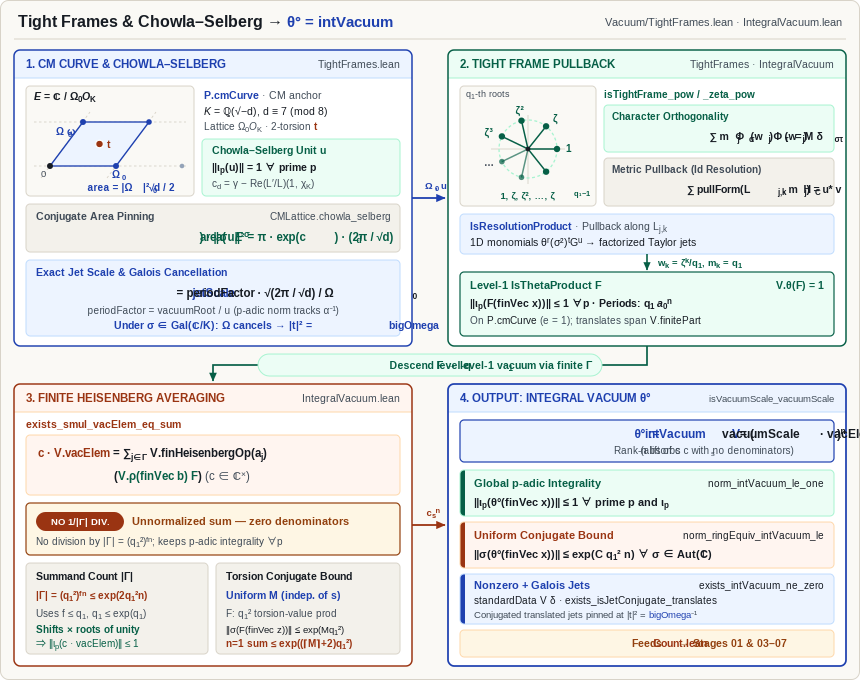
Level 1 — First-Principles
On the real line, sine and cosine repeat identically whenever you step forward by
Stage 02 needs to control high-dimensional theta functions on a many-variable space attached to a field
Factorizing a high-dimensional function into a theta product pays off twice across Stage 02. First, because the directions form a tight frame, the individual one-variable exponential multipliers add up to the exact global transformation law required on the big space; averaging finite translates of a single theta product then recovers an integral multiple of the vacuum vector with controlled
Limits of the intuition
Thinking of an elliptic theta function as a two-dimensional cousin of cosine, and of a theta product as a simple separable product
Level 2 — Undergrad Bridge
Let C.twistedTranslate m l) is
An entire function
Stage 02 deploys products of one-variable theta sections along two complementary pipelines:
Resolution products and the integral vacuum (
tight_frames.lean,integral_vacuum.lean). Given a tight frameof length with multiplicities and a CM lattice of area , define the linear projections . Because is a tight frame, pulling back the weighted Hermitian forms along sums identically to the standard Hermitian form ( sum_pullForm_resolutionLinearForm_apply). Henceobeys the multi-variable theta functional equation ( normalizedShift_prod_comp_of_mem_lattice), yielding a Schwartz vectorwhose rational translates factor both at values and at Taylor jet series ( IsResolutionProduct,exists_isResolutionProduct_of_isTightFrame). Specializing to the root-of-unity framewith uniform multiplicity and produces a theta product ( IsThetaProduct) of levelwith and -adically integral finite values ( exists_isThetaProduct_cmCurve). Averagingover finite Heisenberg translates isolates a nonzero multiple of the vacuum ( IsThetaProduct.exists_smul_vacElem_eq_sum), establishing the integral vacuumintVacuumand Galois jet conjugacy (exists_isJetConjugate_translates).-adic factorization into theta normal form ( theta_products.lean). At a primenot split in ( ), formal-group analysis (cf. Finis 2006) factors the -adically read one-variable theta series at scale (with ) as Forming the multi-variable theta product
along integral linear forms and rescaling all variables by turns products into sums inside the exponential ( rescale_thetaProd_eq_mul_expSubst):When the forms
come from a resolution of the identity, the weighted sum collapses modulo into the Frobenius coupling sum ( dvd_sum_subst_sub_couplingSum), establishingHasNormalForm(exists_hasNormalForm).
Level 3 — Formal Lean Contract
Stage 02 formalizes resolution products, specialized theta products, and the
02_derivatives/tight_frames.lean#New.Parameters.IsResolutionProduct(upstreamsrc/New/Derivatives/Vacuum/TightFrames.lean:674-689):leanstructure New.Parameters.IsResolutionProduct [Fintype I] (V : Space (P.E s) n ε) (C : CMLattice P.d) (b : ℂ) (w : I → P.E s) (m : I → ℕ) (f : I × n → ℂ → ℂ) (F : 𝒮 V) : Prop where mem_finitePart : F ∈ V.finitePart differentiable (i : I × n) : Differentiable ℂ (f i) entireTheta_translate (γ : n → P.E s) (z : InfinitePlace (P.E s) × n → ℂ) : entireTheta (V.ϱ (finVec (finiteImage γ)) F) z = ∏ i : I × n, C.twistedTranslate (m i.1) (resolutionShift b w γ i) (f i) (resolutionLinearForm (b / P.areaScale) w i z)02_derivatives/integral_vacuum.lean#New.Parameters.IsThetaProduct(upstreamsrc/New/Derivatives/Vacuum/IntegralVacuum.lean:134-160):leanstructure New.Parameters.IsThetaProduct [DecidableEq n] (V : Space (P.E s) n ε) (C : CMLattice P.d) (Ω : ℂˣ) (e : ℕ+) (F : 𝒮 V) : Prop where mem_finitePart : F ∈ V.finitePart theta_translate (γ : n → P.E s) : V.θ (V.ϱ (finVec (finiteImage γ)) F) = ∏ k : Fin (P.q₁ s), ∏ j : n, zetaCoordThetaTranslate C Ω k (γ j) 0 ^ P.q₁ s jetSeries_translate (γ : n → P.E s) (c : ℂ) : V.jetSeries c (V.ϱ (finVec (finiteImage γ)) F) = ∏ k : Fin (P.q₁ s), ∏ j : n, (taylorAtZero (zetaCoordThetaTranslate C Ω k (γ j))).subst (zetaLinearSeries Ω c k j) ^ P.q₁ s norm_le_one (p : ℕ) [Fact p.Prime] [PadicPlace p] (x : n → 𝔸f (P.E s)) : ‖ιₚ (F (finVec x))‖ ≤ 1 isThetaFunction : IsThetaFunction (star (P.q₁ s * e : P.E s) • idealLattice (P.E s) n) (entireTheta F)02_derivatives/theta_products.lean#New.CMLattice.rescale_thetaProd_eq_mul_expSubst(upstreamsrc/New/Derivatives/FormalGroup/ThetaProducts.lean:404-433):leanlemma New.CMLattice.rescale_thetaProd_eq_mul_expSubst {κ : ℂ_[p]} {W Ξ : PowerSeries (valRingCp p)} (hΞ : PowerSeries.constantCoeff Ξ = 0) (h_theta : (taylorVia ιₚ C.θ).rescale ϖ = seriesToCp W * expSubst (κ • seriesToCp Ξ)) (m : I → ℕ) : (C.thetaProd (fun (i : I) (x : X) ↦ (μ i x : ℂ_[p])) m).rescale (fun _ : X ↦ ϖ) = seriesToCp (∏ i : I, W.subst (linearSeries (μ i)) ^ m i) * expSubst (κ • seriesToCp (∑ i : I, m i • Ξ.subst (linearSeries (μ i))))
Notice how IsResolutionProduct abstracts the general tight-frame product of arbitrary entire sections f i, IsThetaProduct packages the specialized root-of-unity product with its jet factorization, intVacuum, and rescale_thetaProd_eq_mul_expSubst performs the formal-group algebraic bridge that feeds New.Parameters.exists_hasNormalForm (ThetaProducts.lean:439-477). See the page's live verification banner (audit/verification-status.json) for the currently pinned upstream snapshot and local Lean build status (build_status: unverified-locally).
Where this analogy breaks
Thinking of an elliptic theta function as a doubly periodic trigonometric wave like
Formal Lean Anchors
structure New.Parameters.IsResolutionProduct — Upstream source (src/New/Derivatives/Vacuum/TightFrames.lean L674-L689)
/-- `F` is the product of the functions `f i` along the vectors `w` at scale `b`: for a rational
vector `γ`, the theta function of `V.ϱ (finVec (finiteImage γ)) F`, the translate of `F` by the
finite image of `γ`, is the product of the twisted translates of the `f i`, each evaluated at a
linear form. The factor `i = (j, k)` is translated by `resolutionShift b w γ i` in degree `m j`:
`C.twistedTranslate m l g` is `z ↦ g (z + l)` times a Gaussian factor. -/
structure New.Parameters.IsResolutionProduct [Fintype I] (V : Space (P.E s) n ε) (C : CMLattice P.d) (b : ℂ)
(w : I → P.E s) (m : I → ℕ) (f : I × n → ℂ → ℂ) (F : 𝒮 V) : Prop where
/-- `F` lies in the finite part of `V`. -/
mem_finitePart : F ∈ V.finitePart
/-- The factors are entire. -/
differentiable (i : I × n) : Differentiable ℂ (f i)
/-- The product formula; `P.areaScale = √(2π / √d)`. -/
entireTheta_translate (γ : n → P.E s) (z : InfinitePlace (P.E s) × n → ℂ) :
entireTheta (V.ϱ (finVec (finiteImage γ)) F) z =
∏ i : I × n, C.twistedTranslate (m i.1) (resolutionShift b w γ i) (f i)
(resolutionLinearForm (b / P.areaScale) w i z)structure New.Parameters.IsThetaProduct — Upstream source (src/New/Derivatives/Vacuum/IntegralVacuum.lean L134-L160)
/-- The vector `F` is the product of copies of the theta function of `C` along the frame of the
`ζᵏ / q₁`, each taken `q₁` times, in every coordinate. The period `Ω` scales the coordinates along
the frame to complex numbers, and the level `e` gives the lattice `q₁ e 𝔞₀ⁿ` of periods, where
`𝔞₀ⁿ = idealLattice E n` consists of the rational vectors `γ` with `α⁻¹ γ` integral, `α` being the
idele of the Weil data and `q₁` the order of `ζ`. -/
structure New.Parameters.IsThetaProduct [DecidableEq n] (V : Space (P.E s) n ε) (C : CMLattice P.d) (Ω : ℂˣ)
(e : ℕ+) (F : 𝒮 V) : Prop where
/-- The vector lies in the finite part, the span of the translates of the vacuum by the operators
`finHeisenbergOp`. -/
mem_finitePart : F ∈ V.finitePart
/-- The theta value of the translate by a rational vector `γ` is a product of values at `0` of
twisted translates of the theta function of `C`. Here `finiteImage γ` is the finite adelic vector
`α⁻¹ γ`, with `α` the idele of the Weil data. -/
theta_translate (γ : n → P.E s) : V.θ (V.ϱ (finVec (finiteImage γ)) F) =
∏ k : Fin (P.q₁ s), ∏ j : n, zetaCoordThetaTranslate C Ω k (γ j) 0 ^ P.q₁ s
/-- The series of jets `jetSeries c` of that translate (for a standard space, the Taylor series at
`0` of its theta function at the scale `c`) is a product of Taylor series `taylorAtZero` at `0` of
functions of one variable, each composed with a linear form. -/
jetSeries_translate (γ : n → P.E s) (c : ℂ) :
V.jetSeries c (V.ϱ (finVec (finiteImage γ)) F) = ∏ k : Fin (P.q₁ s), ∏ j : n,
(taylorAtZero (zetaCoordThetaTranslate C Ω k (γ j))).subst (zetaLinearSeries Ω c k j) ^ P.q₁ s
/-- The values at finite points are integral at every prime `p`, for every `p`-adic place of `ℂ`
(a ring homomorphism `ιₚ` from `ℂ` to `ℂ_[p]`). -/
norm_le_one (p : ℕ) [Fact p.Prime] [PadicPlace p] (x : n → 𝔸f (P.E s)) : ‖ιₚ (F (finVec x))‖ ≤ 1
/-- The theta function of the vector is a theta function for `q₁ e 𝔞₀ⁿ`. -/
isThetaFunction :
IsThetaFunction (star (P.q₁ s * e : P.E s) • idealLattice (P.E s) n) (entireTheta F)lemma New.CMLattice.rescale_thetaProd_eq_mul_expSubst — Upstream source (src/New/Derivatives/FormalGroup/ThetaProducts.lean L404-L433)
/-- Let `C` be a lattice with complex multiplication by the integers of `ℚ(√-d)` and a point of
order two, and `θ = taylorVia ιₚ C.θ` the Taylor series of its theta function, read in `ℂ_p` by the
embedding `ιₚ` of `ℂ`. Let `θ(ϖ z) = W exp (κ Ξ)` with integral series `W`, `Ξ` and `Ξ(0) = 0`. Then
`C.thetaProd`, the product `∏ θ(μ_i z) ^ m_i` for integral linear forms `μ_i`, is at `ϖ z` the
integral series `∏ W(μ_i z) ^ m_i` times `exp (κ ∑ m_i Ξ(μ_i z))`. -/
lemma New.CMLattice.rescale_thetaProd_eq_mul_expSubst {κ : ℂ_[p]} {W Ξ : PowerSeries (valRingCp p)}
    (hΞ : PowerSeries.constantCoeff Ξ = 0)
    (h_theta : (taylorVia ιₚ C.θ).rescale ϖ = seriesToCp W * expSubst (κ • seriesToCp Ξ))
    (m : I → ℕ) :
    (C.thetaProd (fun (i : I) (x : X) ↦ (μ i x : ℂ_[p])) m).rescale (fun _ : X ↦ ϖ) =
      seriesToCp (∏ i : I, W.subst (linearSeries (μ i)) ^ m i) *
expSubst (κ • seriesToCp (∑ i : I, m i • Ξ.subst (linearSeries (μ i)))) := by
sorry -- [EXTRACTED_STUB upstream=src/New/Derivatives/FormalGroup/ThetaProducts.lean:404-433 commit=41c2716658c42ba08eb0648994a2efe83082a95c body_lines=19 body_sha256=6912ddf424ec1d937b3a79c5a9ae82c496841d4fb4dd30f9bd6dc5310bd9e4e0]Related Concepts
- complex plane — The two-dimensional coordinate plane of numbers s = σ + it, where the horizontal coordinate σ = Re(s) sets decay rate and the vertical coordinate t = Im(s) sets oscillation frequency.
- complex multiplication — Extra scaling-and-rotation symmetries of a two-dimensional lattice in ℂ preserved by the integers 𝓞_K of an imaginary quadratic field K = ℚ(√(-d)), pinning down every Galois-conjugate lattice area via the Chowla–Selberg formula.
- tight frame — A balanced, possibly overcomplete family of vectors with integer multiplicities whose projections reconstruct the exact standard inner product—allowing integral root-of-unity spokes to pull back one-dimensional elliptic theta sections into high-dimensional integral theta functions.
- theta normal form — A p-adic factorization of rescaled multivariable theta products into an integral power series times an exponential of Frobenius-power couplings pairing each infinite place with its shifted partner place.
- arithmetic height — A logarithmic measure combining ordinary archimedean size with prime-by-prime p-adic divisibility, locked together by the product formula so a nonzero algebraic quantity cannot be simultaneously small at every place.
Referenced By
- Stage: Formal Groups, Theta Normal Form & Prime-Counting Divisibility
- Stage: Sharpness: Proving the Valuation Bound Is Attained
- Stage: Stage 02 — Derivatives of Theta Functions
- Stage: Tight Frames, Chowla–Selberg Scaling & the Integral Vacuum
- Concept: complex multiplication
- Concept: formal group law
- Concept: Schur jet
- Concept: theta correspondence
- Concept: theta normal form
- Concept: tight frame
Authoritative Sources
- Tata Lectures on Theta I (book) — D. Mumford, Progress in Mathematics 28, Birkhäuser (1983).
- On the equations defining abelian varieties I (paper) — D. Mumford, Inventiones Mathematicae 1 (1966), pp. 287–354.
- Divisibility of anticyclotomic L-functions and theta functions with complex multiplication (paper) — T. Finis, Annals of Mathematics 163 (2006), pp. 767–807.
Page Glossary
- complex plane
- The two-dimensional coordinate plane of numbers s = σ + it, where the horizontal coordinate σ = Re(s) sets decay rate and the vertical coordinate t = Im(s) sets oscillation frequency.
- arithmetic height
- A logarithmic measure combining ordinary archimedean size with prime-by-prime p-adic divisibility, locked together by the product formula so a nonzero algebraic quantity cannot be simultaneously small at every place.
- complex multiplication
- Extra scaling-and-rotation symmetries of a two-dimensional lattice in ℂ preserved by the integers 𝓞_K of an imaginary quadratic field K = ℚ(√(-d)), pinning down every Galois-conjugate lattice area via the Chowla–Selberg formula.
- tight frame
- A balanced, possibly overcomplete family of vectors with integer multiplicities whose projections reconstruct the exact standard inner product—allowing integral root-of-unity spokes to pull back one-dimensional elliptic theta sections into high-dimensional integral theta functions.
- theta normal form
- A p-adic factorization of rescaled multivariable theta products into an integral power series times an exponential of Frobenius-power couplings pairing each infinite place with its shifted partner place.