Formal Groups, Theta Normal Form & Prime-Counting Divisibility
This page unpacks the two core divisibility landmarks of Stage 02 — src/New/Derivatives/FormalGroup/ThetaProducts.lean (02_derivatives/theta_products) and src/New/Derivatives/Divisibility/Count.lean (02_derivatives/count) — together with their immediate upstream formal-group and direction-elimination helpers (FrobeniusCongruence.lean, Exponent.lean, NullFrames.lean) and downstream Stage 03 bridge (Vacuum/Divisibility.lean). Return to the Stage 02 Overview, or continue to Tight Frames, Resolution Products & the Integral Vacuum and Sharpness: Attaining the Divisibility Bound.
Level 1 — First-Principles
Take a smooth function
Now replace a generic series by the quasi-periodic entire function attached to an elliptic curveelliptic theta function with extra ring symmetries from the integers of an imaginary quadratic fieldcomplex multiplication
- When
splits ( ), the formal group law has height , so rescaling by a number of valuation wipes out the entire factorial gain: the net slope is . - When
is inert ( ), the curve is supersingular modulo (height ), so the Frobenius congruence jumps by instead of : Because is vastly larger than , rescaling the variable by of valuation only already pulls almost all of into an integral series, leaving a single controlled exponential tail. Every derivative therefore keeps an extra divisibility slope - When
is ramified ( ), the uniformizer is of valuation and norm , costing and leaving extra slope
In every case,
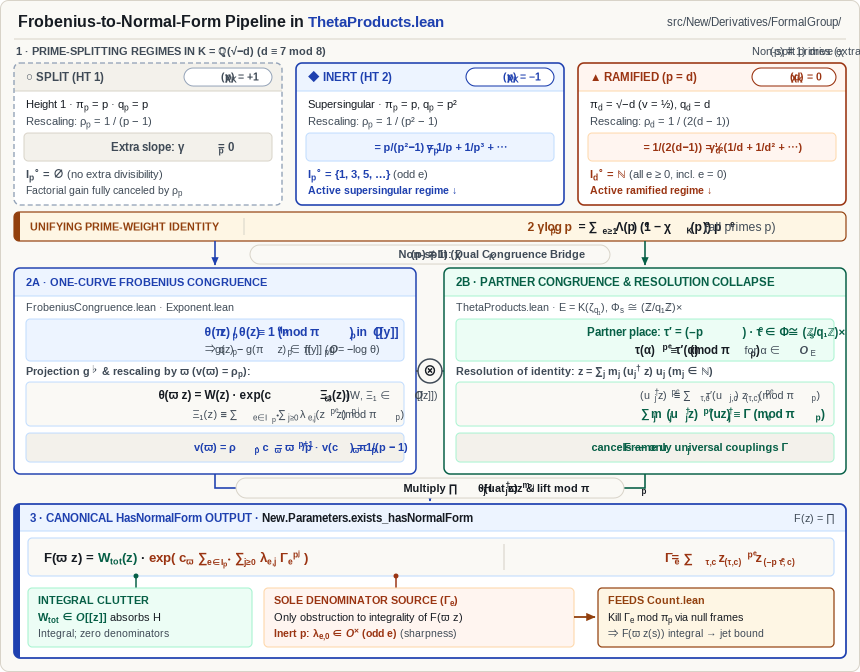
Passing from one variable to the multi-variable theta functions over the cyclotomic CM field
- Collapse along a spanning frame: Suppose a family of vectors
with multiplicities forms a weighted spanning family reconstructing every vector from its projections tight frame (a resolution of the identity). Taking the product multiplies the one-variable exponential tails together into a single exponent . - Pair each place with its Galois partner: Modulo
, raising a coordinate at an infinite place to the -th power acts like complex conjugation at the shifted place . That congruence collapses the sum over all frame vectors into a universal canonical factorization expressing as an integral series times the exponential of cross-place couplings pairing each place with its shifted partner theta normal form. Crucially, the resulting theta normal form forgets every detail of the specific frame . - Kill the couplings by changing directions: The exponential factor
is the only obstruction preventing from having integral coefficients. Because has valuation , making every active Frobenius coupling divisible by forces the entire exponential — and hence — to become integral up to degree . Stage 02 achieves this by applying a linear change of variables that steers the column directions into null spaces modulo , paying a controlled determinant "deduction" for each imposed congruence. - Read off the derivative bound and lift to Schur matrices: Once
is integral in degree , Legendre's factorial bound gives . Dividing by the chain-rule scaling factor and the change-of-direction determinants leaves minus the deduction sum — the exact derivative divisibility lower bound on matrix minors and Schur-matrix polynomialsSchur jet (the predicted divisibility of every minor product and Schur jet entry).
Where this analogy breaks
Saying that "killing the couplings turns
Level 2 — Undergrad Bridge
1. Prime splitting and the supersingular formal group (FrobeniusCongruence.lean, Exponent.lean)
Fix
Let C.integralSeriesRing over the valuation ring
For any prime
| Prime Type | partnerExponents) | positivePartnerExponents) | ||||||
|---|---|---|---|---|---|---|---|---|
| Split | ||||||||
| Inert (height | ||||||||
| Ramified ( |
The one-curve formal-group pipeline then runs in two modules:
FrobeniusCongruence.lean: Proves the Frobenius congruencein ( New.CMLattice.exists_rescale_theta_eq_pow_mul_one_add_smul), hence( New.CMLattice.exists_negLogTheta_frobenius_congruence). Independently, a recursion proves that at an inert primethe coefficient of in is a -adic unit ( New.CMLattice.norm_coeff_taylorVia_translatedX_eq_one).Exponent.lean: Averagingover the -th roots of unity isolates the part supported in degrees . Solving the resulting functional equation degree by degree for (where and ) yields New.CMLattice.exists_exponent_tsum:with , and when is inert, for all odd (a unit property later essential for sharpness in BoundAttained.lean). Note the exact balancing identity (New.Parameters.norm_pow_succ_div_mul_piPrimeInt):which sits right at the threshold where has integral coefficients.
2. Partner places, Frobenius couplings, and the theta normal form (ThetaProducts.lean)
Let New.Parameters.partner):
Comparing Frobenius on the generators of New.Parameters.norm_pow_sub_conj_partner_le (and its conjugate form norm_conj_pow_sub_partner_le for elements integral above
Now let vectors IsResolution u m), meaning norm_daggerForms_le_one). By dvd_pow_sub_sum_partner, New.Parameters.piPrimeInt_dvd_sum_linearSeries_sub_coupling:
Because rescale_thetaProd_eq_mul_expSubst) and lifting the congruence term-by-term through dvd_sum_subst_sub_couplingSum) while checking that any integral series rescale_mem_range_of_mem_multiSeriesRing) produces the headline theorem of ThetaProducts.lean, New.Parameters.exists_hasNormalForm:
3. Direction substitution, Legendre's bound, deductions, and charges (NullFrames.lean, Count.lean)
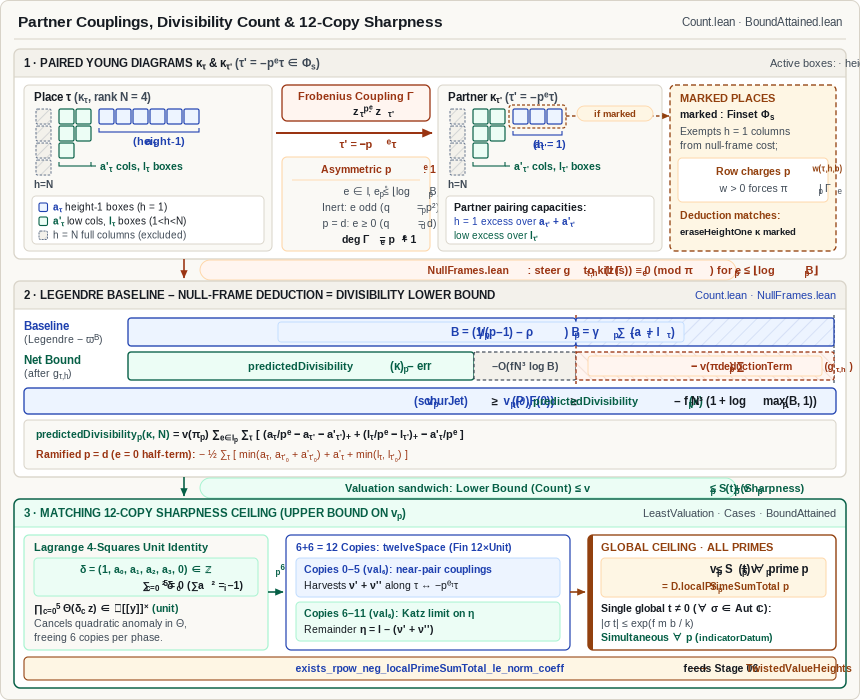
Now specialize the variable index set to New.minorProd i' y) is the homogeneous polynomial of degree
To bound HasNormalForm, Count.lean runs a three-step machine:
Direction substitution and null-frame elimination (
NullFrames.lean,Count.lean): Introduce auxiliary variables( DirectionVar, at mostvariables by card_directionVar_le) and substitutevia
directionSubstandnewDirection g y. Fix a finite setmarkedof marked places; a pair of heightsat is exempt ( IsExemptPair) ifand either or ( and ). - For the active exponents
, NullFrames.lean::exists_newDirection_dvdconstructs integral matricessuch that divides every non-exempt Frobenius pairing , while the determinant product costs at most - For the exempt pairs, the row-charge condition
IsChargeExponentensuresor , so (hence ) divides the scaled pairing. By dvd_subst_coupling_directionSubst_of_charges,for every . - Since
( norm_pow_succ_div_mul_piPrimeInt),HasNormalForm.norm_coeff_subst_le_oneguarantees thathas integral coefficients in degree .
- For the active exponents
Legendre's factorial bound and the chain rule (
norm_jet_le_of_isHomogeneous,norm_jet_columnDetProd_subst): Letbe the product of the determinants , homogeneous of degree ( isHomogeneous_columnDetProd). By Legendre's bound on multinomial factorials (norm_prod_factorial_le),norm_jet_le_of_isHomogeneousgivesOn the other hand, the chain rule (
norm_jet_columnDetProd_subst) computesDividing through by
turns into , proving New.Parameters.norm_jet_minorProd_le_of_isChargeExponent.Relating deductions to
predictedDivisibility(mul_tsum_deductionAt,mul_sum_deductionTerm_le): Write, , and , so ( boxes_eq_sum). Becauseand , New.mul_tsum_deductionAtproves the exact identitywhere
Marking
markedhas the exact same effect on deductions as erasing height-columns at marked(deductionTerm_eraseHeightOne), yieldingmul_sum_deductionTerm_leand hencenorm_jet_minorProd_le_of_charges(and, withmarked = ∅and, norm_jet_minorProd_le_of_hasNormalForm).
4. From minor products to Schur-matrix jets and Stage 03 (Count.lean, Vacuum/Divisibility.lean)
When FitsRanks), New.minorProd_eq_sum expands the minor product schur κ z:
Because the polynomials New.exists_norm_le_norm_sum_mul_eval produces an integral point New.exists_norm_schurJet_le_norm_jet_minorProd:
Combining this with exists_hasNormalForm_jetSeries and norm_jet_minorProd_le_of_charges in src/New/Derivatives/Vacuum/Divisibility.lean produces New.Parameters.norm_schurJet_jetSeries_le_of_charges, the exact entry point consumed by Stage 03 (src/New/UpperBound/Divisibility/ChainValuation.lean and ValuationAtNonSplitPrimes.lean) to bound valuations of iterated unitary theta lifts at all non-split primes.
Level 3 — Formal Lean Contract
The extracted Stage 02 skeletons embedded below correspond to src/New/Derivatives/FormalGroup/ThetaProducts.lean and src/New/Derivatives/Divisibility/Count.lean at pinned upstream commit 41c2716658c42ba08eb0648994a2efe83082a95c (41c2716658c4).
Extractor Stub-Truncation Disclosure (skeleton/02_derivatives/count.lean)
Deterministic
rh-extractstub truncation on threelet-bound return types: Insrc/New/Derivatives/Divisibility/Count.lean(lines581–713), the three headline theoremsNew.Parameters.norm_jet_minorProd_le_of_isChargeExponent,New.Parameters.norm_jet_minorProd_le_of_charges, andNew.Parameters.norm_jet_minorProd_le_of_hasNormalFormintroducelet N : ℕ := card n'inside their Lean return types. Becauserh-extractsplits proof bodies at the first depth-0:=token after the signature colon, those three generated stubs inskeleton/02_derivatives/count.leantruncate atlet N : ℕ := by sorryrather than displaying the full inequality.
For complete formal transparency, the exact, verbatim upstream theorem statements from src/New/Derivatives/Divisibility/Count.lean (lines 581–593, 658–672, and 703–710 at commit 41c2716658c42ba08eb0648994a2efe83082a95c) are reproduced below:
-- src/New/Derivatives/Divisibility/Count.lean:581-593
theorem norm_jet_minorProd_le_of_isChargeExponent [DecidableEq n'] (hp : chiK P.d p ≠ 1)
    (hϖ : ‖ϖ‖ = p ^ (-varpiValuation P.d p))
    (hF : HasNormalForm (partnerExponents P.d p) (P.partner s p) ϖ l F)
    (marked : Finset (P.Φ s)) (w : P.Φ s → ℕ → n' → ℕ)
    (hw : ∀ e ∈ partnerExponents P.d p, IsChargeExponent (P.partner s p e) marked w)
    (i' : WeylIndex n' κ) (y : P.Φ s → n → ℕ → valRingCp p) :
    let N : ℕ := card n'
    let B : ℕ := boxes κ N
    ‖jet ℂ_[p] (minorProd i' fun (τ : P.Φ s) (a : n) (k : ℕ) ↦ (y τ a k : ℂ_[p])) F‖ ≤
      p ^ (fillingCharge w i' - (gammaPrime P.d p * B -
        piPrimeValuation P.d p * ∑ e ≤ p.log B with e ∈ partnerExponents P.d p,
          ∑ τ : P.Φ s, deductionTerm p κ N marked τ (P.partner s p e τ) e -
card (P.Φ s) * N ^ 3 * (p.log B + 1)) : ℝ) := by-- src/New/Derivatives/Divisibility/Count.lean:658-672
theorem norm_jet_minorProd_le_of_charges [DecidableEq n'] (hp : chiK P.d p ≠ 1)
(hϖ : ‖ϖ‖ = p ^ (-varpiValuation P.d p))
(hF : HasNormalForm (partnerExponents P.d p) (P.partner s p) ϖ l F)
(marked : Finset (P.Φ s)) (w : P.Φ s → ℕ → n' → ℕ)
(hw : ∀ e ∈ partnerExponents P.d p, ∀ (τ : P.Φ s) (h : ℕ) (b : n'),
κ τ 1 ≠ 0 → κ (P.partner s p e τ) h ≠ 0 → τ ∈ marked ∨ h = 1 ∧ P.partner s p e τ ∈ marked →
w τ 1 b ≠ 0 ∨ w (P.partner s p e τ) h b ≠ 0)
(i' : WeylIndex n' κ) (y : P.Φ s → n → ℕ → valRingCp p) :
let N : ℕ := card n'
let B : ℕ := boxes κ N
‖jet ℂ_[p] (minorProd i' fun (τ : P.Φ s) (a : n) (k : ℕ) ↦ (y τ a k : ℂ_[p])) F‖ ≤
p ^ (fillingCharge w i' -
(predictedDivisibility P.d p (P.partner s p) (eraseHeightOne κ marked) N +
gammaPrime P.d p * (B - boxes (eraseHeightOne κ marked) N) -
card (P.Φ s) * N ^ 3 * (1 + Real.logb p (max B 1 : ℕ))) : ℝ) := by-- src/New/Derivatives/Divisibility/Count.lean:703-710
theorem norm_jet_minorProd_le_of_hasNormalForm [DecidableEq n'] (hp : chiK P.d p ≠ 1)
(hϖ : ‖ϖ‖ = p ^ (-varpiValuation P.d p))
(hF : HasNormalForm (partnerExponents P.d p) (P.partner s p) ϖ l F)
(i' : WeylIndex n' κ) (y : P.Φ s → n → ℕ → valRingCp p) :
let N : ℕ := card n'
‖jet ℂ_[p] (minorProd i' fun (τ : P.Φ s) (a : n) (k : ℕ) ↦ (y τ a k : ℂ_[p])) F‖ ≤
p ^ (-(predictedDivisibility P.d p (P.partner s p) κ N -
card (P.Φ s) * N ^ 3 * (1 + Real.logb p (max (boxes κ N) 1 : ℕ))) : ℝ) := byVerification status (audit/verification-status.json): Local Lean compilation and kernel replay remain build_status: unverified-locally at pinned commit 41c2716658c42ba08eb0648994a2efe83082a95c (41c2716658c4). Static token scanning currently has scan_scope: entry, covering only Challenge.lean, src/Main.lean, and src/Statements.lean (0 forbidden tokens in solution files, 5 expected sorry tokens in Challenge.lean). Neither ThetaProducts.lean nor Count.lean has been locally compiled, kernel-checked, or statically scanned here.
lemma New.coeff_subst_linearSeries — Upstream source (src/New/Derivatives/FormalGroup/ThetaProducts.lean L56-L72)
/-- The coefficient of `z ^ D` in `g(∑ c_x z_x)` is `c ^ D g⁽ⁿ⁾(0) / D!` with `n = |D|`, where
`c ^ D = ∏ c_x ^ D_x`, `D! = ∏ D_x!` and `g⁽ⁿ⁾(0)` is `n!` times the `n`-th coefficient of `g`. -/
@[simp] lemma New.coeff_subst_linearSeries {D : X →₀ ℕ} (c : X → ℂ_[p]) (g : PowerSeries ℂ_[p]) :
    (g.subst (linearSeries c)).coeff D =
      (∏ x : X, c x ^ D x) * (D.degree ! * g.coeff D.degree) / ∏ x : X, ((D x)! : ℂ_[p]) := by
  sorry -- [EXTRACTED_STUB upstream=src/New/Derivatives/FormalGroup/ThetaProducts.lean:56-72 commit=41c2716658c42ba08eb0648994a2efe83082a95c body_lines=13 body_sha256=bc3775e6c43ef0d5b8b9818097d78ea023e44ae8d09a2fe1f880d2a3754e7a1f]
lemma New.rescale_subst_linearSeries — Upstream source (src/New/Derivatives/FormalGroup/ThetaProducts.lean L74-L79)
/-- Scaling all variables of `g(∑ c_x z_x)` by `a` is scaling the variable of `g` by `a`. -/
@[simp] lemma New.rescale_subst_linearSeries {a : ℂ_[p]} (c : X → ℂ_[p]) (g : PowerSeries ℂ_[p]) :
    rescale (fun _ : X ↦ a) (g.subst (linearSeries c)) = (g.rescale a).subst (linearSeries c) := by
  sorry -- [EXTRACTED_STUB upstream=src/New/Derivatives/FormalGroup/ThetaProducts.lean:74-79 commit=41c2716658c42ba08eb0648994a2efe83082a95c body_lines=4 body_sha256=e1afd2a784c34d4aa8e74cd7474224f2cbb36c1f4b21228466714541de1432b2]
lemma New.piPrimeInt_dvd_iff — Upstream source (src/New/Derivatives/FormalGroup/ThetaProducts.lean L98-L102)
/-- An element of the valuation ring of `ℂ_p` is divisible by `π_p` (`√-d` if `p = d`, else `p`)
exactly when its norm is at most that of `π_p`. -/
lemma New.piPrimeInt_dvd_iff {d p : ℕ} [PrimeSevenModEight d] [Fact p.Prime] [PadicPlace p]
    {x : valRingCp p} : piPrimeInt d ∣ x ↔ ‖(x : ℂ_[p])‖ ≤ ‖ιₚ (piPrime d p)‖ := by
  sorry -- [EXTRACTED_STUB upstream=src/New/Derivatives/FormalGroup/ThetaProducts.lean:98-102 commit=41c2716658c42ba08eb0648994a2efe83082a95c body_lines=1 body_sha256=03140b8a044605f648388b2e3181be544a769773753f0b649f00ee0de1b59d39]
def New.Parameters.partner — Upstream source (src/New/Derivatives/FormalGroup/ThetaProducts.lean L106-L112)
/-- The partner `-p ^ e τ` of an infinite place `τ` of `E`. Here `P` fixes the prime `d` and the
modulus `q₀`, and `E = P.E s` is `K = ℚ(√-d)` with a root of unity of order `q₁ = P.q₁ s` adjoined,
`s` being the level in the tower of these fields. The infinite places `P.Φ s` of `E` form the group
`Gal(E/K) = (ℤ/q₁)ˣ`, and the partner is the product of `τ` with `P.placeOfInt s (-p ^ e)`, the
place of the class of `-p ^ e` modulo `q₁` (the identity if this class is not a unit). -/
noncomputable def New.Parameters.partner (P : Parameters) (s p e : ℕ) (τ : P.Φ s) : P.Φ s := by
  sorry -- [EXTRACTED_STUB upstream=src/New/Derivatives/FormalGroup/ThetaProducts.lean:106-112 commit=41c2716658c42ba08eb0648994a2efe83082a95c body_lines=1 body_sha256=b6e981f2c6b5eeb194da9fd8055a6ac1990d615b700600686569cb146aeb97fa]
lemma New.Parameters.norm_pow_succ_div_mul_piPrimeInt — Upstream source (src/New/Derivatives/FormalGroup/ThetaProducts.lean L114-L134)
/-- Let `p` be non-split in `K = ℚ(√-d)` (`χ_K(p) ≠ 1`) and let `ϖ` have valuation
`ρ_p = varpiValuation P.d p`, which is `1 / (p² - 1)` if `p` is inert and `1 / (2 p - 2)` if
`p = d`. Then `c_ϖ π_p` has valuation `1 / (p - 1)`, where `c_ϖ = ϖ ^ (p + 1) / p` and `π_p` is
`√-d` if `p = d` and `p` otherwise. -/
lemma New.Parameters.norm_pow_succ_div_mul_piPrimeInt (P : Parameters) {p : ℕ} [Fact p.Prime] [PadicPlace p]
    (hp : chiK P.d p ≠ 1) {ϖ : ℂ_[p]} (hϖ : ‖ϖ‖ = p ^ (-varpiValuation P.d p)) :
    ‖ϖ ^ (p + 1) / p * (piPrimeInt P.d : valRingCp p)‖ = p ^ (-(1 / (p - 1)) : ℝ) := by
  sorry -- [EXTRACTED_STUB upstream=src/New/Derivatives/FormalGroup/ThetaProducts.lean:114-134 commit=41c2716658c42ba08eb0648994a2efe83082a95c body_lines=15 body_sha256=e00979897e7ec7004ac61b51fa350a3e1d7bf32e7483f8e7063e3aa4583cc0d8]
lemma New.Parameters.norm_pow_sub_conj_partner_le — Upstream source (src/New/Derivatives/FormalGroup/ThetaProducts.lean L136-L178)
/-- Let `E = P.E s` be `K = ℚ(√-d)` (`d = P.d`) with a root of unity of order `q₁ = P.q₁ s`
adjoined, `s` being the level in the tower of these fields. Let `e` be in
`I_p° = partnerExponents P.d p`. Let `τ : P.Φ s` be an infinite place of `E`, and
`τ' = -p ^ e τ = P.partner s p e τ` its partner: the product of `τ` with the class of `-p ^ e` in
the group `Gal(E/K) = (ℤ/q₁)ˣ` of places. Then `τ(α) ^ p ^ e ≡ conj (τ'(α))` modulo `π_p` for `α` in
`𝓞 E`. -/
lemma New.Parameters.norm_pow_sub_conj_partner_le {P : Parameters} {s p : ℕ} [Fact p.Prime] [PadicPlace p] {e : ℕ}
    (he : e ∈ partnerExponents P.d p) (τ : P.Φ s) (α : 𝓞 (P.E s)) :
    ‖ιₚ (Φ τ α) ^ p ^ e - ιₚ (conj (Φ (P.partner s p e τ) α))‖ ≤ ‖ιₚ (piPrime P.d p)‖ := by
  sorry -- [EXTRACTED_STUB upstream=src/New/Derivatives/FormalGroup/ThetaProducts.lean:136-178 commit=41c2716658c42ba08eb0648994a2efe83082a95c body_lines=35 body_sha256=7c512132aa4a0a04edb13c8ad8d099134b6aebfca8ffa6c51cd694b65e21adf0]
lemma New.Parameters.norm_conj_pow_sub_partner_le — Upstream source (src/New/Derivatives/FormalGroup/ThetaProducts.lean L180-L209)
/-- Let `E = P.E s` be `K = ℚ(√-d)` (`d = P.d`) with a root of unity of order `q₁ = P.q₁ s`
adjoined, `s` being the level in the tower of these fields. Let `e` be in
`I_p° = partnerExponents P.d p`. Let `τ : P.Φ s` be an infinite place of `E`, and
`τ' = -p ^ e τ = P.partner s p e τ` its partner: the product of `τ` with the class of `-p ^ e` in
the group `Gal(E/K) = (ℤ/q₁)ˣ` of places. Then `conj (τ(y)) ^ p ^ e ≡ τ'(y)` modulo `π_p` for `y` in
`E` integral at all primes above `p`. -/
lemma New.Parameters.norm_conj_pow_sub_partner_le {P : Parameters} {s p : ℕ} [Fact p.Prime] [PadicPlace p] {e : ℕ}
    (he : e ∈ partnerExponents P.d p) (τ : P.Φ s) {y : P.E s} (hy : IsIntegralAbove p y) :
    ‖ιₚ (conj (Φ τ y)) ^ p ^ e - ιₚ (Φ (P.partner s p e τ) y)‖ ≤ ‖ιₚ (piPrime P.d p)‖ := by
  sorry -- [EXTRACTED_STUB upstream=src/New/Derivatives/FormalGroup/ThetaProducts.lean:180-209 commit=41c2716658c42ba08eb0648994a2efe83082a95c body_lines=22 body_sha256=25850759c82bc26a32745b8106d1866e8cb8c75e73fc9e3a9789f18664cdb0ea]
lemma New.Parameters.dvd_pow_sub_sum_partner — Upstream source (src/New/Derivatives/FormalGroup/ThetaProducts.lean L211-L232)
/-- Let `E = P.E s` be `K = ℚ(√-d)` with a root of unity of order `q₁ = P.q₁ s` adjoined, `e` in
`I_p° = partnerExponents P.d p` and `y` a vector over `E` integral above `p`. Then the `p ^ e`-th
power of the linear form `y† z = ∑ conj (τ(y_c)) z_(τ,c)` is `∑ τ'(y_c) z_(τ,c) ^ p ^ e` modulo
`π_p`; the sum runs over infinite places `τ` in `P.Φ s` and coordinates `c`.
`τ' = -p ^ e τ = P.partner s p e τ` is the product of `τ` with the class of `-p ^ e` in the group
`Gal(E/K) = (ℤ/q₁)ˣ` of places. `μ`, `ν` are the coefficients of the form and of the sum, read as
integers of `ℂ_p` through the embedding `ιₚ : ℂ → ℂ_p`. -/
lemma New.Parameters.dvd_pow_sub_sum_partner {P : Parameters} {s p : ℕ} [Fact p.Prime] [PadicPlace p] {e : ℕ}
    {n : Type} [Fintype n] (he : e ∈ partnerExponents P.d p)
    {y : n → P.E s} (hy : ∀ i : n, IsIntegralAbove p (y i))
    {μ ν : P.Φ s × n → valRingCp p} (hμ : ∀ x : P.Φ s × n, (μ x : ℂ_[p]) = ιₚ (dagger y x))
    (hν : ∀ x : P.Φ s × n, (ν x : ℂ_[p]) = ιₚ (Φ (P.partner s p e x.1) (y x.2))) :
    C (piPrimeInt P.d) ∣ linearSeries μ ^ p ^ e - ∑ x : P.Φ s × n, ν x • X x ^ p ^ e := by
  sorry -- [EXTRACTED_STUB upstream=src/New/Derivatives/FormalGroup/ThetaProducts.lean:211-232 commit=41c2716658c42ba08eb0648994a2efe83082a95c body_lines=10 body_sha256=c44fd2aa8e2f2c8dc7d61d422785a7104f64be643a7e57bcbe2396a1b48e5ff6]
lemma New.Parameters.norm_daggerForms_le_one — Upstream source (src/New/Derivatives/FormalGroup/ThetaProducts.lean L234-L241)
/-- For vectors `u_j` over `E = P.E s` integral above `p`, the linear forms `u_j† z`, whose
coefficient at `z_(τ,c)` is `conj (τ(u_{j,c}))` read in `ℂ_p` through the embedding `ιₚ` of `ℂ`,
have integral coefficients. -/
lemma New.Parameters.norm_daggerForms_le_one (P : Parameters) (s : ℕ) {p : ℕ} [Fact p.Prime] [PadicPlace p]
    {n J : Type} {u : J → n → P.E s}
    (hu : ∀ (j : J) (i : n), IsIntegralAbove p (u j i)) (j : J) (x : P.Φ s × n) :
    ‖(daggerForms u j x : ℂ_[p])‖ ≤ 1 := by
  sorry -- [EXTRACTED_STUB upstream=src/New/Derivatives/FormalGroup/ThetaProducts.lean:234-241 commit=41c2716658c42ba08eb0648994a2efe83082a95c body_lines=1 body_sha256=9c9b3b10c9753c70429fbdf5af73ae57b370c375f785d8a176a8052aad1ec760]
lemma New.Parameters.piPrimeInt_dvd_sum_linearSeries_sub_coupling — Upstream source (src/New/Derivatives/FormalGroup/ThetaProducts.lean L243-L276)
/-- Let `E = P.E s` be `K = ℚ(√-d)` (`d = P.d`) with a root of unity of order `q₁ = P.q₁ s`
adjoined, `s` being the tower level, and let `e` be in `I_p° = partnerExponents P.d p`. Let the
vectors `u_j` of `Eⁿ`, integral above `p` and each taken `m_j` times, be a resolution of the
identity: `z = ∑ m_j (u_j† z) u_j`. Then `∑ m_j (u_j† z) ^ p ^ e * (u_j† z)` is the coupling
`Γ_e = ∑ z_(τ,c) ^ p ^ e * z_(τ',c)` modulo `π_p`. -/
lemma New.Parameters.piPrimeInt_dvd_sum_linearSeries_sub_coupling (P : Parameters) (s : ℕ) {p : ℕ} [Fact p.Prime]
    [PadicPlace p]
    {n J : Type} [Fintype n] [Fintype J] {u : J → n → P.E s} {m : J → ℕ} [DecidableEq n]
    {e : ℕ} (he : e ∈ partnerExponents P.d p)
    (h_res : IsResolution u m) (hu : ∀ (j : J) (i : n), IsIntegralAbove p (u j i))
    {μ : J → P.Φ s × n → valRingCp p}
    (hμ : ∀ (j : J) (x : P.Φ s × n), (μ j x : ℂ_[p]) = daggerForms u j x) :
    C (piPrimeInt P.d) ∣
      ∑ j : J, m j * (linearSeries (μ j) ^ p ^ e * linearSeries (μ j)) -
        coupling (P.partner s p) e := by
  sorry -- [EXTRACTED_STUB upstream=src/New/Derivatives/FormalGroup/ThetaProducts.lean:243-276 commit=41c2716658c42ba08eb0648994a2efe83082a95c body_lines=20 body_sha256=5d3c7c31cded664942b3f6ec8e404146ad406bd465d86cc1b468d263c10af4cd]
lemma New.dvd_sum_subst_sub_couplingSum — Upstream source (src/New/Derivatives/FormalGroup/ThetaProducts.lean L298-L350)
/-- Let `π ∣ p`, let `Ξ` be a series in one variable congruent to
`∑ λ_{e j} (z ^ p ^ e * z) ^ p ^ j` modulo `π`, the sum over `e ∈ S` and `j` with
`λ_{e j} = l e j`, and let `partner e` be a self-map of the set `Φ` of places, with
`Γ_e = coupling partner e = ∑ z_(τ,c) ^ p ^ e * z_(partner e τ,c)` summed over `(τ, c)` in `Φ × n`.
If series `L_i` without constant term are such that `∑ m_i L_i ^ p ^ e * L_i` is `Γ_e` modulo `π`
for `e ∈ S`, then the `Ξ(L_i)`, each taken `m_i` times, add up to
`couplingSum S partner l = ∑ λ_{e j} Γ_e ^ p ^ j` modulo `π`. -/
lemma New.dvd_sum_subst_sub_couplingSum {Φ n J : Type} [Fintype Φ] [Fintype n] [Fintype J]
    {S : Set ℕ} {partner : ℕ → Φ → Φ} {l : ℕ → ℕ → valRingCp p} {π : valRingCp p} (hπ : π ∣ p)
    {Ξ : PowerSeries (valRingCp p)}
    (hΞ : C π ∣ Ξ -
      ∑' x : S × ℕ, l x.1 x.2 • (PowerSeries.X ^ p ^ (x.1 : ℕ) * PowerSeries.X) ^ p ^ x.2)
    {L : J → MvPowerSeries (Φ × n) (valRingCp p)} (hL : ∀ i : J, constantCoeff (L i) = 0)
    {m : J → ℕ} (hΓ : ∀ e ∈ S, C π ∣ ∑ i : J, m i * (L i ^ p ^ e * L i) - coupling partner e) :
    C π ∣ ∑ i : J, m i • Ξ.subst (L i) - couplingSum S partner l := by
  sorry -- [EXTRACTED_STUB upstream=src/New/Derivatives/FormalGroup/ThetaProducts.lean:298-350 commit=41c2716658c42ba08eb0648994a2efe83082a95c body_lines=39 body_sha256=1943ccf834776cebee76492fc148c944a423e7bd4683784ebff9fdacdde8a5c5]
lemma New.expSubst_nsmul — Upstream source (src/New/Derivatives/FormalGroup/ThetaProducts.lean L352-L355)
/-- For a series `g` without constant term, `exp (n g) = exp(g) ^ n`. -/
lemma New.expSubst_nsmul {σ : Type} {g : MvPowerSeries σ ℂ_[p]} (hg : constantCoeff g = 0) (n : ℕ) :
    expSubst (n • g) = expSubst g ^ n := by
  sorry -- [EXTRACTED_STUB upstream=src/New/Derivatives/FormalGroup/ThetaProducts.lean:352-355 commit=41c2716658c42ba08eb0648994a2efe83082a95c body_lines=2 body_sha256=55153e63a97f327a64147cfaf05a673f9cc2e1de6b671200fdea2cf3d0589f4d]
lemma New.rescale_subst_linearSeries_coe — Upstream source (src/New/Derivatives/FormalGroup/ThetaProducts.lean L357-L364)
/-- For a linear form `L = ∑ ν_x z_x` with integral coefficients, `g(L)` at `ϖ z` is the series
`g(ϖ t)` at `t = L`. -/
lemma New.rescale_subst_linearSeries_coe {X : Type} [Fintype X] (ϖ : ℂ_[p]) (g : PowerSeries ℂ_[p])
    (ν : X → valRingCp p) :
    (g.subst (linearSeries fun x : X ↦ (ν x : ℂ_[p]))).rescale (fun _ : X ↦ ϖ) =
      (g.rescale ϖ).subst (seriesToCp (linearSeries ν)) := by
  sorry -- [EXTRACTED_STUB upstream=src/New/Derivatives/FormalGroup/ThetaProducts.lean:357-364 commit=41c2716658c42ba08eb0648994a2efe83082a95c body_lines=3 body_sha256=b5c7b982c0c62bbfb3b13e81feb4959bef74057bdcb713a7068aa395fd25c765]
lemma New.seriesToCp_subst — Upstream source (src/New/Derivatives/FormalGroup/ThetaProducts.lean L366-L371)
/-- The inclusion `seriesToCp` of integral series commutes with substituting a series `L` without
constant term into a series `G` in one variable. -/
lemma New.seriesToCp_subst {X : Type} {L : MvPowerSeries X (valRingCp p)} (hL : constantCoeff L = 0)
    (G : PowerSeries (valRingCp p)) :
    seriesToCp (G.subst L) = PowerSeries.subst (seriesToCp L) (seriesToCp G) := by
  sorry -- [EXTRACTED_STUB upstream=src/New/Derivatives/FormalGroup/ThetaProducts.lean:366-371 commit=41c2716658c42ba08eb0648994a2efe83082a95c body_lines=1 body_sha256=2f1d0c513de539b20865927cfe5f62f1f07dadcd58a54cbb93ba585bd678800c]
lemma New.CMLattice.rescale_mem_range_of_mem_multiSeriesRing — Upstream source (src/New/Derivatives/FormalGroup/ThetaProducts.lean L377-L402)
/-- Let `d ≡ 7 mod 8` be prime, `C` a lattice with complex multiplication by the integers of
`ℚ(√-d)` and a point `t` of order two with `a₁² = 12 ℘(t)`, and `y` the Taylor series at `0`, read
in `ℂ_p` by `ιₚ`, of `C.translatedY z = (℘'(z + t) - a₁ (℘(z + t) - ℘(t))) / 2`. Let `μ_i` be
integral linear forms and `v(ϖ) ≥ ρ_p = varpiValuation d p`. Then a series `H` in
`C.multiSeriesRing`, the ring of integral series in the `y(μ_i z)`, is integral at `ϖ z`: `H(ϖ z)`
is in the range of `seriesToCp`, the inclusion of series over the integers of `ℂ_p`. -/
lemma New.CMLattice.rescale_mem_range_of_mem_multiSeriesRing [PrimeSevenModEight d]
    (hϖ : ‖ϖ‖ ≤ p ^ (-varpiValuation d p))
    {H : MvPowerSeries X ℂ_[p]} (hH : H ∈ C.multiSeriesRing fun (i : I) (x : X) ↦ (μ i x : ℂ_[p])) :
    H.rescale (fun _ : X ↦ ϖ) ∈ seriesToCp.range := by
  sorry -- [EXTRACTED_STUB upstream=src/New/Derivatives/FormalGroup/ThetaProducts.lean:377-402 commit=41c2716658c42ba08eb0648994a2efe83082a95c body_lines=17 body_sha256=b3b19b42992d2aaccc9e2dc9fee927db636a28580f130fab8f7a2bf90b183b59]
lemma New.CMLattice.rescale_thetaProd_eq_mul_expSubst — Upstream source (src/New/Derivatives/FormalGroup/ThetaProducts.lean L404-L433)
/-- Let `C` be a lattice with complex multiplication by the integers of `ℚ(√-d)` and a point of
order two, and `θ = taylorVia ιₚ C.θ` the Taylor series of its theta function, read in `ℂ_p` by the
embedding `ιₚ` of `ℂ`. Let `θ(ϖ z) = W exp (κ Ξ)` with integral series `W`, `Ξ` and `Ξ(0) = 0`. Then
`C.thetaProd`, the product `∏ θ(μ_i z) ^ m_i` for integral linear forms `μ_i`, is at `ϖ z` the
integral series `∏ W(μ_i z) ^ m_i` times `exp (κ ∑ m_i Ξ(μ_i z))`. -/
lemma New.CMLattice.rescale_thetaProd_eq_mul_expSubst {κ : ℂ_[p]} {W Ξ : PowerSeries (valRingCp p)}
    (hΞ : PowerSeries.constantCoeff Ξ = 0)
    (h_theta : (taylorVia ιₚ C.θ).rescale ϖ = seriesToCp W * expSubst (κ • seriesToCp Ξ))
    (m : I → ℕ) :
    (C.thetaProd (fun (i : I) (x : X) ↦ (μ i x : ℂ_[p])) m).rescale (fun _ : X ↦ ϖ) =
      seriesToCp (∏ i : I, W.subst (linearSeries (μ i)) ^ m i) *
        expSubst (κ • seriesToCp (∑ i : I, m i • Ξ.subst (linearSeries (μ i)))) := by
  sorry -- [EXTRACTED_STUB upstream=src/New/Derivatives/FormalGroup/ThetaProducts.lean:404-433 commit=41c2716658c42ba08eb0648994a2efe83082a95c body_lines=19 body_sha256=6912ddf424ec1d937b3a79c5a9ae82c496841d4fb4dd30f9bd6dc5310bd9e4e0]
lemma New.Parameters.exists_hasNormalForm — Upstream source (src/New/Derivatives/FormalGroup/ThetaProducts.lean L439-L477)
/-- Let `E = P.E s` be `K = ℚ(√-d)` with a root of unity of order `q₁ = P.q₁ s` adjoined, `p` a
prime not split in `K` (`chiK P.d p ≠ 1`), `I_p° = partnerExponents P.d p`, and for an infinite
place `τ` of `E` let its partner `τ' = -p ^ e τ` be the product of `τ` with the class of `-p ^ e` in
the group `Gal(E/K) = (ℤ/q₁)ˣ` of places. There are `ϖ` of valuation `ρ_p = varpiValuation P.d p`
and integers `λ_{e j}` of `ℂ_p`, with the `λ_{e 0}` for odd `e` units if `p` is inert, such that the
following holds. Take any resolution of the identity by vectors `u_j` of `Eⁿ`, taken `m_j` times and
integral above `p`. Then the product `∏ θ(u_j† z) ^ m_j` times an integral series in the `y(u_j† z)`
has the normal form. -/
lemma New.Parameters.exists_hasNormalForm (P : Parameters) (s : ℕ) [PadicPlace p] (hp : chiK P.d p ≠ 1) :
    ∃ (ϖ : ℂ_[p]) (l : ℕ → ℕ → valRingCp p),
    ‖ϖ‖ = p ^ (-varpiValuation P.d p) ∧
    (chiK P.d p = -1 → ∀ e : ℕ, Odd e → IsUnit (l e 0)) ∧
    ∀ {n J : Type} [Fintype n] [DecidableEq n] [Fintype J] (u : J → n → P.E s) (m : J → ℕ),
      IsResolution u m → (∀ (j : J) (i : n), IsIntegralAbove p (u j i)) →
        ∀ H ∈ P.cmCurve.multiSeriesRing (daggerForms u),
          HasNormalForm (partnerExponents P.d p) (P.partner s p) ϖ l
            (P.cmCurve.thetaProd (daggerForms u) m * H) := by
  sorry -- [EXTRACTED_STUB upstream=src/New/Derivatives/FormalGroup/ThetaProducts.lean:439-477 commit=41c2716658c42ba08eb0648994a2efe83082a95c body_lines=23 body_sha256=13683f6b838cae63d5052f3d5b3afcbb38c5bd6c65d341cfaf10b1f242e9a0c4]
lemma New.norm_prod_factorial_le — Upstream source (src/New/Derivatives/Divisibility/Count.lean L70-L85)
/-- Legendre's bound for a multi-index `d`, of degree `l = d.degree`: the valuation of `∏ (d x)!`
is at least `l / (p - 1) - card σ * (1 + ⌊log_p l⌋)`. -/
lemma New.norm_prod_factorial_le (d : σ →₀ ℕ) :
    ‖d.prod fun (_ : σ) (k : ℕ) ↦ (k.factorial : ℂ_[p])‖ ≤
      p ^ (card σ * (p.log d.degree + 1) - d.degree / (p - 1) : ℝ) := by
  sorry -- [EXTRACTED_STUB upstream=src/New/Derivatives/Divisibility/Count.lean:70-85 commit=41c2716658c42ba08eb0648994a2efe83082a95c body_lines=12 body_sha256=e6d7d71b286167034aedfb2257a08f439b9009f8269ebb329e5bac80cc365fc2]
lemma New.norm_jet_le_of_isHomogeneous — Upstream source (src/New/Derivatives/Divisibility/Count.lean L87-L103)
/-- If the coefficients of degree `l` of the series `G` are integral and `Q` is a homogeneous
polynomial of degree `l` with integral coefficients, then the jet `(Q(∂) G)(0)` has valuation at
least `l / (p - 1) - card σ * (1 + ⌊log_p l⌋)`.

A consequence of the lower bound `v(m!) ≥ m / (p - 1) - (1 + ⌊log_p m⌋)` given by Legendre's
formula, applied to each exponent of each monomial of `Q`. -/
lemma New.norm_jet_le_of_isHomogeneous {G : MvPowerSeries σ ℂ_[p]} {l : ℕ}
    (hG : ∀ d : σ →₀ ℕ, d.degree = l → ‖G.coeff d‖ ≤ 1) {Q : MvPolynomial σ (valRingCp p)}
    (hQ : Q.IsHomogeneous l) :
    ‖jet ℂ_[p] (Q.map (valRingCp p).subtype) G‖ ≤
      p ^ (card σ * (p.log l + 1) - l / (p - 1) : ℝ) := by
  sorry -- [EXTRACTED_STUB upstream=src/New/Derivatives/Divisibility/Count.lean:87-103 commit=41c2716658c42ba08eb0648994a2efe83082a95c body_lines=7 body_sha256=8fc1475ebbad1ab3954d1ae8241a9fefc598a4f3a383aec4b43ef1df3f27ae37]
def New.minorProd — Upstream source (src/New/Derivatives/Divisibility/Count.lean L111-L118)
/-- The polynomial `P_y(z)` in the entries `X (τ, b, a)` of matrices `z_τ` of size `n' × n`. It is
the product, over the places `τ` and the columns `j` of height `h < card n'` of the diagram `κ τ`,
of the minor of `z_τ y_τ` on the rows `(i' τ).1 h j b` that the filling `i'` puts into the column
and on the first `h` columns. -/
noncomputable def New.minorProd (i' : WeylIndex n' κ) (y : Φ → n → ℕ → R) :
    MvPolynomial (Φ × n' × n) R := by
  sorry -- [EXTRACTED_STUB upstream=src/New/Derivatives/Divisibility/Count.lean:111-118 commit=41c2716658c42ba08eb0648994a2efe83082a95c body_lines=2 body_sha256=0ab04c46a15396ce309c7be3a56a7e7a972a730d28ad05102fb64fedb57808a3]
abbrev New.DirectionVar — Upstream source (src/New/Derivatives/Divisibility/Count.lean L126-L128)
/-- The index type of the new variables `s_(τ h k b)`: an index `(⟨h, k⟩, τ, b)` consists of a
height `h < N`, a direction `k < h` of that height, a place `τ` and a row `b`. -/
abbrev New.DirectionVar (Φ n' : Type) (N : ℕ) : Type := by
  sorry -- [EXTRACTED_STUB upstream=src/New/Derivatives/Divisibility/Count.lean:126-128 commit=41c2716658c42ba08eb0648994a2efe83082a95c body_lines=1 body_sha256=ab5c4d61c26ac0211a15ec461ac065deaab24e4e53fe65990d686834317b3b9f]
lemma New.card_directionVar_le — Upstream source (src/New/Derivatives/Divisibility/Count.lean L131-L135)
lemma New.card_directionVar_le : card (DirectionVar Φ n' (card n')) ≤ card Φ * card n' ^ 3 := by
  sorry -- [EXTRACTED_STUB upstream=src/New/Derivatives/Divisibility/Count.lean:131-135 commit=41c2716658c42ba08eb0648994a2efe83082a95c body_lines=5 body_sha256=503d85cf8d5329183093827647809d60686a65cf6dbdbc7a2df8bf9798ded298]
def New.directionSubst — Upstream source (src/New/Derivatives/Divisibility/Count.lean L137-L144)
/-- The matrix of the linear substitution `z(s)` with row factors `c` and directions `β`: row `b`
of `z_τ(s)` is `∑_(h, k) c_(τ h b) s_(τ h k b) β_(τ h k)`. So the entry at `x = (τ, b, a)` and
`o = (⟨h, k⟩, τ', b')` is `c τ h b * β τ h k a` if `(τ', b') = (τ, b)`, and zero otherwise. -/
noncomputable def New.directionSubst [DecidableEq Φ]
    {N : ℕ} (c : Φ → ℕ → n' → R) (β : Φ → ∀ h : ℕ, Fin h → n → R) :
    Matrix (Φ × n' × n) (DirectionVar Φ n' N) R := by
  sorry -- [EXTRACTED_STUB upstream=src/New/Derivatives/Divisibility/Count.lean:137-144 commit=41c2716658c42ba08eb0648994a2efe83082a95c body_lines=3 body_sha256=ce85e98988c12b5e3b7aba3ac3ae5b573ce7b8486f6e77a4d50daa01bb136c2f]
lemma New.linSubst_directionSubst_X — Upstream source (src/New/Derivatives/Divisibility/Count.lean L146-L155)
/-- The map `linSubst M` sends each variable `X o` to `∑_x M x o • X x`. For the matrix `M` of the
substitution `z(s)` it sends `s_(τ h k b)` to `c_(τ h b)` times the linear form
`∑_a β_(τ h k a) z_(τ b a)`. -/
lemma New.linSubst_directionSubst_X [DecidableEq Φ]
    {N : ℕ} (c : Φ → ℕ → n' → R) (β : Φ → ∀ h : ℕ, Fin h → n → R)
    (h : Fin N) (k : Fin h) (τ : Φ) (b : n') :
    linSubst (directionSubst c β) (X (⟨h, k⟩, τ, b)) =
      C (c τ h b) * ∑ a : n, C (β τ h k a) * X (τ, b, a) := by
  sorry -- [EXTRACTED_STUB upstream=src/New/Derivatives/Divisibility/Count.lean:146-155 commit=41c2716658c42ba08eb0648994a2efe83082a95c body_lines=3 body_sha256=6c3f03378021eb9be7ffe7d5fca0d5bdd72b0778ab450e3fa383849d24af6883]
def New.columnDetProd — Upstream source (src/New/Derivatives/Divisibility/Count.lean L158-L164)
/-- The polynomial `P_*` in the new variables: the product, over the places `τ` and the columns `j`
of height `h < card n'` of the diagram `κ τ`, of the determinants `det (s_(τ h k b))`, with `k < h`
and `b` among the rows that the filling `i'` puts into the column. -/
noncomputable def New.columnDetProd (i' : WeylIndex n' κ) :
    MvPolynomial (DirectionVar Φ n' (card n')) R := by
  sorry -- [EXTRACTED_STUB upstream=src/New/Derivatives/Divisibility/Count.lean:158-164 commit=41c2716658c42ba08eb0648994a2efe83082a95c body_lines=2 body_sha256=5eefb9f19b39b5cf7e9d615b4cd38eff493cefbd00b362727454920080e81986]
lemma New.map_columnDetProd — Upstream source (src/New/Derivatives/Divisibility/Count.lean L166-L169)
/-- The polynomial `columnDetProd R i'` is compatible with change of the coefficient ring. -/
lemma New.map_columnDetProd {R' : Type} [CommRing R'] (φ : R →+* R') (i' : WeylIndex n' κ) :
    (columnDetProd R i').map φ = columnDetProd R' i' := by
  sorry -- [EXTRACTED_STUB upstream=src/New/Derivatives/Divisibility/Count.lean:166-169 commit=41c2716658c42ba08eb0648994a2efe83082a95c body_lines=2 body_sha256=8ce82a61460fc637c19202933c202f20c396b856d6557f19d33c174dceee28d4]
lemma New.isHomogeneous_det_directionVar — Upstream source (src/New/Derivatives/Divisibility/Count.lean L172-L184)
/-- The determinant of the `h × h` matrix of the variables `s_(τ h k b) = X (⟨h, k⟩, τ, I b)` of
`MvPolynomial (DirectionVar Φ n' N) R`, with rows `I b` and directions `k < h`, is homogeneous of
degree `h`. -/
lemma New.isHomogeneous_det_directionVar {N : ℕ} (τ : Φ) (h : Fin N) (I : Fin h → n') :
    IsHomogeneous (of fun b k : Fin h ↦
      (X (⟨h, k⟩, τ, I b) : MvPolynomial (DirectionVar Φ n' N) R)).det h := by
  sorry -- [EXTRACTED_STUB upstream=src/New/Derivatives/Divisibility/Count.lean:172-184 commit=41c2716658c42ba08eb0648994a2efe83082a95c body_lines=8 body_sha256=80d6239a326984e7e2a6569bf5189a8ac2f39cb3a37ba0390e6514b7b6f91888]
lemma New.isHomogeneous_columnDetProd — Upstream source (src/New/Derivatives/Divisibility/Count.lean L186-L194)
/-- The product `columnDetProd R i'` of the determinants of the columns of `κ` is homogeneous. Its
degree `boxes κ (card n')` is the number of boxes in the columns of height below `card n'`. -/
lemma New.isHomogeneous_columnDetProd (i' : WeylIndex n' κ) :
    (columnDetProd R i').IsHomogeneous (boxes κ (card n')) := by
  sorry -- [EXTRACTED_STUB upstream=src/New/Derivatives/Divisibility/Count.lean:186-194 commit=41c2716658c42ba08eb0648994a2efe83082a95c body_lines=6 body_sha256=738eee8336b3ac1c6c814620e4fa9b62a7f63aa8152fca948174d8447285f938]
lemma New.jet_columnDetProd_subst — Upstream source (src/New/Derivatives/Divisibility/Count.lean L196-L235)
/-- The chain rule for the substitution `z(s)` along the polynomial `P_* = columnDetProd R i'`. The
filling `i'` puts the row `(i' τ).1 h j b` into box `b` of column `j` of height `h` at the place
`τ`. With new variables `s_(τ h k r)`, `P_*` is the product over all `τ`, `h`, `j` of the
determinants `det (s_(τ h k r))`, with `k < h` and `r` among the rows of the column. The matrix
`directionSubst c (newDirection g y)` defines the substitution `z_(τ r a) = ∑_(h, k) c_(τ h r) *
β_(τ h k a) * s_(τ h k r)`, where `β_(τ h k a)` is the new direction
`∑_k' (g τ h)_(k k') y_(τ a k')`. The jet of `F(z(s))` along `P_*` is the jet of `F` along the
product of minors `minorProd i' y`, times `det (g τ h)` for each column and `c_(τ h r)` for each
box, `r` being its row. -/
lemma New.jet_columnDetProd_subst [DecidableEq Φ] (i' : WeylIndex n' κ) (c : Φ → ℕ → n' → R)
    (g : Φ → ∀ h : ℕ, Matrix (Fin h) (Fin h) R) (y : Φ → n → ℕ → R)
    (F : MvPowerSeries (Φ × n' × n) R) :
    jet R (columnDetProd R i')
        (F.subst fun x : Φ × n' × n ↦ linearSeries (directionSubst c (newDirection g y) x)) =
      (∏ τ : Φ, ∏ h : Fin (card n'), ∏ j : Fin (κ τ h),
        ((g τ h).det * ∏ b : Fin h, c τ h ((i' τ).1 h j b))) *
        jet R (minorProd i' y) F := by
  sorry -- [EXTRACTED_STUB upstream=src/New/Derivatives/Divisibility/Count.lean:196-235 commit=41c2716658c42ba08eb0648994a2efe83082a95c body_lines=24 body_sha256=923e11a022df02270a7780b09dba918258a52a122e03efd5227192408906d744]
lemma New.dvd_subst_coupling — Upstream source (src/New/Derivatives/Divisibility/Count.lean L244-L272)
/-- Let `π` divide `p`, let `α` be the index type of the entries at one place, and substitute linear
forms `∑_o z x o * s_o` for the variables `X_x`, `x = (τ, a) ∈ Φ × α`, of the coupling
`Γ_e = ∑ X_(τ, a) ^ p ^ e * X_(pr e τ, a)`. Modulo `p` the result is a combination of the
`s_o ^ p ^ e * s_q`. If `π` divides all coefficients of this combination, it divides the result. -/
lemma New.dvd_subst_coupling {α ι : Type} [Fintype α] [Fintype ι] (hπ : π ∣ p)
    {z : Φ × α → ι → valRingCp p}
    (hz : ∀ o q : ι, π ∣ ∑ x : Φ × α, z x o ^ p ^ e * z (pr e x.1, x.2) q) :
    MvPowerSeries.C π ∣ (coupling pr e : MvPowerSeries (Φ × α) (valRingCp p)).subst
      fun x : Φ × α ↦ linearSeries (z x) := by
  sorry -- [EXTRACTED_STUB upstream=src/New/Derivatives/Divisibility/Count.lean:244-272 commit=41c2716658c42ba08eb0648994a2efe83082a95c body_lines=21 body_sha256=d42f92a877695fc8348f4babc7f115f662c08ecf407f859737ba7b6396f7381d]
lemma New.dvd_subst_coupling_directionSubst — Upstream source (src/New/Derivatives/Divisibility/Count.lean L274-L301)
/-- Let `π` divide `p`. The source variables `s_(τ h k b)` are indexed by a height `h < N`, a
direction `k < h`, a place `τ` and a row `b`. The matrix `directionSubst c β` defines the
substitution `z_(τ b a) = ∑_(h, k) c_(τ h b) * β_(τ h k a) * s_(τ h k b)`, with row factors `c` and
directions `β`. If `π` divides `c ^ p ^ e * c'` times the pairing `[β, β']_e = ∑ β_a ^ p ^ e * β'_a`
for each place `τ` and its partner `pr e τ`, each row and all directions `β` at `τ` and `β'` at the
partner, then `π` divides `Γ_e(z(s))`. -/
lemma New.dvd_subst_coupling_directionSubst (hπ : π ∣ p) {N : ℕ} {c : Φ → ℕ → n' → valRingCp p}
    {β : Φ → ∀ h : ℕ, Fin h → n → valRingCp p}
    (h_pair : ∀ (τ : Φ) (b : n') (h : ℕ) (k : Fin h) (h' : ℕ) (k' : Fin h'),
      π ∣ c τ h b ^ p ^ e * c (pr e τ) h' b * ∑ a : n, β τ h k a ^ p ^ e * β (pr e τ) h' k' a) :
    MvPowerSeries.C π ∣ (coupling pr e : MvPowerSeries (Φ × n' × n) (valRingCp p)).subst
      fun x : Φ × n' × n ↦ linearSeries (directionSubst (N := N) c β x) := by
  sorry -- [EXTRACTED_STUB upstream=src/New/Derivatives/Divisibility/Count.lean:274-301 commit=41c2716658c42ba08eb0648994a2efe83082a95c body_lines=17 body_sha256=6539410cee6b76569dbe6d98c4167efba29aec6529eb68f8f0a0dbd94527c9a1]
def New.IsChargeExponent — Upstream source (src/New/Derivatives/Divisibility/Count.lean L303-L310)
/-- The charges `p ^ w τ h b` (place, height, row) cover the exempt pairs for the set `ev` of marked
places and the map `partner` on places. A pair consists of the height one at `τ` and a height `h` at
`partner τ`. It is exempt if `τ ∈ ev`, or if `h = 1` and `partner τ ∈ ev`. In each exempt pair and
each row `b`, one of the two exponents is not zero, so that `p` divides the product of the
charges. -/
def New.IsChargeExponent (partner : Φ → Φ) (ev : Finset Φ) (w : Φ → ℕ → n' → ℕ) : Prop := by
  sorry -- [EXTRACTED_STUB upstream=src/New/Derivatives/Divisibility/Count.lean:303-310 commit=41c2716658c42ba08eb0648994a2efe83082a95c body_lines=2 body_sha256=468256dd5d9db608d585ed560204d8a287371df9d12adde21d997a72fc170093]
def New.fillingCharge — Upstream source (src/New/Derivatives/Divisibility/Count.lean L312-L315)
/-- The sum of the exponents `w τ h r` over the boxes in the columns of height `h < card n'` of the
diagrams `κ τ`, where `r` is the row that the filling `i'` puts into the box. -/
def New.fillingCharge {κ : Φ → ℕ → ℕ} (w : Φ → ℕ → n' → ℕ) (i' : WeylIndex n' κ) : ℕ := by
  sorry -- [EXTRACTED_STUB upstream=src/New/Derivatives/Divisibility/Count.lean:312-315 commit=41c2716658c42ba08eb0648994a2efe83082a95c body_lines=1 body_sha256=b680bebfd7625e67d8c4baa984828b8f03cf327337bc2ebdd466a68f5313338a]
lemma New.fillingCharge_zero — Upstream source (src/New/Derivatives/Divisibility/Count.lean L318-L319)
lemma New.fillingCharge_zero {κ : Φ → ℕ → ℕ} (i' : WeylIndex n' κ) :
    fillingCharge (0 : Φ → ℕ → n' → ℕ) i' = 0 := by
  sorry -- [EXTRACTED_STUB upstream=src/New/Derivatives/Divisibility/Count.lean:318-319 commit=41c2716658c42ba08eb0648994a2efe83082a95c body_lines=1 body_sha256=37513f527673a95cddbf536e90a37b7ad8cf3492afb36bcf559d85ff16a05aea]
lemma New.fillingCharge_congr — Upstream source (src/New/Derivatives/Divisibility/Count.lean L322-L328)
/-- The sum `fillingCharge w i'` of the exponents `w` over the filling `i'` depends only on the
values `w τ h b` at the heights `h` that occur in `κ τ` (those with `κ τ h ≠ 0`). -/
lemma New.fillingCharge_congr {κ : Φ → ℕ → ℕ} {w w' : Φ → ℕ → n' → ℕ}
    (h_eq : ∀ (τ : Φ) (h : ℕ) (b : n'), κ τ h ≠ 0 → w τ h b = w' τ h b) (i' : WeylIndex n' κ) :
    fillingCharge w i' = fillingCharge w' i' := by
  sorry -- [EXTRACTED_STUB upstream=src/New/Derivatives/Divisibility/Count.lean:322-328 commit=41c2716658c42ba08eb0648994a2efe83082a95c body_lines=2 body_sha256=84170b2ab50a2dc846ce0925031a2a94b38f393ac8fcef81b345b04767cfb863]
lemma New.dvd_subst_coupling_directionSubst_of_charges — Upstream source (src/New/Derivatives/Divisibility/Count.lean L330-L354)
/-- Let `π` divide `p` and let `marked` be a set of places. A pair of heights `h` at `τ` and `h'` at
the partner `τ' = pr e τ` is exempt (`IsExemptPair`) if `h = 1`, and `τ ∈ marked` or both `h' = 1`
and `τ' ∈ marked`. Suppose that `π` divides the pairings `∑ β_a ^ p ^ e * β'_a` of directions `β` at
`τ` and `β'` at `τ'`, except for the exempt pairs. If one of the two exponents `w` is positive in
each exempt pair (`IsChargeExponent`), then `π` divides the coupling
`Γ_e = ∑ z_(τ b a) ^ p ^ e * z_(pr e τ, b a)` after the substitution `directionSubst`. -/
lemma New.dvd_subst_coupling_directionSubst_of_charges (hπ : π ∣ p) {N : ℕ} {marked : Finset Φ}
    {w : Φ → ℕ → n' → ℕ} {β : Φ → ∀ h : ℕ, Fin h → n → valRingCp p}
    (hw : IsChargeExponent (pr e) marked w)
    (h_pair : ∀ (τ : Φ) (h : ℕ) (k : Fin h) (h' : ℕ) (k' : Fin h'),
      ¬IsExemptPair marked τ (pr e τ) h h' →
        π ∣ ∑ a : n, β τ h k a ^ p ^ e * β (pr e τ) h' k' a) :
    MvPowerSeries.C π ∣ (coupling pr e : MvPowerSeries (Φ × n' × n) (valRingCp p)).subst
      fun x : Φ × n' × n ↦ linearSeries (directionSubst (N := N)
        (fun (τ : Φ) (h : ℕ) (b : n') ↦ (p : valRingCp p) ^ w τ h b) β x) := by
  sorry -- [EXTRACTED_STUB upstream=src/New/Derivatives/Divisibility/Count.lean:330-354 commit=41c2716658c42ba08eb0648994a2efe83082a95c body_lines=11 body_sha256=370e6334b1671cda23ce4b8f113d68e3c544bad9a8258dd3e9af720fdb937979]
lemma New.norm_jet_columnDetProd_subst — Upstream source (src/New/Derivatives/Divisibility/Count.lean L356-L386)
/-- The chain rule in norms for `F(ϖ z)`. Here `z` is the linear substitution `directionSubst`, that
is `z_(τ r a) = ∑_(h, k) p ^ (w τ h r) * β_(τ h k a) * s_(τ h k r)` with the new directions
`β_(τ h k a) = ∑_k' (g τ h)_(k k') y_(τ a k')`, and `seriesToCp` reads an integral series as one
over `ℂ_[p]`. The filling `i'` puts a row `r` into each box of the `κ τ h` columns of height `h` at
the place `τ`. The polynomial `columnDetProd` is the product over the columns with `h < card n'` of
the determinants `det (s_(τ h k r))`, with `k < h` and `r` among the rows of the column, and
`minorProd` is the product of the corresponding minors of `z_τ y_τ`. The norm of the jet along the
former is that of the jet of `F` along the latter up to factors: each box gives `ϖ` and its row
factor, and each column gives `det (g τ h)`. -/
lemma New.norm_jet_columnDetProd_subst {κ : Φ → ℕ → ℕ} (i' : WeylIndex n' κ) (w : Φ → ℕ → n' → ℕ)
    (g : Φ → ∀ h : ℕ, Matrix (Fin h) (Fin h) (valRingCp p)) (y : Φ → n → ℕ → valRingCp p)
    (ϖ : ℂ_[p]) (F : MvPowerSeries (Φ × n' × n) ℂ_[p]) :
    ‖jet ℂ_[p] (columnDetProd ℂ_[p] i') (F.subst fun x : Φ × n' × n ↦ ϖ • seriesToCp
        (linearSeries (directionSubst (fun (τ : Φ) (h : ℕ) (b : n') ↦ p ^ w τ h b)
          (newDirection g y) x)))‖ =
      ‖ϖ‖ ^ boxes κ (card n') * (p : ℝ)⁻¹ ^ fillingCharge w i' *
        (∏ τ : Φ, ∏ h : Fin (card n'), ‖((g τ h).det : ℂ_[p])‖ ^ κ τ h) *
        ‖jet ℂ_[p] (minorProd i' fun (τ : Φ) (a : n) (k : ℕ) ↦ (y τ a k : ℂ_[p])) F‖ := by
  sorry -- [EXTRACTED_STUB upstream=src/New/Derivatives/Divisibility/Count.lean:356-386 commit=41c2716658c42ba08eb0648994a2efe83082a95c body_lines=14 body_sha256=311bfa0a1e3fddb930bcf846731fca634da9ac52a9d1b91b93bbcc4b93ef0d0f]
def New.heightOneColumns — Upstream source (src/New/Derivatives/Divisibility/Count.lean L394-L396)
/-- The number `a_τ` of columns of height one at `τ`, among the heights below `N`. Here `κ τ h` is
the number of columns of height `h` at the place `τ`. -/
def New.heightOneColumns (τ : Φ) : ℕ := by
  sorry -- [EXTRACTED_STUB upstream=src/New/Derivatives/Divisibility/Count.lean:394-396 commit=41c2716658c42ba08eb0648994a2efe83082a95c body_lines=1 body_sha256=8ae11d9814c9f22924156209402e143a49d263d8dff6343919dd1883ebd5da00]
def New.lowColumnCount — Upstream source (src/New/Derivatives/Divisibility/Count.lean L398-L400)
/-- The number `a'_τ` of low columns at `τ`, those whose height is below `N` and is not one. (A
diagram has no column of height zero; if `κ τ 0 ≠ 0`, these columns count here.) -/
def New.lowColumnCount (τ : Φ) : ℕ := by
  sorry -- [EXTRACTED_STUB upstream=src/New/Derivatives/Divisibility/Count.lean:398-400 commit=41c2716658c42ba08eb0648994a2efe83082a95c body_lines=1 body_sha256=1cf12af82bc0019db04b256316ff22fe9a3a4d34c8c838110390f3c65cb6ca8c]
def New.lowBoxCount — Upstream source (src/New/Derivatives/Divisibility/Count.lean L402-L404)
/-- The number `l_τ` of boxes in the low columns at `τ`, those whose height is below `N` and is not
one. -/
def New.lowBoxCount (τ : Φ) : ℕ := by
  sorry -- [EXTRACTED_STUB upstream=src/New/Derivatives/Divisibility/Count.lean:402-404 commit=41c2716658c42ba08eb0648994a2efe83082a95c body_lines=1 body_sha256=7b69bb2ed6ba6fdb37d3478d97bb4463de701a9cadb1edc2224b80e179be07e1]
def New.eraseHeightOne — Upstream source (src/New/Derivatives/Divisibility/Count.lean L406-L409)
/-- The diagrams `κ` without their columns of height one at the places of the set `ev`, the marked
places. -/
def New.eraseHeightOne (ev : Finset Φ) (τ : Φ) (h : ℕ) : ℕ := by
  sorry -- [EXTRACTED_STUB upstream=src/New/Derivatives/Divisibility/Count.lean:406-409 commit=41c2716658c42ba08eb0648994a2efe83082a95c body_lines=1 body_sha256=ffa90f21f7199753ed9688de1b1ed290c6d61f64cb4f12b74407f819a6bd8961]
def New.predictedDivisibility — Upstream source (src/New/Derivatives/Divisibility/Count.lean L411-L428)
/-- The predicted divisibility at a prime `p`. Let `a_τ` be the number of columns of
height one, `a'_τ` the number of the other columns and `l_τ` the number of boxes in these, all
among the heights below `N`. With `τ' = pr e τ` the predicted divisibility is
`v(π_p) ∑_e ∑_τ ((a_τ / p ^ e - a_τ' - a'_τ')₊ + (l_τ / p ^ e - l_τ')₊ - a'_τ / p ^ e)`. Here
`v(π_p) = piPrimeValuation d p`, and `e` runs over `I_p = positivePartnerExponents d p` (the odd
numbers if `p` is inert, all `e ≥ 1` if `p = d`, none if `p` splits). If `p = d`, half the sum of
`min (a_τ, a_τ' + a'_τ') + a'_τ + min (l_τ, l_τ')` with `τ' = pr 0 τ` is subtracted. -/
noncomputable def New.predictedDivisibility [Fact d.Prime] : ℝ := by
  sorry -- [EXTRACTED_STUB upstream=src/New/Derivatives/Divisibility/Count.lean:411-428 commit=41c2716658c42ba08eb0648994a2efe83082a95c body_lines=10 body_sha256=b8deb5d6dda113a603683342daef0f97315f63a59241d41f41f88b9baa60f84a]
def New.deductionAt — Upstream source (src/New/Derivatives/Divisibility/Count.lean L430-L433)
/-- The sum of the deduction terms for the couplings of the places `τ` with their partners `pr e τ`,
without marked places; it is zero unless `e` lies in `I_p° = partnerExponents d p`. -/
noncomputable def New.deductionAt [Fact d.Prime] (e : ℕ) : ℝ := by
  sorry -- [EXTRACTED_STUB upstream=src/New/Derivatives/Divisibility/Count.lean:430-433 commit=41c2716658c42ba08eb0648994a2efe83082a95c body_lines=1 body_sha256=ec4ed445dc575d060238a654f5b15df81fafac3d0072b3f529a46aa8dea959dc]
lemma New.eraseHeightOne_empty — Upstream source (src/New/Derivatives/Divisibility/Count.lean L436-L438)
lemma New.eraseHeightOne_empty : eraseHeightOne κ ∅ = κ := by
  sorry -- [EXTRACTED_STUB upstream=src/New/Derivatives/Divisibility/Count.lean:436-438 commit=41c2716658c42ba08eb0648994a2efe83082a95c body_lines=3 body_sha256=41a93a0dc6e29c68e2b7afeb62662149f1e60601ac9803b425cecb4ce15338cb]
lemma New.deductionTerm_empty — Upstream source (src/New/Derivatives/Divisibility/Count.lean L441-L449)
/-- The deduction term without marked places, in terms of the numbers of columns of height one, of
low columns (those of other height) and of boxes in the low columns. -/
lemma New.deductionTerm_empty (τ τ' : Φ) (e : ℕ) :
    deductionTerm p κ N ∅ τ τ' e =
      min (heightOneColumns κ N τ / p ^ e : ℝ) (heightOneColumns κ N τ' + lowColumnCount κ N τ') +
        lowColumnCount κ N τ / p ^ e +
        min (lowBoxCount κ N τ / p ^ e : ℝ) (lowBoxCount κ N τ') := by
  sorry -- [EXTRACTED_STUB upstream=src/New/Derivatives/Divisibility/Count.lean:441-449 commit=41c2716658c42ba08eb0648994a2efe83082a95c body_lines=3 body_sha256=e72e56e1795c3b1f4ab017f4edfe9ed09a1faecd098bf001e503d64bba1ee440]
lemma New.deductionTerm_eraseHeightOne — Upstream source (src/New/Derivatives/Divisibility/Count.lean L452-L461)
/-- Marking the places of `marked` has the same effect on the deduction terms as removing their
columns of height one. -/
lemma New.deductionTerm_eraseHeightOne (marked : Finset Φ) (τ τ' : Φ) (e : ℕ) :
    deductionTerm p (eraseHeightOne κ marked) N ∅ τ τ' e = deductionTerm p κ N marked τ τ' e := by
  sorry -- [EXTRACTED_STUB upstream=src/New/Derivatives/Divisibility/Count.lean:452-461 commit=41c2716658c42ba08eb0648994a2efe83082a95c body_lines=7 body_sha256=7ba9b115610a6947a365fdf024c60d8c5ece0c075cd4a97d58d1e53a90bf12b9]
lemma New.boxes_eq_sum — Upstream source (src/New/Derivatives/Divisibility/Count.lean L464-L472)
/-- The number `boxes κ N` of boxes in the columns of height below `N` is the sum over the places
`τ` of `heightOneColumns κ N τ`, the columns of height one, and `lowBoxCount κ N τ`, the boxes in
the columns of other height below `N`. -/
lemma New.boxes_eq_sum :
    (boxes κ N : ℝ) = ∑ τ : Φ, (heightOneColumns κ N τ + lowBoxCount κ N τ : ℝ) := by
  sorry -- [EXTRACTED_STUB upstream=src/New/Derivatives/Divisibility/Count.lean:464-472 commit=41c2716658c42ba08eb0648994a2efe83082a95c body_lines=5 body_sha256=98718ac2781a58c47cc1c3cdb940a430cecce9d749f05ebf31f37d0227b260eb]
lemma New.deductionAt_nonneg — Upstream source (src/New/Derivatives/Divisibility/Count.lean L474-L476)
lemma New.deductionAt_nonneg [Fact d.Prime] (e : ℕ) : 0 ≤ deductionAt d p pr κ N e := by
  sorry -- [EXTRACTED_STUB upstream=src/New/Derivatives/Divisibility/Count.lean:474-476 commit=41c2716658c42ba08eb0648994a2efe83082a95c body_lines=3 body_sha256=e143a9c6af22ca84a9a4515ab7d8e4e2527b9a592309b44352b82f2bf951e0ad]
lemma New.summable_deductionAt — Upstream source (src/New/Derivatives/Divisibility/Count.lean L478-L495)
/-- The sums of deduction terms are summable over `e`: they are bounded by a constant times `p⁻ᵉ`.
The term `deductionAt d p pr κ N e` is the sum over `τ` of `deductionTerm p κ N ∅ τ (pr e τ) e` if
`e ∈ partnerExponents d p` (odd if `p` is inert in `ℚ(√-d)`, arbitrary if `p = d`, none if `p`
splits), and zero otherwise. -/
lemma New.summable_deductionAt [Fact p.Prime] [Fact d.Prime] :
    Summable (deductionAt d p pr κ N) := by
  sorry -- [EXTRACTED_STUB upstream=src/New/Derivatives/Divisibility/Count.lean:478-495 commit=41c2716658c42ba08eb0648994a2efe83082a95c body_lines=13 body_sha256=f6f17a7a6e9f6a263b66232d40b093c7fe64dcec0ec863e945bcdfd8f85c5cc8]
lemma New.mul_tsum_deductionAt — Upstream source (src/New/Derivatives/Divisibility/Count.lean L497-L535)
/-- The deduction is `γ_p B` less the predicted divisibility. Here `d` is the prime of `ℚ(√-d)`, `p`
the prime at which one counts, `pr e τ` the partner of the place `τ`, `κ τ h` the number of columns
of height `h` at `τ`, `B` the number of boxes in the columns of height below `N`, and as usual
`v(π_p) = piPrimeValuation d p`, `γ_p = gammaPrime d p`. -/
lemma New.mul_tsum_deductionAt [Fact p.Prime] [Fact d.Prime] :
    piPrimeValuation d p * ∑' e : ℕ, deductionAt d p pr κ N e =
      gammaPrime d p * boxes κ N - predictedDivisibility d p pr κ N := by
  sorry -- [EXTRACTED_STUB upstream=src/New/Derivatives/Divisibility/Count.lean:497-535 commit=41c2716658c42ba08eb0648994a2efe83082a95c body_lines=33 body_sha256=bbc8d61dc38da7ad2518905c52e5b41089447db37e00110a776f1d256e2c7cdc]
lemma New.mul_sum_deductionTerm_le — Upstream source (src/New/Derivatives/Divisibility/Count.lean L537-L554)
/-- Let `d` and `p` be primes, `pr e τ` the partner of the place `τ` and `κ τ h` the number of
columns of height `h` at `τ`; only heights below `N` count. The deduction for the set `marked` of
places is `v(π_p) = piPrimeValuation d p` times the sum of `deductionTerm p κ N marked τ (pr e τ) e`
over all `τ` and the `e ≤ e₀` in `I_p° = partnerExponents d p`. It is at most `γ_p B°` less the
predicted divisibility of `κ° = eraseHeightOne κ marked`, which is `κ` without its columns of height
one at the marked places. Here `B°` is the number of boxes of `κ°` and `γ_p = gammaPrime d p`. -/
lemma New.mul_sum_deductionTerm_le [Fact p.Prime] [Fact d.Prime] (marked : Finset Φ) (e₀ : ℕ) :
    piPrimeValuation d p *
        ∑ e ≤ e₀ with e ∈ partnerExponents d p, ∑ τ : Φ, deductionTerm p κ N marked τ (pr e τ) e ≤
      gammaPrime d p * boxes (eraseHeightOne κ marked) N -
        predictedDivisibility d p pr (eraseHeightOne κ marked) N := by
  sorry -- [EXTRACTED_STUB upstream=src/New/Derivatives/Divisibility/Count.lean:537-554 commit=41c2716658c42ba08eb0648994a2efe83082a95c body_lines=8 body_sha256=7cd1d447ae6f2cb4b7eff9b60621db893a72021d6dd4d5c6be95d4e8da64182e]
theorem New.Parameters.norm_jet_minorProd_le_of_isChargeExponent — Upstream source (src/New/Derivatives/Divisibility/Count.lean L563-L639)
/-- The count with charges, with the deduction cut at `⌊log_p B⌋`. Here `P` fixes the prime `d` of
`K = ℚ(√-d)`, `P.Φ s` is the set of infinite places of the field of level `s`, the instance
`PadicPlace p` is an embedding of `ℂ` into `ℂ_[p]`, and `κ τ h` is the number of columns of height
`h` at the place `τ`. Let `p` be non-split (`chiK P.d p ≠ 1`), let `v(ϖ) = ρ_p`, where
`ρ_p = varpiValuation P.d p = v(π_p) / (q_p - 1)` for the norm `q_p` of a prime above `p`, and let
`F` have the normal form for the exponents `e ∈ I_p°` (odd; all `e` if `p = d`): `F(ϖ z)` is an
integral series times the exponential of the product of `ϖ ^ (p + 1) / p` with a combination of
powers `Γ_e ^ p ^ j` of couplings, whose integral coefficients are given by `l`. Mark a set `marked`
of places, and give row `b` of the columns of height `h` at `τ` a charge `p ^ w τ h b`. For a
partner `τ'` of `τ`, one of `w τ 1 b` and `w τ' h b` is positive if `τ ∈ marked`, or if `h = 1` and
`τ' ∈ marked` (`IsChargeExponent`). The filling `i'` puts a row into each box of `κ`, and with the
integral matrices `y_τ` it defines the product of minors `P_y = minorProd i' y`: over the columns,
the minor of `z_τ y_τ` on the rows of the column and the first `h` columns. Let `B` be the number of
boxes. Then the valuation of `jet` of `F` along `P_y`, plus the sum `fillingCharge w i'` of the
exponents over the boxes, is at least `gammaPrime P.d p * B`, less `v(π_p) = piPrimeValuation P.d p`
times the sum of `deductionTerm` over all places and the exponents `e ∈ I_p°` with `e ≤ ⌊log_p B⌋`,
and less `f N ^ 3 (1 + ⌊log_p B⌋)`. Here `f` is the number of infinite places, `N` the number of
rows, and only columns of height below `N` are counted. -/
theorem New.Parameters.norm_jet_minorProd_le_of_isChargeExponent [DecidableEq n'] (hp : chiK P.d p ≠ 1)
    (hϖ : ‖ϖ‖ = p ^ (-varpiValuation P.d p))
    (hF : HasNormalForm (partnerExponents P.d p) (P.partner s p) ϖ l F)
    (marked : Finset (P.Φ s)) (w : P.Φ s → ℕ → n' → ℕ)
    (hw : ∀ e ∈ partnerExponents P.d p, IsChargeExponent (P.partner s p e) marked w)
    (i' : WeylIndex n' κ) (y : P.Φ s → n → ℕ → valRingCp p) :
    let N : ℕ := by
  sorry -- [EXTRACTED_STUB upstream=src/New/Derivatives/Divisibility/Count.lean:563-639 commit=41c2716658c42ba08eb0648994a2efe83082a95c body_lines=53 body_sha256=a775fe3767de7595bba8bcb54c03d9d6d6b8162b141500d9acf1056b41bc9d36]
theorem New.Parameters.norm_jet_minorProd_le_of_charges — Upstream source (src/New/Derivatives/Divisibility/Count.lean L641-L684)
/-- **The count with charges.** Here `P` fixes the prime `d` of `K = ℚ(√-d)`, `P.Φ s` is the set of
infinite places of the field of level `s`, the instance `PadicPlace p` is an embedding of `ℂ` into
`ℂ_[p]`, and `κ τ h` is the number of columns of height `h` at the place `τ`. Let `p` be non-split,
let `v(ϖ) = ρ_p`, where `ρ_p = varpiValuation P.d p = v(π_p) / (q_p - 1)` for the norm `q_p` of a
prime above `p`, let `F` have the normal form for the exponents `e ∈ I_p°` (odd; all `e` if
`p = d`): `F(ϖ z)` is an integral series times the exponential of `ϖ ^ (p + 1) / p` times a
combination of powers `Γ_e ^ p ^ j` of couplings, with integral coefficients `l`. The filling `i'`
puts a row into each box of `κ` and, with the integral matrices `y_τ`, defines
`P_y = minorProd i' y`: the product over the columns of the minor of `z_τ y_τ` on the rows of the
column and the first `h` columns, `h` being its height. Let `κ°` arise from `κ` by removing the
columns of height one at the places of `marked`. Let charges `p ^ w` be given such that one of
`w τ 1 b` and `w τ' h b` is positive whenever `τ'` is a partner of `τ`, the heights `1` at `τ` and
`h` at `τ'` occur, and either `τ ∈ marked`, or `h = 1` and `τ' ∈ marked`. Then the valuation of the
jet of `F` along `P_y`, plus the sum `fillingCharge w i'` of the exponents over the boxes, is at
least the predicted divisibility of `κ°`, plus `γ_p = gammaPrime P.d p` for each removed box, less
`f N ^ 3 (1 + log_p max (B, 1))`. Here `f` is the number of infinite places, `N` the number of rows
and `B` the number of boxes of `κ` in columns of height below `N`. -/
theorem New.Parameters.norm_jet_minorProd_le_of_charges [DecidableEq n'] (hp : chiK P.d p ≠ 1)
    (hϖ : ‖ϖ‖ = p ^ (-varpiValuation P.d p))
    (hF : HasNormalForm (partnerExponents P.d p) (P.partner s p) ϖ l F)
    (marked : Finset (P.Φ s)) (w : P.Φ s → ℕ → n' → ℕ)
    (hw : ∀ e ∈ partnerExponents P.d p, ∀ (τ : P.Φ s) (h : ℕ) (b : n'),
      κ τ 1 ≠ 0 → κ (P.partner s p e τ) h ≠ 0 → τ ∈ marked ∨ h = 1 ∧ P.partner s p e τ ∈ marked →
        w τ 1 b ≠ 0 ∨ w (P.partner s p e τ) h b ≠ 0)
    (i' : WeylIndex n' κ) (y : P.Φ s → n → ℕ → valRingCp p) :
    let N : ℕ := by
  sorry -- [EXTRACTED_STUB upstream=src/New/Derivatives/Divisibility/Count.lean:641-684 commit=41c2716658c42ba08eb0648994a2efe83082a95c body_lines=19 body_sha256=7611aa7288a6f1eadd46e9074521fd340018c3a8f26c73521d51c1e1680217f2]
theorem New.Parameters.norm_jet_minorProd_le_of_hasNormalForm — Upstream source (src/New/Derivatives/Divisibility/Count.lean L686-L713)
/-- **The count.** Here `P` fixes the prime `d` of `K = ℚ(√-d)`, `P.Φ s` is the set of infinite
places of the field of level `s`, and the instance `PadicPlace p` is an embedding of `ℂ` into
`ℂ_[p]`. Let `p` be non-split (`chiK P.d p ≠ 1`), and let `v(ϖ) = ρ_p`, where
`ρ_p = varpiValuation P.d p = v(π_p) / (q_p - 1)` for the norm `q_p` of a prime above `p`. Let `F`
have the normal form (`HasNormalForm`) for the exponents `e ∈ I_p°` (odd; all `e` if `p = d`):
`F(ϖ z)` is an integral series times the exponential of `ϖ ^ (p + 1) / p` times a combination of
powers `Γ_e ^ p ^ j` of couplings, with integral coefficients `l`. The filling `i'` puts a row into
each box of `κ` and, with the integral matrices `y_τ`, defines `P_y = minorProd i' y`, the product
over the columns of the minor of `z_τ y_τ` on the rows of the column and the first `h` columns, `h`
being its height. Then the valuation of the jet `P_y(∂)F(0)` of `F` along `P_y` is at least the
predicted divisibility of `κ`, less `f N ^ 3 (1 + log_p max (B, 1))`. Here `f` is the number of
infinite places, `N` the number of rows and `B` the number of boxes of `κ` in columns of height
below `N`. The predicted divisibility is
`v(π_p) ∑_e ∑_τ ((a_τ / p ^ e - a_τ' - a'_τ')₊ + (l_τ / p ^ e - l_τ')₊ - a'_τ / p ^ e)` over
positive `e ∈ I_p°`, where `τ' = P.partner s p e τ = -p ^ e τ` is the partner
of `τ` and `a`, `a'`, `l` count the columns of height one, the other columns and the boxes in these;
for `p = d` half a term for `e = 0` is subtracted (`predictedDivisibility`). -/
theorem New.Parameters.norm_jet_minorProd_le_of_hasNormalForm [DecidableEq n'] (hp : chiK P.d p ≠ 1)
    (hϖ : ‖ϖ‖ = p ^ (-varpiValuation P.d p))
    (hF : HasNormalForm (partnerExponents P.d p) (P.partner s p) ϖ l F)
    (i' : WeylIndex n' κ) (y : P.Φ s → n → ℕ → valRingCp p) :
    let N : ℕ := by
  sorry -- [EXTRACTED_STUB upstream=src/New/Derivatives/Divisibility/Count.lean:686-713 commit=41c2716658c42ba08eb0648994a2efe83082a95c body_lines=7 body_sha256=24900ed018628d84e7d816b6a1583e00734d42549ffe68e94061840791766a50]
lemma New.exists_norm_le_norm_sum_mul_eval — Upstream source (src/New/Derivatives/Divisibility/Count.lean L723-L759)
/-- If polynomials `b t` over the valuation ring of `ℂ_[p]` stay linearly independent over the
residue field, then for all numbers `α t` there is an integral point `y` at which
`∑ α t * b t (y)` has norm at least that of a given `α t₁`. -/
lemma New.exists_norm_le_norm_sum_mul_eval {ι σ : Type} [Fintype ι]
    {b : ι → MvPolynomial σ (valRingCp p)}
    (hb : LinearIndependent (IsLocalRing.ResidueField (valRingCp p))
      fun t : ι ↦ (b t).map (IsLocalRing.residue (valRingCp p)))
    (α : ι → ℂ_[p]) (t₁ : ι) :
    ∃ y : σ → valRingCp p, ‖α t₁‖ ≤ ‖∑ t : ι, α t * (eval y (b t) : valRingCp p)‖ := by
  sorry -- [EXTRACTED_STUB upstream=src/New/Derivatives/Divisibility/Count.lean:723-759 commit=41c2716658c42ba08eb0648994a2efe83082a95c body_lines=29 body_sha256=8f5086b022da3e86ae2c2207e3946bb282ab2856d732cee6c799b1478dfe23fd]
lemma New.minorProd_eq_sum — Upstream source (src/New/Derivatives/Divisibility/Count.lean L761-L788)
/-- Expansion of the product of minors `P_y(z) = minorProd i' y`: the entries of row `i'` of the
Schur matrix of the variables `z_τ` are its coefficients in the family `nablaBasis i * detPow`
evaluated at `y`. Here `nablaBasis i` is the product of minors for the filling `i`, and `detPow` is
the product, over the places `τ`, of the determinant of the first `card n` columns of `y_τ`, each to
the power `schurDetExp`: the number `κ τ (card n)` if `card n < card n'`, and zero otherwise. The
hypothesis `FitsRanks` says `card n ≤ card n'` and that `κ` has no column of height strictly between
the two. -/
lemma New.minorProd_eq_sum (hκ : FitsRanks (fun _ : Φ ↦ n) (fun _ : Φ ↦ n') κ) (i' : WeylIndex n' κ)
    (y : (Σ _ : Φ, n) × ℕ → R) :
    minorProd i' (fun (τ : Φ) (a : n) (k : ℕ) ↦ y (⟨τ, a⟩, k)) =
      ∑ i : WeylIndex n κ, eval y (nablaBasis R (fun _ : Φ ↦ n) κ i *
          detPow R (fun _ : Φ ↦ n) (schurDetExp (fun _ : Φ ↦ n) (fun _ : Φ ↦ n') κ)) •
        schur κ (fun τ : Φ ↦ of fun (b : n') (a : n) ↦ X (τ, b, a)) i' i := by
  sorry -- [EXTRACTED_STUB upstream=src/New/Derivatives/Divisibility/Count.lean:761-788 commit=41c2716658c42ba08eb0648994a2efe83082a95c body_lines=16 body_sha256=425736712b86563c17a8edbc2975179502b2c07968f400d1cb12d53850cf0d85]
lemma New.exists_norm_schurJet_le_norm_jet_minorProd — Upstream source (src/New/Derivatives/Divisibility/Count.lean L790-L821)
/-- An entry of the Schur matrix `schur κ z` may be replaced by a product of minors. Suppose
`card n ≤ card n'` and that `κ` has no column of height strictly between the two (`FitsRanks`). Take
a power series `F` and standard fillings `i'`, `i`. Let `P` be the polynomial entry of `schur κ z`
at `(i', i)`. Then there are matrices `y_τ` with entries in `valRingCp p` such that
`schurJet κ F i' i = (P(∂) F)(0)` has norm at most that of `(P_y(∂) F)(0)`, where
`P_y = minorProd i' y`. -/
lemma New.exists_norm_schurJet_le_norm_jet_minorProd
    (hκ : FitsRanks (fun _ : Φ ↦ n) (fun _ : Φ ↦ n') κ)
    (F : MvPowerSeries (Φ × n' × n) ℂ_[p]) (i' : WeylIndex n' κ) (i : WeylIndex n κ) :
    ∃ y : Φ → n → ℕ → valRingCp p,
      ‖schurJet κ F i' i‖ ≤ ‖jet ℂ_[p]
        (minorProd i' fun (τ : Φ) (a : n) (k : ℕ) ↦ (y τ a k : ℂ_[p])) F‖ := by
  sorry -- [EXTRACTED_STUB upstream=src/New/Derivatives/Divisibility/Count.lean:790-821 commit=41c2716658c42ba08eb0648994a2efe83082a95c body_lines=21 body_sha256=ada23d9656b3e76e27d98a949b39ec9268169aa843d377180748129911d97514]
Page Glossary
- prime number
- A whole number greater than 1 whose only positive whole-number divisors are 1 and itself; every integer above 1 factors uniquely into a product of them.
- elliptic theta function
- A quasi-periodic entire function on a CM lattice normalized at the origin, whose finite products along tight-frame projections build integral multi-variable theta functions and collapse p-adically into exponential normal forms.
- complex multiplication
- Extra scaling-and-rotation symmetries of a two-dimensional lattice in ℂ preserved by the integers 𝓞_K of an imaginary quadratic field K = ℚ(√(-d)), pinning down every Galois-conjugate lattice area via the Chowla–Selberg formula.
- arithmetic height
- A logarithmic measure combining ordinary archimedean size with prime-by-prime p-adic divisibility, locked together by the product formula so a nonzero algebraic quantity cannot be simultaneously small at every place.
- quadratic twist
- Multiplying a Dirichlet character χ modulo N by the Legendre symbol (·/d) of an odd prime d coprime to N, yielding a non-principal character modulo N·d whose L-function family admits zero-density control.
- formal group law
- A power-series addition law encoding an elliptic curve's group structure near the origin, whose Lubin–Tate scaling and Frobenius congruence isolate the exact p-adic powers controlling theta-function derivatives.
- von Mangoldt function
- The arithmetic weight Λ(n) equal to log p when n is a prime power pᵏ (k ≥ 1) and 0 otherwise, converting multiplicative prime factorizations into additive logarithms.
- tight frame
- A balanced, possibly overcomplete family of vectors with integer multiplicities whose projections reconstruct the exact standard inner product—allowing integral root-of-unity spokes to pull back one-dimensional elliptic theta sections into high-dimensional integral theta functions.
- theta normal form
- A p-adic factorization of rescaled multivariable theta products into an integral power series times an exponential of Frobenius-power couplings pairing each infinite place with its shifted partner place.
- Schur jet
- The evaluation at the origin of a symmetry-adapted Schur differential operator on a theta function's multivariate Taylor expansion, whose prime-by-prime divisibility is controlled through minor products and matched by an explicit sharpness construction.