central idempotent
Also known as: cuspidal type, good idempotent, primitive polynomial label, Plancherel share.
A class-function element of a finite group algebra satisfying z² = z that acts as a G-equivariant orthogonal projection, splitting good cuspidal types from rare bad types across two level primes.
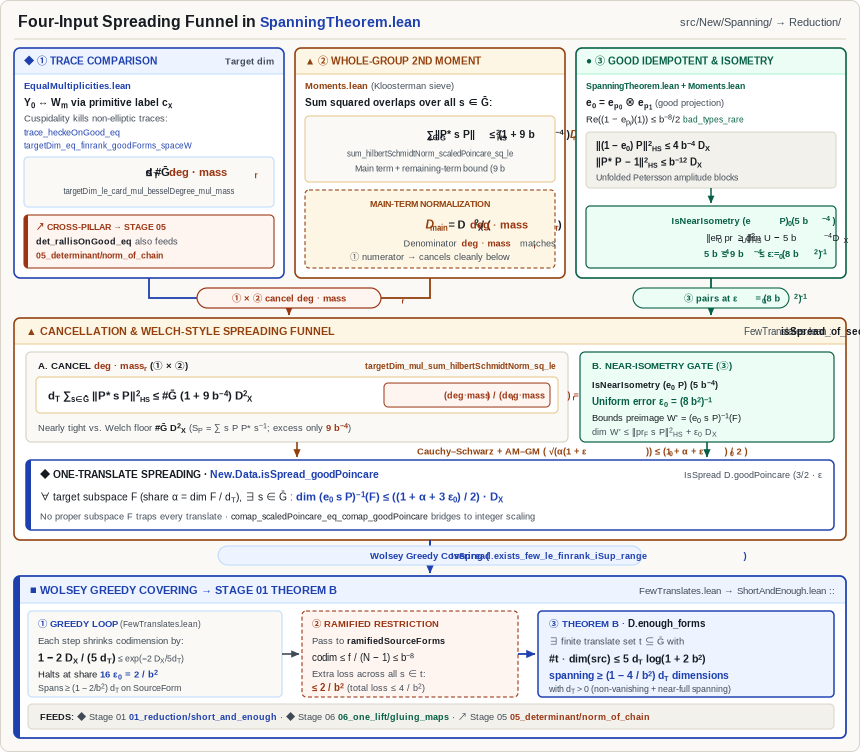
Level 1 — First-Principles
Whenever a finite symmetry group IsCentralProj.isSymmetricProjection). Its coefficient at the identity,
In Stage 04, the finite group is
- Cuspidality for matching traces: At least one place above each level prime carries a primitive polynomial label—an irreducible monic degree-
polynomial over the residue field whose roots generate the full multiplicative group of the degree- extension—inducing a cuspidal type that unlocks matching spherical Hecke traces between indefinite and definite unitary spacestrace comparison. - Negligible energy loss on the Poincaré map: The complement
(the "bad types" lacking an allowed primitive label) must occupy such a tiny Plancherel share that projecting the scaled Poincaré map onto the good forms loses almost none of its root-sum-of-squares operator energyHilbert–Schmidt norm.
Stage 04 builds one good idempotent bad_types_rare: each complement
and bounds each prime's loss separately while holding the other prime fixed at
Limits of the intuition
Picturing a central idempotent as a clean band-pass filter that passes nearly Moments.lean::mem_besselU_of_reduction_eq_one kills the
Level 2 — Undergrad Bridge
In Green's parametrization of complex characters of
1. Construction of SpanningTheorem.lean, BadTypes.lean)
For each level prime index New.Data.goodIdempotentAbove i defines
isCentralProj_goodIdempotentAbove: Eachsatisfies IsCentralProj—it is idempotent, central (a class function), and hence self-adjoint in any unitary representation (IsCentralProj.isSymmetricProjection).levelRepresentation_goodIdempotentAbove_eq: Their tensor productpiTensorElem D.goodIdempotentAboveacts through D.levelRepresentationidentically to the target projectorD.e₀.re_coeff_one_sub_goodIdempotentAbove_le: CombiningMainTerm/BadTypes.leanwith Green's degree formula yields the Plancherel-share boundpackaged together as New.Data.bad_types_rare.
2. Why two primes turn Moments.lean)
Let sum_norm_sq_coeff_of_isCentralProj, Pi.mulSingle i (fixing the other prime
- Unfolding to trace + remainder: Since
acts as an orthogonal projection, . - Trace term (
): Because the other prime component is , mem_besselU_of_reduction_eq_oneforces every contributing rational Bessel element into the unipotent subgroupbesselU, sotrace_besselTranslate_eq_mul_reducedCharevaluates. Averaging over conjugates replaces by the class function ; Cauchy–Schwarz against sum_norm_reducedCharMean_sq_le() gives ( re_sum_coeff_mul_trace_besselTranslate_le). - Remainder term (
): hilbertSchmidtNorm_sum_smul_sub_besselTranslate_sq_leboundsusing the second moment near , so Cauchy–Schwarz against adds at most . - Combining the two primes: Each prime contributes
( hilbertSchmidtNorm_asAlgebraHom_comp_sq_le). ApplyinghilbertSchmidtNorm_one_sub_mul_comp_sq_letosums the two prime losses to ( hilbertSchmidtNorm_one_sub_piTensorElem_comp_sq_le), which combines withto yield the near-isometry error in isNearIsometry_piTensorElem_comp.
Level 3 — Formal Lean Contract
Stage 04 extracts the good-idempotent definitions, rarity bound, and projection loss bounds into skeleton/04_spanning/spanning_theorem.lean and skeleton/04_spanning/moments.lean:
04_spanning/spanning_theorem.lean#New.Data.goodIdempotentAbove(upstreamsrc/New/Spanning/SecondMoment/SpanningTheorem.lean:176-182):leannoncomputable def New.Data.goodIdempotentAbove (i : Fin 2) : MonoidAlgebra ℂ (∀ w : D.filling.chosenPlaces i, GL D.RowIndex (ResField w.val))04_spanning/spanning_theorem.lean#New.Data.bad_types_rare(upstreamsrc/New/Spanning/SecondMoment/SpanningTheorem.lean:234-245):leantheorem New.Data.bad_types_rare : (∀ i : Fin 2, IsCentralProj (D.goodIdempotentAbove i)) ∧ D.levelRepresentation.asAlgebraHom (piTensorElem D.goodIdempotentAbove) = (D.principalRep (D.spaceY 0)).asAlgebraHom D.e₀ ∧ ∀ i : Fin 2, ((1 - D.goodIdempotentAbove i).coeff 1).re ≤ (D.b ^ 8)⁻¹ / 204_spanning/moments.lean#New.IsCentralProj.isSymmetricProjection(upstreamsrc/New/Spanning/Unfolding/Moments.lean:75-82):leanlemma New.IsCentralProj.isSymmetricProjection {H : Type} [Group H] [Fintype H] {ρ : Representation ℂ H V} (hρ : ∀ (s : H) (x y : V), ⟪ρ s x, ρ s y⟫_ℂ = ⟪x, y⟫_ℂ) {z : MonoidAlgebra ℂ H} (hz : IsCentralProj z) : (ρ.asAlgebraHom z).IsSymmetricProjection04_spanning/moments.lean#New.Filling.HasAmplitudeBlocks.hilbertSchmidtNorm_one_sub_piTensorElem_comp_sq_le(upstreamsrc/New/Spanning/Unfolding/Moments.lean:1177-1217):leantheorem New.Filling.HasAmplitudeBlocks.hilbertSchmidtNorm_one_sub_piTensorElem_comp_sq_le [WeilData E] (hP : S.HasAmplitudeBlocks ρ P) (hρ : ∀ (s : S.ResidueGL) (x y : V), ⟪ρ s x, ρ s y⟫_ℂ = ⟪x, y⟫_ℂ) (hg : ∀ i : Fin 2, IsCentralProj (g i)) (hg_small : ∀ i : Fin 2, ((1 - g i).coeff 1).re ≤ (S.b ^ 8)⁻¹ / 2) : hilbertSchmidtNorm ((1 - ρ.asAlgebraHom (piTensorElem g)) ∘ₗ P) ^ 2 ≤ 4 * (S.b ^ 4)⁻¹ * S.sourceDim
See the page's live <VerificationBanner /> (audit/verification-status.json) for the pinned upstream commit and local Lean build status (build_status: unverified-locally).
Where this analogy breaks
Picturing a central idempotent as a clean band-pass filter that keeps 99.99% of frequencies and throws away a tiny bad corner captures why 1 - e_0 has small Plancherel share (Re((1 - e_{p_i})(1)) ≤ b⁻⁸ / 2), but hides why Stage 04 MUST split the level across TWO distinct primes p_0 and p_1: bounding ‖(1 - e_{p_0} ⊗ e_{p_1}) P‖² works one prime at a time by keeping the other prime fixed at 1, which forces Bessel-subgroup terms to become purely unipotent (mem_besselU_of_reduction_eq_one) so the trace collapses to the reduced unipotent character.
Formal Lean Anchors
def New.Data.goodIdempotentAbove — Upstream source (src/New/Spanning/SecondMoment/SpanningTheorem.lean L176-L182)
/-- The idempotent `e_{p_i}` for the level prime `p_i = D.levelPrime i`: the sum of the
`⊗_w e_{c_w}` over the tuples `c` of allowed polynomials of degree `r` at the chosen places above
`p_i` that have a primitive member. -/
noncomputable def New.Data.goodIdempotentAbove (i : Fin 2) :
MonoidAlgebra ℂ (∀ w : D.filling.chosenPlaces i, GL D.RowIndex (ResField w.val)) := by
sorry -- [EXTRACTED_STUB upstream=src/New/Spanning/SecondMoment/SpanningTheorem.lean:176-182 commit=41c2716658c42ba08eb0648994a2efe83082a95c body_lines=2 body_sha256=2532b54684a762d9c28eaa009959bdd7877022a546308234b3d3be93c098a284]theorem New.Data.bad_types_rare — Upstream source (src/New/Spanning/SecondMoment/SpanningTheorem.lean L234-L245)
/-- **Bad types are rare.** The two elements `e_{p_i} = D.goodIdempotentAbove i` of the group
algebras at the level primes `p_i` are central idempotents. Their tensor product
`piTensorElem D.goodIdempotentAbove` acts through `D.levelRepresentation` as the projector `D.e₀`
onto the good forms. The share of the bad types, those that `e_{p_i}` kills, is small: the
coefficient of `1 - e_{p_i}` at the identity has real part at most `b⁻⁸ / 2`, where `b = D.b`. -/
theorem New.Data.bad_types_rare :
    (∀ i : Fin 2, IsCentralProj (D.goodIdempotentAbove i)) ∧
    D.levelRepresentation.asAlgebraHom (piTensorElem D.goodIdempotentAbove) =
      (D.principalRep (D.spaceY 0)).asAlgebraHom D.e₀ ∧
∀ i : Fin 2, ((1 - D.goodIdempotentAbove i).coeff 1).re ≤ (D.b ^ 8)⁻¹ / 2 := by
sorry -- [EXTRACTED_STUB upstream=src/New/Spanning/SecondMoment/SpanningTheorem.lean:234-245 commit=41c2716658c42ba08eb0648994a2efe83082a95c body_lines=2 body_sha256=d9f41312a290225a02b08ce997b8c9b91d52f3a5e90b6938e48f17581e6408eb]lemma New.IsCentralProj.isSymmetricProjection — Upstream source (src/New/Spanning/Unfolding/Moments.lean L75-L82)
/-- In a unitary representation `ρ` of a finite group, a central idempotent `z` of the group algebra
(an idempotent whose coefficients form a class function) acts as an orthogonal projection. -/
lemma New.IsCentralProj.isSymmetricProjection {H : Type} [Group H] [Fintype H]
    {ρ : Representation ℂ H V} (hρ : ∀ (s : H) (x y : V), ⟪ρ s x, ρ s y⟫_ℂ = ⟪x, y⟫_ℂ)
    {z : MonoidAlgebra ℂ H} (hz : IsCentralProj z) :
(ρ.asAlgebraHom z).IsSymmetricProjection := by
sorry -- [EXTRACTED_STUB upstream=src/New/Spanning/Unfolding/Moments.lean:75-82 commit=41c2716658c42ba08eb0648994a2efe83082a95c body_lines=2 body_sha256=ef21c44f582d8fa13dc61b647f2c045b03a2603613aed146acc2e83e9da3cab1]theorem New.Filling.HasAmplitudeBlocks.hilbertSchmidtNorm_one_sub_piTensorElem_comp_sq_le — Upstream source (src/New/Spanning/Unfolding/Moments.lean L1177-L1217)
/-- **Both primes.** Let `S` be admissible filling data (`Filling`, `IsAdmissible`) for a unitary
group `G` over the CM field `E`, which carries Weil data (a primitive `5040`-th root of unity and a
splitting character, see `WeilData`), and let `Ḡ = S.ResidueGL` be the product of the general linear
groups over the residue fields at the chosen places above the two level primes `p₀`, `p₁`. The
source is the Euclidean space with coordinates `(c, i)`, where `c` is a class (a double coset of the
definite unitary group `U(X₀)` for the level) and `i` is a coordinate of the Bessel function `W` at
the infinite places. Let `ρ` be a unitary representation of `Ḡ` on `V` and `P` a linear map from the
source to `V`. Suppose `HasAmplitudeBlocks`: the block `(c, c')` of `P_s = P* ρ(s) P` is the
conjugate of `A(c, s, c') / ν`, where `ν = S.unipotentCovolume > 0` and `A(c, s, c')` is the sum,
over the rational `γ` in `G` such that `h_c⁻¹ γ h_c'` is integral with reduction `s`, of an integral
of `W(y) ⊗ W(γ⁻¹ y)^*` against cutoffs (`h_c` represents the class `c`). Let `g_i` be a central
idempotent (an idempotent whose coefficients form a class function; it is then self-adjoint) of the
group algebra of the factor of `Ḡ` above `p_i`, such that the coefficient of `1 - g_i` at `1` has
real part at most `b⁻⁸ / 2`, where `b = S.b ≥ 1000` is the size parameter of `S`. Let
`e₀ = piTensorElem g` be the tensor product `g₀ ⊗ g₁` in `ℂ[Ḡ]`, acting on `V` through `ρ`. Then
`‖(1 - e₀) P‖² ≤ 4 b⁻⁴ D_X` in Hilbert–Schmidt norm, where `D_X = S.sourceDim` is the dimension of
the source. -/
theorem New.Filling.HasAmplitudeBlocks.hilbertSchmidtNorm_one_sub_piTensorElem_comp_sq_le [WeilData E]
    (hP : S.HasAmplitudeBlocks ρ P) (hρ : ∀ (s : S.ResidueGL) (x y : V), ⟪ρ s x, ρ s y⟫_ℂ = ⟪x,
      y⟫_ℂ)
    (hg : ∀ i : Fin 2, IsCentralProj (g i))
    (hg_small : ∀ i : Fin 2, ((1 - g i).coeff 1).re ≤ (S.b ^ 8)⁻¹ / 2) :
    hilbertSchmidtNorm ((1 - ρ.asAlgebraHom (piTensorElem g)) ∘ₗ P) ^ 2 ≤
4 * (S.b ^ 4)⁻¹ * S.sourceDim := by
sorry -- [EXTRACTED_STUB upstream=src/New/Spanning/Unfolding/Moments.lean:1177-1217 commit=41c2716658c42ba08eb0648994a2efe83082a95c body_lines=18 body_sha256=fb1498d7e65a8445e2efca3ec288f6afe35f432b21d34d3fb37e379d337c2872]Related Concepts
- prime number — A whole number greater than 1 whose only positive whole-number divisors are 1 and itself; every integer above 1 factors uniquely into a product of them.
- trace comparison — Matching traces of spherical Hecke operators between an indefinite unitary group and its definite inner form via a cuspidal local test function—proving equal eigensystem multiplicities, Rallis determinant equality, and the target-dimension bound.
- Hilbert–Schmidt norm — The Frobenius-style root-sum-of-squares norm on linear maps whose second moment over group translates, paired with near-isometry on the good subspace, proves Welch-style spreading and Wolsey greedy covering for Theorem B.
- Bessel orbital integral — An archimedean correlation integral ∫ β_c(y) β_{c'}(γ⁻¹ y) W(y) ⊗ W(γ⁻¹ y)* dy unfolding Petersson inner products P* ρ(s) P into class-indexed amplitude blocks.
Referenced By
- Stage: Galois Main Summands and the Anticyclotomic Selmer Twisting Theorem
- Stage: Regular Twist Families and the Assembly of Theorem C
- Stage: Relative-Trace Unfolding, Bessel Translates, and the Two Moment Bounds
- Stage: Stage 04 — Spanning: Second Moment (Theorem B)
- Stage: Stage 07 — Lower Bound: Congruences & Galois Representations (Theorem C, Part 3)
- Stage: Target Dimension, Multiplicity Equality, and One Good Translate
- Stage: Vanishing Periods of False Lifts and Negative Heights of Twisted L-Values
- Concept: auxiliary spanning form
- Concept: Bessel orbital integral
- Concept: false-lift period
- Concept: Galois main summand
- Concept: Hilbert–Schmidt norm
- Concept: trace comparison
Authoritative Sources
- The characters of the finite general linear groups (paper) — J. A. Green, Trans. Amer. Math. Soc. 80 (1955), 402–447.
- Finite Fields (book) — R. Lidl & H. Niederreiter, Cambridge Univ. Press (1983), ch. 3.
- Finite Groups of Lie Type: Conjugacy Classes and Complex Characters (book) — R. W. Carter, Wiley (1985).
Page Glossary
- prime number
- A whole number greater than 1 whose only positive whole-number divisors are 1 and itself; every integer above 1 factors uniquely into a product of them.
- trace comparison
- Matching traces of spherical Hecke operators between an indefinite unitary group and its definite inner form via a cuspidal local test function—proving equal eigensystem multiplicities, Rallis determinant equality, and the target-dimension bound.
- Hilbert–Schmidt norm
- The Frobenius-style root-sum-of-squares norm on linear maps whose second moment over group translates, paired with near-isometry on the good subspace, proves Welch-style spreading and Wolsey greedy covering for Theorem B.
- Bessel orbital integral
- An archimedean correlation integral ∫ β_c(y) β_{c'}(γ⁻¹ y) W(y) ⊗ W(γ⁻¹ y)* dy unfolding Petersson inner products P* ρ(s) P into class-indexed amplitude blocks.