Rallis inner product formula
Also known as: Rallis inner product, Rallis formula, Rallis product, lift determinant, triangle of lifts.
Relating the squared norm (and Gram determinant) of a theta lift or m-step chain of lifts to spherical Hecke operators and single-lift determinants—factoring Z(theta)/Z(1) across m lifts up to quotient L-value ratios.
Level 1 — First-Principles
Given a linear map
In Stage 05, the target space of Theorem C consists of good forms on the indefinite space
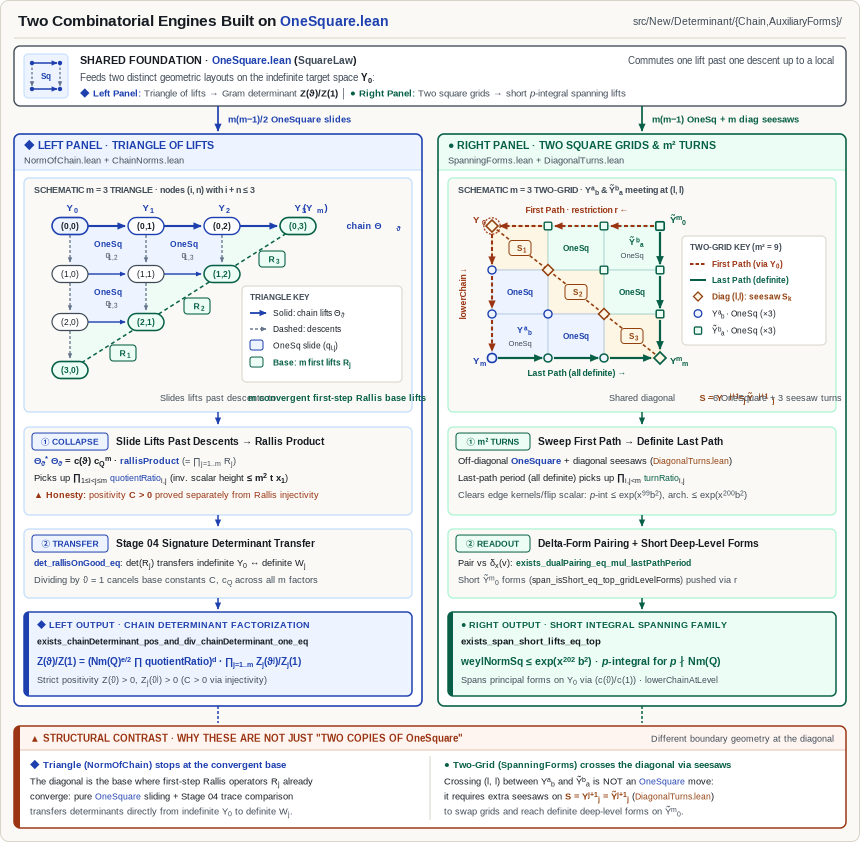
- Sliding across a triangle of lifts: Place the intermediate spaces into a triangle of lifts indexed by intervals
. Repeatedly applying the commuting theta squaretheta square law slides lifts past descents until the Gram operator collapses onto a scalar multiple of the Rallis product of first-step Rallis operators on , with scalar norm controlled by the pairwise quotient ratios of Hecke L-valuesHecke L-value ratio for . - Transferring determinants across signatures: Taking determinants turns
into a product of . By Stage 04's trace comparison between inner forms of different real signaturestrace comparison ( det_rallisOnGood_eq), eachequals on the definite companion space —which by the single-step Rallis inner product ( exists_normDet_goodLift_sq_eq) is proportional to the lift determinantof the single good lift from to .
Dividing the twisted chain volume exists_chainDeterminant_pos_and_div_chainDeterminant_one_eq):
That factorization reduces the
Limits of the intuition
Treating the Rallis inner product formula as an automatic positivity certificate hides a delicate logical split in NormOfChain.lean. The commutation calculus across the triangle of lifts yields HasAbsUpToNormPower, which states only OneSquare.lean). Strict positivity (liftDeterminant_pos, and chainDeterminant_pos) does not come from the square law—it is proved separately from the injectivity of the lifts (lowerChainAtLevel_injective in ChainNorms.lean) in the convergent range of the Rallis inner product formula. Notice also a minor naming convention: upstream docstrings call u.normDet ^ 2 = det(u* u) the "volume" of liftDeterminant and chainDeterminant.
Level 2 — Undergrad Bridge
In src/New/Determinant/Chain/NormOfChain.lean (backed by ChainNorms.lean, TriangleLifts.lean, and TriangleNorms.lean), the determinant factorization unfolds in five clean algebraic lemmas:
- Linear-algebra volume rule (
New.normDet_sq_eq_pow_mul_det): Ifsatisfies for , then and hence . - Single-lift Rallis determinant transferred from
to ( exists_normDet_goodLift_sq_eq,normDet_goodLift_sq_pos,liftDeterminant_pos): For each, D.goodLift ϑ jmapsD.goodForms (D.spaceW j)to(D.descentPair ϑ j).FormV. Note the argument convention:D.goodLift ϑ jtakes aD.TameChar, whereasD.liftDeterminant ϑ jtakes aD.MFoldTwistand evaluates the-th lift at . Applying the single-step Rallis formula on and Stage 04's D.det_rallisOnGood_eqto replace(D.rallisOnGood (D.spaceW j) ϑ j).detby(D.rallisOnGood (D.spaceY 0) ϑ j).detgives a nonzero constantindependent of such that with and . Injectivity gives liftDeterminant_pos : 0 < D.liftDeterminant ϑ j. - Triangle Gram identity (
exists_inner_weightedChain_eq,exists_inner_chain_eq,exists_adjoint_chain_comp_eq_smul_rallisProduct): Using the two square commutation relations inChainNorms.lean(exists_isTriangle), the Gram form of the weighted chain across the triangle evaluates to a multiple ofD.rallisProduct ϑ(the ordered product). Rescaling from the weighted chain to D.Θ ϑgivesexists_inner_chain_eq, and combining withchainDeterminant_posrules outso HasAbsUpToNormPower.exists_norm_div_eq_mul_prod_quotientRatioupgrades the scalar to a strictly positive constantand integer : - Determinant factorization (
exists_chainDeterminant_eq_pow_mul_prod_liftDeterminant,exists_div_chainDeterminant_one_eq,exists_chainDeterminant_pos_and_div_chainDeterminant_one_eq): Taking determinants inexists_adjoint_chain_comp_eq_smul_rallisProductand substitutingexists_normDet_goodLift_sq_eqcancels thetwist factors identically, leaving times the quotient-ratio power times . Dividing by (where prod_quotientRatio_onegives) cancels as well. - Height bound on the quotient-ratio scalar (
HasSmallRatios.heightLe_inv_rpow_mul_prod_quotientRatio): Each of thepairs is a ramified ratio ( isRamifiedRatio_of_mem_sigma) ofcritical -value ratios, so under HasSmallRatios θthe inverse scalar has height at most( LongForms.leanupgrades this tovia D.le_of_hasLogBound).
Level 3 — Formal Lean Contract
Stage 05 extracts the determinant factorization into skeleton/05_determinant/norm_of_chain.lean (24 declarations; 1 intermediate lemma exists_inner_weightedChain_eq at L86 truncates at let u :=, quoted verbatim in Chain Determinant Factorization and Two-Grid Auxiliary Forms; all headline theorems below extract untruncated):
05_determinant/norm_of_chain.lean#New.Data.exists_normDet_goodLift_sq_eq(upstreamNormOfChain.lean:118-141):leanlemma New.Data.exists_normDet_goodLift_sq_eq (j : D.LiftIndex) : ∃ A : ℂ, A ≠ 0 ∧ ∀ ϑ : D.TameChar, ((D.goodLift ϑ j).normDet : ℂ) ^ 2 = (A * (D.descentPair ϑ j).twistFactor) ^ D.targetDim * (D.rallisOnGood (D.spaceY 0) ϑ j).det05_determinant/norm_of_chain.lean#New.Data.exists_adjoint_chain_comp_eq_smul_rallisProduct(upstreamNormOfChain.lean:295-346):leantheorem New.Data.exists_adjoint_chain_comp_eq_smul_rallisProduct (D : Data P) : ∃ (C : ℝ) (e : ℤ) (c : D.MFoldTwist → ℂ), 0 < C ∧ (∀ ϑ : D.MFoldTwist, ‖c ϑ‖ = C * ((ϑ.normQ : ℝ) ^ (e / 2 : ℝ) * ∏ i ∈ Ioc 0 D.m, ∏ j ∈ Ioc i D.m, D.quotientRatio i j ϑ)) ∧ ∀ ϑ : D.MFoldTwist, (D.Θ ϑ).adjoint ∘ₗ D.Θ ϑ = (c ϑ * (D.descentPair ϑ 1).twistFactor ^ D.m) • D.rallisProduct ϑ05_determinant/norm_of_chain.lean#New.Data.exists_chainDeterminant_pos_and_div_chainDeterminant_one_eq(upstreamNormOfChain.lean:418-435):leantheorem New.Data.exists_chainDeterminant_pos_and_div_chainDeterminant_one_eq : ∃ e : ℤ, ∀ ϑ : D.MFoldTwist, 0 < D.chainDeterminant ϑ ∧ (∀ j : D.LiftIndex, 0 < D.liftDeterminant ϑ j) ∧ D.chainDeterminant ϑ / D.chainDeterminant 1 = (((ϑ.normQ : ℝ) ^ (e / 2 : ℝ) * ∏ i ∈ Ioc 0 D.m, ∏ j ∈ Ioc i D.m, D.quotientRatio i j ϑ : ℝ) : ℂ) ^ D.targetDim * ∏ j ∈ Icc 1 D.m, D.liftDeterminant ϑ j / D.liftDeterminant 1 j- Also anchored:
05_determinant/norm_of_chain.lean#New.Data.liftDeterminant_pos(upstreamNormOfChain.lean:88-92) and05_determinant/norm_of_chain.lean#New.Data.chainDeterminant_pos(upstreamNormOfChain.lean:110-116).
See the page's live <VerificationBanner /> (audit/verification-status.json) for the pinned upstream commit and local Lean build status (build_status: unverified-locally).
Where this analogy breaks
Thinking of the Rallis inner product formula as a single closed-form scalar identity for any theta lift hides two crucial subtleties in Stage 05: first, the m-step chain Y_0 -> Y_m leaves the convergent Rallis range after the first step, so NormOfChain must slide lifts past descents across a triangle of spaces using the theta square law; second, the intermediate predicate HasAbsUpToNormPower allows C = 0, so strict positivity (C > 0, chainDeterminant_pos, liftDeterminant_pos) must be proved separately via injectivity of the first lifts.
Formal Lean Anchors
lemma New.Data.exists_normDet_goodLift_sq_eq — Upstream source (src/New/Determinant/Chain/NormOfChain.lean L118-L141)
/-- For `j : D.LiftIndex`, so `1 ≤ j ≤ m`, there is a constant `A ≠ 0` with the following property.
For every tame character `ϑ`, let `u = D.goodLift ϑ j` be the lift `singleLift` restricted to the
good forms on `W_j = D.spaceW j`. Then its volume `normDet ^ 2 = det(u* u)` is `(A c_Q) ^ targetDim`
times a determinant, where `targetDim` is the dimension of the target forms. That determinant is the
one of `rallisOnGood`, the series of Rallis' formula for the `j`-th lift for `ϑ`, acting as a
spherical Hecke operator on the target forms, the good forms on `Y₀ = D.spaceY 0`. Here `c_Q` is the
constant `New.DescentPair.twistFactor` of `D.descentPair ϑ j`, the pair of spaces and the data of
that lift. -/
lemma New.Data.exists_normDet_goodLift_sq_eq (j : D.LiftIndex) :
    ∃ A : ℂ, A ≠ 0 ∧ ∀ ϑ : D.TameChar,
      ((D.goodLift ϑ j).normDet : ℂ) ^ 2 =
        (A * (D.descentPair ϑ j).twistFactor) ^ D.targetDim *
(D.rallisOnGood (D.spaceY 0) ϑ j).det := by
sorry -- [EXTRACTED_STUB upstream=src/New/Determinant/Chain/NormOfChain.lean:118-141 commit=41c2716658c42ba08eb0648994a2efe83082a95c body_lines=12 body_sha256=d8f3c6fdea5ff4b8a94da81fd0f89b1ee948aa05b92d77ecff0dc4d16592c5da]theorem New.Data.exists_adjoint_chain_comp_eq_smul_rallisProduct — Upstream source (src/New/Determinant/Chain/NormOfChain.lean L295-L346)
/-- **Norm of the chain.** For an `m`-fold twist `ϑ` let `Θ = D.Θ ϑ` be the chain of lifts from
forms on `Y₀` to forms on `Y_m`, restricted to the target forms. There are a constant `C > 0`, an
integer `e` and numbers `c ϑ` such that for all `ϑ`
* `‖c ϑ‖ = C (Nm Q) ^ (e / 2) ∏_{1 ≤ i < j ≤ m} quotientRatio i j ϑ`, and
* `Θ* Θ = c ϑ * c_Q ^ m * R`.
Here `Q` is the set of places of `ϑ` and `Nm Q = ϑ.normQ` the product of their norms `q_w`. The
operator `R = D.rallisProduct ϑ` is the product over `1 ≤ j ≤ m` of the series of Rallis' formula
for the `j`-th lift at `ϑ ^ j`. The number `c_Q = (D.descentPair ϑ 1).twistFactor` is
`(Nm Q) ^ (r t) ∏_{w ∈ Q} ∏_{t < i ≤ t + r} (1 - q_w ^ (-i))`, and `quotientRatio i j ϑ` is the
product of the ratios of Hecke values of the quotient of the `j`-th and `i`-th lift characters at
`ϑ ^ (j - i)`. -/
theorem New.Data.exists_adjoint_chain_comp_eq_smul_rallisProduct (D : Data P) :
    ∃ (C : ℝ) (e : ℤ) (c : D.MFoldTwist → ℂ),
      0 < C ∧
      (∀ ϑ : D.MFoldTwist, ‖c ϑ‖ = C * ((ϑ.normQ : ℝ) ^ (e / 2 : ℝ) *
        ∏ i ∈ Ioc 0 D.m, ∏ j ∈ Ioc i D.m, D.quotientRatio i j ϑ)) ∧
      ∀ ϑ : D.MFoldTwist, (D.Θ ϑ).adjoint ∘ₗ D.Θ ϑ =
(c ϑ * (D.descentPair ϑ 1).twistFactor ^ D.m) • D.rallisProduct ϑ := by
sorry -- [EXTRACTED_STUB upstream=src/New/Determinant/Chain/NormOfChain.lean:295-346 commit=41c2716658c42ba08eb0648994a2efe83082a95c body_lines=34 body_sha256=ec891dde1e97004d952cbd50f5c33b9e5223207876deafb60e895a4e8f6b743d]theorem New.Data.exists_chainDeterminant_pos_and_div_chainDeterminant_one_eq — Upstream source (src/New/Determinant/Chain/NormOfChain.lean L418-L435)
/-- **Factorization of the determinant.** For the data `D`, let `ϑ` be an `m`-fold twist
(`MFoldTwist`): a twist whose tame part has `ψ_wⁿ` nontrivial for all `w` in `Q` and `1 ≤ n ≤ m`.
Let `Θ = D.Θ ϑ` be the chain of lifts restricted to the target forms, and `u = goodLift` the lift at
`1 ≤ j ≤ m` for `ϑ ^ j`, restricted to the good forms on W_j. Then the volumes
`chainDeterminant ϑ` = det(Θ* Θ) and `liftDeterminant ϑ j` = det(u* u), with * the adjoint, are
positive. The ratio `chainDeterminant ϑ / chainDeterminant 1` is `(normQ ϑ ^ (e / 2) * ∏_{i < j}
quotientRatio i j ϑ) ^ targetDim` times the product of the ratios
`liftDeterminant ϑ j / liftDeterminant 1 j`, with an integer `e` independent of `ϑ`. -/
theorem New.Data.exists_chainDeterminant_pos_and_div_chainDeterminant_one_eq :
    ∃ e : ℤ, ∀ ϑ : D.MFoldTwist,
      0 < D.chainDeterminant ϑ ∧
      (∀ j : D.LiftIndex, 0 < D.liftDeterminant ϑ j) ∧
      D.chainDeterminant ϑ / D.chainDeterminant 1 =
        (((ϑ.normQ : ℝ) ^ (e / 2 : ℝ) *
            ∏ i ∈ Ioc 0 D.m, ∏ j ∈ Ioc i D.m, D.quotientRatio i j ϑ : ℝ) : ℂ) ^ D.targetDim *
∏ j ∈ Icc 1 D.m, D.liftDeterminant ϑ j / D.liftDeterminant 1 j := by
sorry -- [EXTRACTED_STUB upstream=src/New/Determinant/Chain/NormOfChain.lean:418-435 commit=41c2716658c42ba08eb0648994a2efe83082a95c body_lines=3 body_sha256=a3717854cdfc288badceb978d2677dfe65c55fcef36a1b2230c8d04fed9d5027]theorem New.Data.liftDeterminant_pos — Upstream source (src/New/Determinant/Chain/NormOfChain.lean L88-L92)
/-- For `1 ≤ j ≤ m` the volume of the lift from `W_j` for the twist `ϑ ^ j`, restricted to the good
forms, is a positive real number. -/
theorem New.Data.liftDeterminant_pos (ϑ : D.MFoldTwist) (j : D.LiftIndex) : 0 < D.liftDeterminant ϑ j := by
  sorry -- [EXTRACTED_STUB upstream=src/New/Determinant/Chain/NormOfChain.lean:88-92 commit=41c2716658c42ba08eb0648994a2efe83082a95c body_lines=3 body_sha256=c483297d86717fa4655fd6562485048b452c65221c70bbfc680b04214d9bd7f6]
theorem New.Data.chainDeterminant_pos — Upstream source (src/New/Determinant/Chain/NormOfChain.lean L110-L116)
/-- For every m-fold twist `ϑ : D.MFoldTwist`, `D.chainDeterminant ϑ` is a positive real number.
This is the volume det(u* u) of the map u = ι_ϑ from forms on Y₀ to forms on Y_m, restricted to the
target forms. So this map is injective. -/
theorem New.Data.chainDeterminant_pos (ϑ : D.MFoldTwist) : 0 < D.chainDeterminant ϑ := by
  sorry -- [EXTRACTED_STUB upstream=src/New/Determinant/Chain/NormOfChain.lean:110-116 commit=41c2716658c42ba08eb0648994a2efe83082a95c body_lines=4 body_sha256=b59817e79000386f0d7c639de50340b92ebb5caf7b51cb2b4c0949f9070cbec0]
Related Concepts
- Gram determinant — The determinant of the matrix of pairwise inner products of a family of vectors, measuring the squared volume of the parallelotope they span and controlled by Hadamard's and Fischer's inequalities.
- theta correspondence — An integral transform built from a two-variable theta kernel that carries automorphic forms from one unitary group to another, iterated along a ladder of Hermitian spaces and packaged via admissible chain data.
- Hecke operator — An averaging operator that sums values of an automorphic form over neighboring sublattices—indexed by cosets of a parahoric subgroup—which Stage 03 scales by powers of a prime to eliminate collision losses in the composite theta lift.
- trace comparison — Matching traces of spherical Hecke operators between an indefinite unitary group and its definite inner form via a cuspidal local test function—proving equal eigensystem multiplicities, Rallis determinant equality, and the target-dimension bound.
- theta square law — Commutation of theta lifts around a four-corner square (U_1, U_2, A, A'): summing down-then-up over matched matrix data equals (kappa / c) times summing up-then-down, with |c|^2 = C * L_*(t) != 0 and kappa independent of twist.
- Hecke L-value ratio — The ratio |L^S(z, (nu * theta^s)^-1)| / |L^S(z, nu^-1)| of twisted to untwisted partial Hecke L-values at a critical pair (nu, z), tracking how Siegel–Weil exchange constants scale under twisting across chain quotients and grid turns.
Referenced By
- Stage: Chain Determinant Factorization and Two-Grid Auxiliary Forms
- Stage: Regular Twist Families and the Assembly of Theorem C
- Stage: Siegel–Weil Exchange and the Commuting Theta Square
- Stage: Stage 05 — Lower Bound: The Determinant (Theorem C, Part 1)
- Stage: Vanishing Periods of False Lifts and Negative Heights of Twisted L-Values
- Concept: character theta lift
- Concept: Hecke L-value ratio
- Concept: regular twist family
- Concept: theta square law
Authoritative Sources
- Injectivity properties of liftings associated to Weil representations (paper) — S. Rallis, Compositio Math. 52 (1984), 139–169.
- Non-vanishing theorems for the cohomology of certain arithmetic quotients (paper) — J.-S. Li, J. Reine Angew. Math. 428 (1992), 177–217.
- The regularized Siegel–Weil formula (the second term identity) and the Rallis inner product formula (paper) — W. T. Gan, Y. Qiu & S. Takeda, Invent. Math. 198 (2014), 739–831.
Page Glossary
- Gram determinant
- The determinant of the matrix of pairwise inner products of a family of vectors, measuring the squared volume of the parallelotope they span and controlled by Hadamard's and Fischer's inequalities.
- theta correspondence
- An integral transform built from a two-variable theta kernel that carries automorphic forms from one unitary group to another, iterated along a ladder of Hermitian spaces and packaged via admissible chain data.
- Hecke operator
- An averaging operator that sums values of an automorphic form over neighboring sublattices—indexed by cosets of a parahoric subgroup—which Stage 03 scales by powers of a prime to eliminate collision losses in the composite theta lift.
- theta square law
- Commutation of theta lifts around a four-corner square (U_1, U_2, A, A'): summing down-then-up over matched matrix data equals (kappa / c) times summing up-then-down, with |c|^2 = C * L_*(t) != 0 and kappa independent of twist.
- Hecke L-value ratio
- The ratio |L^S(z, (nu * theta^s)^-1)| / |L^S(z, nu^-1)| of twisted to untwisted partial Hecke L-values at a critical pair (nu, z), tracking how Siegel–Weil exchange constants scale under twisting across chain quotients and grid turns.
- trace comparison
- Matching traces of spherical Hecke operators between an indefinite unitary group and its definite inner form via a cuspidal local test function—proving equal eigensystem multiplicities, Rallis determinant equality, and the target-dimension bound.