carrier form
Also known as: exchange pair, Hecke value product, three-exchange reduction.
The fixed, nonzero, full-level holomorphic theta lift of 1 from U(0, m) to U(2m, m) onto which the first two Siegel–Weil exchanges collapse a twisted class sum, letting a third exchange turn the entire twist dependence into a scalar c(theta) controlled by the raw Hecke value product Gamma_j(theta).
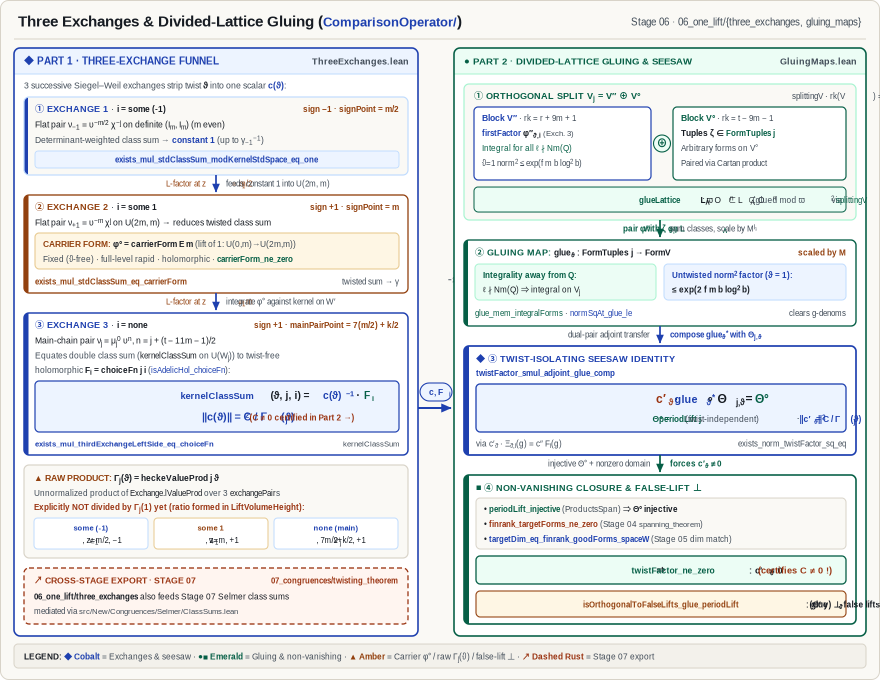
Level 1 — First-Principles
In Stage 06, we want to compare a twisted theta lift against an untwisted one without losing track of where the twist character
The bridge in the middle of that reduction is the carrier form
- Twist-free and full level:
depends only on the CM field and the even integer , never on the twist . It is rapidly decreasing and invariant under the full congruence structure at every level ( carrierForm_mem_rapidOfLevel_and_isAdelicHol). - Holomorphic and nonzero:
is adelically holomorphic for a positive-first basis order, and it is strictly nonzero ( carrierForm_ne_zero). - Target of the first two exchanges: Evaluating a twisted class sum of theta kernels on
against an explicit coefficient function produces a scalar multiple of ( exists_mul_stdClassSum_eq_carrierForm).
Once the twist has been pushed into a scalar in front of
where New.Data.exchangePair j i for
- First exchange (
): a flat pair evaluated up to with twist sign . - Second exchange (
): a flat pair evaluated up to with twist sign . - Third exchange (
): the main-chain character (with ) evaluated up to with twist sign .
Each factor in
Limits of the intuition
Calling the carrier form a "twist-free receptacle" makes the three exchanges look like an automatic algebraic factorization. Two caveats matter in the formal proof. First, heckeValueProd j ϑ is the raw product TwistedValueHeights and LiftVolumeHeight form exists_mul_thirdExchangeLeftSide_eq_choiceFn produces a constant GluingMaps.lean (twistFactor_ne_zero).
Level 2 — Undergrad Bridge
In Li (1992), Yang (1997), and Gan–Qiu–Takeda (2014), stable-range theta lifts of characters from definite unitary groups are holomorphic, rapidly decreasing, and nonzero, while equal-rank Siegel–Weil exchanges convert definite class sums with determinant data into special values of Hecke src/New/OneLift/ComparisonOperator/ThreeExchanges.lean executes this pipeline in four steps:
- First exchange on
( exists_mul_stdClassSum_modKernelStdSpace_eq_one,exists_stdClassSum_modKernelStdSpace_neg_eq_one): For evenand a tame character of weight on , the class sum over of the determinant-weighted theta kernel equals (constant function ), with . Conjugating and passing to the negated space handles the companion sign. - Second exchange to the carrier form (
exists_mul_stdClassSum_eq_carrierForm,carrierForm_mem_rapidOfLevel_and_isAdelicHol,carrierForm_ne_zero): Composing the first two exchanges onof signature paired with evaluates with . Fock-space invariance ( fockInner_realPairWeil_variableMinor_pow_eq_self) ensures, while rapid decay and holomorphy hold at every level. - Third exchange to twist-free choice functions (
exists_mul_thirdExchangeLeftSide_eq_choiceFn,integral_carrierForm_mul_eq_card_mul_choiceFn): Pairingagainst (rank ) with invariant trace datum modulo equates , where is the integral of against the theta kernel on and . - Rewriting as a single theta series (
thirdExchangeLeftSide_eq_kernelClassSum,isAdelicHol_choiceFn): Using row-stabilizer levelrowFixingLeveland product datumwhenever , the double class sum collapses into kernelClassSumonbuilt from leftSideSeries ϑ j i, whilechoiceFn j iinherits holomorphy of weight( isAdelicHol_choiceFn).
Level 3 — Formal Lean Contract
All six anchors live in skeleton/06_one_lift/three_exchanges.lean (43 declarations; 1 unrelated intermediate lemma fockInner_realPairWeil_variableMinor_pow_eq_self is truncated at let v :=, while all 6 anchors below extract untruncated):
06_one_lift/three_exchanges.lean#New.Data.exchangePair(upstreamThreeExchanges.lean:138-177) and06_one_lift/three_exchanges.lean#New.Data.heckeValueProd(upstreamThreeExchanges.lean:179-187).06_one_lift/three_exchanges.lean#New.Rows.exists_mul_stdClassSum_eq_carrierForm(upstreamThreeExchanges.lean:282-404):leanlemma New.Rows.exists_mul_stdClassSum_eq_carrierForm {m : ℕ} [NeZero m] (hm_even : Even m) : ∃ C : ℝ, ∀ {𝔪 : Modulus E} {c : AutChar E} {χ : MulChar 𝔪.ResidueRing ℂ}, IsTameFor 𝔪 c 0 χ → ∃ γ : ℂ, ‖γ‖ ^ 2 = C / (lValueProd 𝔪.places (c⁻¹ * upsilonU1 ^ m) m * lValueProd 𝔪.places (c * upsilonU1 ^ (m / 2)) (m / 2)) ∧ ∀ x : G E (1 ⊕ᵥ -1), γ * stdClassSum (stdLevel E (Fin (2 * m) ⊕ Fin m)) (fun h : Gf E (Fin (2 * m) ⊕ Fin m) ↦ carrierCoeff m c h * modKernelStdSpace (signedSpace E (1 ⊕ᵥ -1)) (upsilonU1 ^ m) c 𝔪 (fun y : Matrix (Fin (2 * m) ⊕ Fin m) (Fin (2 * m) ⊕ Fin m) 𝔪.ResidueRing ↦ χ y.det) 1 x h) = carrierForm E m x06_one_lift/three_exchanges.lean#New.Rows.carrierForm_mem_rapidOfLevel_and_isAdelicHol(upstreamThreeExchanges.lean:417-485) and06_one_lift/three_exchanges.lean#New.Rows.carrierForm_ne_zero(upstreamThreeExchanges.lean:530-558).06_one_lift/three_exchanges.lean#New.Data.exists_mul_thirdExchangeLeftSide_eq_choiceFn(upstreamThreeExchanges.lean:811-860):leanlemma New.Data.exists_mul_thirdExchangeLeftSide_eq_choiceFn : ∃ (C : ℂ) (c : D.Twist → ℂ), ∀ ϑ : D.Twist, ‖c ϑ‖ ^ 2 = C / heckeValueProd j ϑ ∧ ∀ (i : ChoiceIndex j) (g : New.G D.E (D.signsW j)), c ϑ * thirdExchangeLeftSide ϑ j i g = choiceFn j i g
See the page's live <VerificationBanner /> (audit/verification-status.json) for the pinned upstream commit and local Lean build status (build_status: unverified-locally).
Where this analogy breaks
Thinking of the carrier form as a single reusable template that simply factors a twist out of an integral hides two technical constraints: first, the Hecke value product Gamma_j(theta) is the raw unnormalized product of lValueProd over the three exchange pairs (not yet divided by Gamma_j(1)); second, the three exchanges leave the scalar c(theta) with squared modulus C / Gamma_j(theta) where C could still be zero until GluingMaps proves periodLift_injective and invokes Stage 04 finrank_targetForms_ne_zero.
Formal Lean Anchors
lemma New.Rows.exists_mul_stdClassSum_eq_carrierForm — Upstream source (src/New/OneLift/ComparisonOperator/ThreeExchanges.lean L282-L404)
/-- Let `E` be a CM field and `m = 2e > 0`. There is a constant `C` such that each character `c` of
`U(1)(𝔸)` of weight 0 that is tame for `(𝔪, χ)` has a `γ` with (a) `‖γ‖ ^ 2 = C / (lValueProd (c⁻¹ υ
^ m, m) * lValueProd (c υ ^ e, e))`, and (b) `γ Σ_h carrierCoeff m c h · θ_{υ^m,c}[χ ∘ det, 1](x,
h) = φ°(x)` for all `x` in `G E (1 ⊕ᵥ -1)`, the adelic unitary group of the space `S` of signature
`(2m, m)`. The sum is the class sum on the finite adelic group `Gf` of the standard definite space
of rank `3m`, at the level `stdLevel`, and θ is the theta kernel of `S` and that space. -/
lemma New.Rows.exists_mul_stdClassSum_eq_carrierForm {m : ℕ} [NeZero m] (hm_even : Even m) :
∃ C : ℝ, ∀ {𝔪 : Modulus E} {c : AutChar E} {χ : MulChar 𝔪.ResidueRing ℂ},
IsTameFor 𝔪 c 0 χ → ∃ γ : ℂ,
-- (a) the size of the constant
‖γ‖ ^ 2 = C / (lValueProd 𝔪.places (c⁻¹ * upsilonU1 ^ m) m *
lValueProd 𝔪.places (c * upsilonU1 ^ (m / 2)) (m / 2)) ∧
-- (b) the carrier as a class sum
∀ x : G E (1 ⊕ᵥ -1), γ * stdClassSum (stdLevel E (Fin (2 * m) ⊕ Fin m))
(fun h : Gf E (Fin (2 * m) ⊕ Fin m) ↦ carrierCoeff m c h *
modKernelStdSpace (signedSpace E (1 ⊕ᵥ -1)) (upsilonU1 ^ m) c 𝔪
(fun y : Matrix (Fin (2 * m) ⊕ Fin m) (Fin (2 * m) ⊕ Fin m) 𝔪.ResidueRing ↦ χ y.det)
1 x h) = carrierForm E m x := by
sorry -- [EXTRACTED_STUB upstream=src/New/OneLift/ComparisonOperator/ThreeExchanges.lean:282-404 commit=41c2716658c42ba08eb0648994a2efe83082a95c body_lines=106 body_sha256=bc4a8f020e9c9341f88cbf3cb1f05239b05e09b85ed46c5ec5e7983f538fb01b]lemma New.Rows.carrierForm_mem_rapidOfLevel_and_isAdelicHol — Upstream source (src/New/OneLift/ComparisonOperator/ThreeExchanges.lean L417-L485)
/-- Let `E` be a CM field and `m` a nonzero even natural number, and let `E` have a character `c` of
`U(1)(𝔸)` of weight 0 that is tame for some `(𝔪, χ)`: its tame part is non-trivial exactly at the
places of `𝔪 ≠ 1` and induces `χ`. The carrier `carrierForm E m` is the theta lift of the constant 1
from `U(0, m)` to `U(S)`, with `S = signedSpace E (1 ⊕ᵥ -1)` of signature `(2m, m)`. (a) For every
integer `N` of `E` the carrier lies in `rapidOfLevel S N`: it is continuous, invariant under the
rational points of `U(S)` on the left and under the principal congruence subgroup `K(N)` on the
right, and rapidly decreasing. (b) There is an order `o`, an injective integer numbering of the
basis of `S` with the positive vectors before the negative ones (`IsPosFirstOrder`), for which the
carrier is holomorphic (`IsAdelicHol`): each left translate, restricted to the real group, extends
analytically to the products `h b` with `b` invertible and `o`-triangular. -/
lemma New.Rows.carrierForm_mem_rapidOfLevel_and_isAdelicHol {m : ℕ} [NeZero m] (hm_even : Even m)
{𝔪 : Modulus E} {c : AutChar E} {χ : MulChar 𝔪.ResidueRing ℂ} (h_tame : IsTameFor 𝔪 c 0 χ) :
-- (a)
(∀ N : RingOfIntegers E, carrierForm E m ∈ rapidOfLevel (signedSpace E (1 ⊕ᵥ -1)) N) ∧
-- (b)
∃ o : Fin (2 * m) ⊕ Fin m → ℤ, IsPosFirstOrder (1 ⊕ᵥ -1) o ∧
IsAdelicHol o (fun _ : InfinitePlace E ↦ 0 ⊕ᵥ 3 * m) (carrierForm E m) := by
sorry -- [EXTRACTED_STUB upstream=src/New/OneLift/ComparisonOperator/ThreeExchanges.lean:417-485 commit=41c2716658c42ba08eb0648994a2efe83082a95c body_lines=53 body_sha256=c470067a6219c12dc174205e8a30fdb03de0e2c2e3ea9c39985cea8e3b803605]lemma New.Rows.carrierForm_ne_zero — Upstream source (src/New/OneLift/ComparisonOperator/ThreeExchanges.lean L530-L558)
/-- Let `E` be a CM field. For every positive `m`, even or odd, the carrier `φ° = carrierForm E m`
is not zero. It is the theta lift of the constant 1 from the definite group U(0, m) to U(S), S of
signature (2m, m). -/
lemma New.Rows.carrierForm_ne_zero {m : ℕ} [NeZero m] : carrierForm E m ≠ 0 := by
sorry -- [EXTRACTED_STUB upstream=src/New/OneLift/ComparisonOperator/ThreeExchanges.lean:530-558 commit=41c2716658c42ba08eb0648994a2efe83082a95c body_lines=26 body_sha256=2310f705e664d786a8b2cd6509ea55a0b5abe9c3690d68ac8ee36e57b93aa422]lemma New.Data.exists_mul_thirdExchangeLeftSide_eq_choiceFn — Upstream source (src/New/OneLift/ComparisonOperator/ThreeExchanges.lean L811-L860)
/-- The third exchange. There are a constant `C` and numbers `c ϑ`, one for each twist `ϑ`, with two
properties. First, `‖c ϑ‖ ^ 2` is `C` divided by `heckeValueProd j ϑ`, the product over the three
pairs `(ν, z)` of `exchangePair j` of the squared `L`-values at `1, …, z` of `(ν ϑ ^ (± 1))⁻¹`,
without the factors at the chosen places and `ϑ.Q`, and of powers of the norms of these places.
Second, for every choice `i : ChoiceIndex j` and every point `g` of the adelic unitary group of
`W_j = D.spaceW j`, the product of `c ϑ` and `thirdExchangeLeftSide ϑ j i g` is `choiceFn j i g`,
the integral of the carrier `carrierForm` against a theta kernel. -/
lemma New.Data.exists_mul_thirdExchangeLeftSide_eq_choiceFn : ∃ (C : ℂ) (c : D.Twist → ℂ), ∀ ϑ : D.Twist,
    ‖c ϑ‖ ^ 2 = C / heckeValueProd j ϑ ∧
    ∀ (i : ChoiceIndex j) (g : New.G D.E (D.signsW j)),
c ϑ * thirdExchangeLeftSide ϑ j i g = choiceFn j i g := by
sorry -- [EXTRACTED_STUB upstream=src/New/OneLift/ComparisonOperator/ThreeExchanges.lean:811-860 commit=41c2716658c42ba08eb0648994a2efe83082a95c body_lines=40 body_sha256=b791bf056987938eb4eab5a4964624a2c928820aeefdf1dae82ee48c29448c0e]def New.Data.exchangePair — Upstream source (src/New/OneLift/ComparisonOperator/ThreeExchanges.lean L138-L177)
/-- The pairs of the three exchanges, indexed by `Option ℤˣ`: the sign `-1` belongs to the first,
the sign `1` to the second and `none` to the third exchange. Here `j` is a lift index
(`1 ≤ j ≤ m`), `w j v = D.liftWeight j v` is the weight and `μ_j⁰ = D.untwistedLiftChar j` the
untwisted part of the character of the `j`-th lift, `υ = upsilonU1`, `t = 5 r`, and `ω` is the tame
part of `χ`. For `none`: `ν_j = μ_j⁰ υ ^ n` with `n = j + (t - 11 m - 1) / 2`, of weight
`-(w j v - n)` at `v` and tame part `ω ^ j`, at the point `z_* = D.mainPairPoint`.
For a sign `s = ±1`: `ν_± = υ ^ (-z_±) χ ^ (± j)`, of weight `-z_±` at every place and tame part
`ω ^ (± j)`, at the point `z_± = D.signPoint s`. -/
noncomputable def New.Data.exchangePair : Option ℤˣ → D.CriticalPair := by
  sorry -- [EXTRACTED_STUB upstream=src/New/OneLift/ComparisonOperator/ThreeExchanges.lean:138-177 commit=41c2716658c42ba08eb0648994a2efe83082a95c body_lines=31 body_sha256=75f873940e38482e118f4128c57b5400a27ea850212dd2501c3af71e850f6c78]
def New.Data.heckeValueProd — Upstream source (src/New/OneLift/ComparisonOperator/ThreeExchanges.lean L179-L187)
/-- The product of the Hecke values for the three pairs `(ν, z)` of `exchangePair j`,
twisted by `ϑ`. A twist consists of a character `ϑ.toAutChar` of U(1)(𝔸) with a tame part that is
non-trivial at every place of its finite set of places `ϑ.Q`. The factor of a pair is the real
number `Exchange.lValueProd` for the set of the chosen places and the places of `ϑ.Q`, the
character `(ν χ')⁻¹` and the integer `z`. Here `χ'` is `ϑ.toAutChar` for the pair `none` and
`ϑ.toAutChar ^ s` for the pair of sign `s`. -/
noncomputable def New.Data.heckeValueProd (ϑ : D.Twist) : ℂ := by
  sorry -- [EXTRACTED_STUB upstream=src/New/OneLift/ComparisonOperator/ThreeExchanges.lean:179-187 commit=41c2716658c42ba08eb0648994a2efe83082a95c body_lines=2 body_sha256=a3db31c610c7563863f32a16d4b943f8b0a06d5f7bb64e5e3fef70ca8a0f5107]
Related Concepts
- theta correspondence — An integral transform built from a two-variable theta kernel that carries automorphic forms from one unitary group to another, iterated along a ladder of Hermitian spaces and packaged via admissible chain data.
- Siegel–Weil exchange — Comparing theta integrals to U(W) from two complementary-rank spaces V and V' on matched ramified matrix functions modulo m—agreeing up to a nonzero scalar c with |c|^2 = C * L_*(e).
- Hecke L-value ratio — The ratio |L^S(z, (nu * theta^s)^-1)| / |L^S(z, nu^-1)| of twisted to untwisted partial Hecke L-values at a critical pair (nu, z), tracking how Siegel–Weil exchange constants scale under twisting across chain quotients and grid turns.
Referenced By
- Stage: Stage 06 — Lower Bound: One Lift (Theorem C, Part 2)
- Stage: Stage 07 — Lower Bound: Congruences & Galois Representations (Theorem C, Part 3)
- Stage: The Lift Comparison Operator and Single-Lift Volume Height
- Stage: Three Exchanges, the Carrier Form, and Divided-Lattice Gluing
- Stage: Vanishing Periods of False Lifts and Negative Heights of Twisted L-Values
- Concept: anticyclotomic Selmer twisting
- Concept: divided-lattice gluing
- Concept: idle direction repayment
Authoritative Sources
- Non-vanishing theorems for the cohomology of certain arithmetic quotients (paper) — J.-S. Li, J. Reine Angew. Math. 428 (1992), 177–217.
- The regularized Siegel–Weil formula (the second term identity) and the Rallis inner product formula (paper) — W. T. Gan, Y. Qiu & S. Takeda, Invent. Math. 198 (2014), 739–831.
- Theta liftings and Hecke L-functions (paper) — T. Yang, J. Reine Angew. Math. 485 (1997), 25–53.
Page Glossary
- Siegel–Weil exchange
- Comparing theta integrals to U(W) from two complementary-rank spaces V and V' on matched ramified matrix functions modulo m—agreeing up to a nonzero scalar c with |c|^2 = C * L_*(e).
- theta correspondence
- An integral transform built from a two-variable theta kernel that carries automorphic forms from one unitary group to another, iterated along a ladder of Hermitian spaces and packaged via admissible chain data.
- Hecke L-value ratio
- The ratio |L^S(z, (nu * theta^s)^-1)| / |L^S(z, nu^-1)| of twisted to untwisted partial Hecke L-values at a critical pair (nu, z), tracking how Siegel–Weil exchange constants scale under twisting across chain quotients and grid turns.