crystalline dual defect
Also known as: dual defect, crystalline loss, local defect bound, summand class, far jump window, odd class bound.
The normalized length of crystalline cocycles of a summand's Tate dual modulo those cup-orthogonal to congruent lattices, uniformly bounded at every prime l by [G_l : Gamma] * rank(L_c) * defectBound(D, l) / x and summing across all primes well inside D.denominatorBudget.
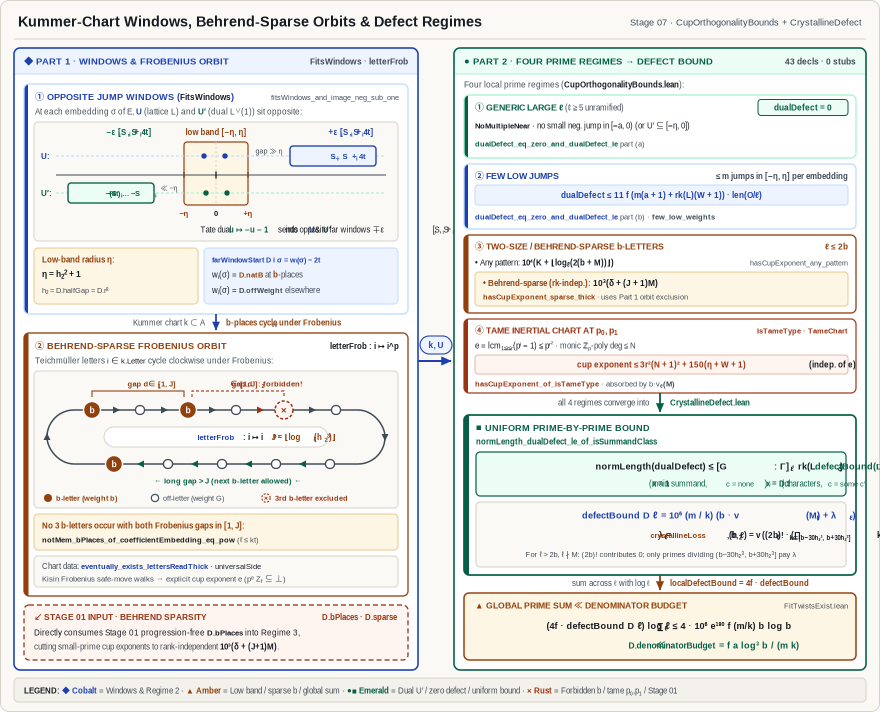
Level 1 — First-Principles
When Ribet's method turns a congruence modulo dualDefect)—is bounded by the normalized length of crystalline cocycles of the Tate dual
LocalLoss/CrystallineDefect.lean binds the four abstract prime regimes of Kummer chart cup orthogonalityKummer chart cup orthogonality to the actual weights and level primes of the admissible data D.bPlaces and IsSummandClass) lets Stage 07 prove one uniform prime-by-prime bound (New.Selmer.normLength_dualDefect_le_of_isSummandClass):
where defectBound!). Here the crystalline loss and defectBound are given explicitly by
(using truncated
Why does this single formula seal the entire proof? When FitTwistsExist.lean sums the sum_localDefectBound_mul_log_le), StdClasses (sum_clearingBound_add_padicValNat_le)—because New.exists_isRegularFamily and closing the final black box of the entire proof.
Limits of the intuition
Notice why the crystalline loss has two distinct pieces inside NoMultipleNear). At every other large prime
Level 2 — Undergrad Bridge
src/New/Congruences/LocalLoss/CrystallineDefect.lean (18 declarations, 0 stub truncations) and src/New/Congruences/FitTwistsExist.lean (19 declarations, 1 let-type stub truncation) bridge local
- Binding windows and Behrend sparsity (
farWindowStart,fitsWindows_and_image_neg_sub_one,notMem_bPlaces_of_coefficientEmbedding_eq_pow,eventually_exists_lettersReadThick): Verifies thatUand its dual-u - 1sit in opposite windows[-η, η] ∪ ∓ cmSign σ [S, S + 4t](η = h₂² + 1,S = farWindowStart D i σ = w_i - 2t), provesnotMem_bPlaces_of_coefficientEmbedding_eq_pow(for, no three b-places sit at Frobenius gaps), and builds the chart LettersReadThickover all largeO : CoeffRing ℓ. - Main-summand vs. character bounds (
hasFewLowJumps_tateDual_of_isMainSummandWeights,subset_Icc_of_jump_eq_single,two_mul_tame_exponent_le_defectBound,crystalline_bound_le_defectBound):- For the main summand (
), its Tate dual has at most jumps in , and crystalline_bound_le_defectBoundcomparesnormLength_dualDefect_le_of_crystallineSizesto. - For each character summand (
), its single dual jump lies in , yielding exact vanishing at generic primes and a factor in defectBound / D.t. - At the two level primes
, two_mul_tame_exponent_le_defectBoundandnormLength_dualDefect_le_defectBound_of_isTameTypeabsorb the tame cup exponentcleanly into .
- For the main summand (
- Uniform prime-by-prime theorem (
normLength_dualDefect_le_of_isSummandClass): Combines the tame and crystalline branches across every primeand every summand c : Option (Fin t)ofIsSummandClass. - Global prime-weighted summation (
sum_defectBound_mul_log_le,sum_localDefectBound_mul_log_le,sum_clearingBound_add_padicValNat_le,New.exists_isRegularFamily): InFitTwistsExist.lean,prod_Ioc_natB_le_powbounds, yielding . Adding the four negligible budgets ( oddClassBound, twistError, denominatorError, StdClasses) fits strictly inside D.denominatorBudget(sum_clearingBound_add_padicValNat_le), establishingNew.exists_isRegularFamilyvia the global height sumarithmetic height.
Level 3 — Formal Lean Contract
All eight anchors extract completely untruncated across skeleton/07_congruences/crystalline_defect.lean (18 declarations, 0 stub truncations) and skeleton/07_congruences/fit_twists_exist.lean:
07_congruences/crystalline_defect.lean#New.Selmer.farWindowStart(upstreamCrystallineDefect.lean:52-59),#New.Selmer.IsSummandClass(CrystallineDefect.lean:383-406),#New.Selmer.hasFewLowJumps_tateDual_of_isMainSummandWeights(CrystallineDefect.lean:420-452),#New.Selmer.normLength_dualDefect_le_defectBound_of_isTameType(CrystallineDefect.lean:467-517), and#New.Selmer.normLength_dualDefect_le_of_isSummandClass(CrystallineDefect.lean:519-624):leanlemma New.Selmer.normLength_dualDefect_le_of_isSummandClass ... : ∀ᶠ O : CoeffRing ℓ in Filter.atTop, ∀ {L : Option (Fin t) → GalLattice O Γ} {F : Filter Γ} {K : Γ → Polynomial O → Prop} {U : (O →ₐ[ℤ_[ℓ]] ℂ_[ℓ]) → Finset ℤ}, IsSummandClass D r (fun g : Gp ℓ ↦ J (complexEmbeddingOf e g)) L F K U → ∀ c : Option (Fin t), InClass F K U (L c) → O.normLength (dualDefect (InClass F K U) (L c).tateDual) ≤ 𝒥.toGp.range.index * ↑(finrank O (L c) * (defectBound D ℓ / (if c = none then 1 else D.t : ℕ)))07_congruences/fit_twists_exist.lean#New.Selmer.sum_localDefectBound_mul_log_le(upstreamFitTwistsExist.lean:136-155),#New.Selmer.sum_clearingBound_add_padicValNat_le(FitTwistsExist.lean:230-260), and#New.exists_isRegularFamily(FitTwistsExist.lean:520-543, untruncated atfit_twists_exist.lean:254-259):leanlemma New.exists_isRegularFamily {P : Parameters} (D : Data P) : ∃ θ : PrimePadicIso → D.MFoldTwist, D.IsRegularFamily θ
See the page's live <VerificationBanner /> (audit/verification-status.json) for the pinned upstream commit and local Lean build status (build_status: unverified-locally).
Where this analogy breaks
Treating crystalline dual defect as a small constant correction at each prime hides why its exact formula depends on (2b)! and a product over (b - 30 h_2^3, b + 30 h_2^3] raised to h_2^3: that factorial-and-interval product automatically vanishes at all primes l > 2b (outside a narrow band near b) while summing with log l across all primes to at most 4 * 10^6 * e^180 * f * (m/k) * b * log b, still dwarfed by D.denominatorBudget = f * a * (log b)^3 / (m * k).
Formal Lean Anchors
structure New.Selmer.IsSummandClass — Upstream source (src/New/Congruences/LocalLoss/CrystallineDefect.lean L383-L406)
/-- The lattices `L i` are the summands at a place above `ℓ`, and `F`, `K`, `U` are the data of a
class `New.Lift.InClass F K U` adapted to them. The summand `L none` is the main summand, of rank
`r` and with jumps `J g` at `coefficientEmbedding O g`; the summand `L (some c)` has the single jump
`c < t`. -/
structure New.Selmer.IsSummandClass {P : Parameters} (D : Data P) {ℓ : ℕ} [ThePrime ℓ] {Γ : Type}
[Group Γ] [𝒥 : OverGp Γ ℓ] {O : CoeffRing ℓ} (r : ℕ) (J : Gp ℓ → Multiset ℤ) {t : ℕ}
(L : Option (Fin t) → GalLattice O Γ) (F : Filter Γ) (K : Γ → Polynomial O → Prop)
(U : (O →ₐ[ℤ_[ℓ]] ℂ_[ℓ]) → Finset ℤ) : Prop where
/-- The class is tame, with `ℓ` one of the primes `D.levelPrime n`, or crystalline with no
condition on inertia. -/
tame_or_crystalline :
(∃ n : Fin 2, ℓ = D.levelPrime n ∧
∀ s : Γ, IsWeilPair (𝒥.toGp s) 0 → IsTameType ℓ D.r ((D.r + D.t) * D.r) (K s)) ∨
(F = ⊤ ∧ K = ⊥)
/-- Every jump allowed by `U` is a jump of one of the summands. -/
exists_jump_ne_zero (γ : O →ₐ[ℤ_[ℓ]] ℂ_[ℓ]) (u : ℤ) (hu : u ∈ U γ) :
∃ i : Option (Fin t), jump (L i).ρ γ u ≠ 0
/-- The main summand has the jumps `J`. -/
hasJumps_none (g : Gp ℓ) : HasJumps (L none).ρ (coefficientEmbedding O g) (J g)
/-- The summand `L (some c)` has the single jump `c`. -/
hasJumps_some (c : Fin t) (g : Gp ℓ) : HasJumps (L (some c)).ρ (coefficientEmbedding O g)
{(c : ℤ)}
/-- The main summand has rank `r`. -/
finrank_none : finrank O (L none) = rabbrev New.Selmer.farWindowStart — Upstream source (src/New/Congruences/LocalLoss/CrystallineDefect.lean L52-L59)
/-- The start of the far window at the embedding `σ` that holds the jumps near `∓ w_i`: it is
`D.natB` if the place of `σ` lies in `D.bPlaces` and `D.offWeight` otherwise, plus `i Δ + h₂ - 2 t`
with `Δ = D.gap`, `h₂ = D.halfGap` and `t = D.t`. -/
noncomputable abbrev New.Selmer.farWindowStart {P : Parameters} (D : Data P) (i : ℕ)
(σ : D.E →+* ℂ) : ℕ := by
sorry -- [EXTRACTED_STUB upstream=src/New/Congruences/LocalLoss/CrystallineDefect.lean:52-59 commit=41c2716658c42ba08eb0648994a2efe83082a95c body_lines=3 body_sha256=4e905107bcdd8c2ff0842bc2fbe612a06304f470ea3f83e6d6c6b27084e379c8]lemma New.Selmer.hasFewLowJumps_tateDual_of_isMainSummandWeights — Upstream source (src/New/Congruences/LocalLoss/CrystallineDefect.lean L420-L452)
/-- Put `h₂ = D.halfGap`, `m = D.m` and `k = D.k = D.r + 1 - m`. Let the multisets `J σ`, for the
complex embeddings `σ` of `D.E`, be the weights of a main summand. Let `L` be a potentially
crystalline lattice over the ring of integers `O` of a finite Galois extension of `ℚ_ℓ`, with an
action of `Γ → G_ℓ`, whose Hodge–Tate jumps at each embedding `γ` of `O`, with multiplicity
`jump L.ρ γ u`, are `J (σ γ)`. Let `U γ` consist of members of `J (σ γ)` and integers in `[0, t)`,
and `U' γ` of jumps of the Tate dual of `L`. Then the dual has few low jumps (`HasFewLowJumps`): the
negative members of `U γ` and `U' γ` are at most `-h₂ / 2`, and at most `⌊r m / k⌋` of its jumps at
`γ` lie in `[-h₂² - 1, h₂² + 1]`. -/
lemma New.Selmer.hasFewLowJumps_tateDual_of_isMainSummandWeights {P : Parameters} {D : Data P}
{ℓ : ℕ} [ThePrime ℓ] {Γ : Type} [Group Γ] [OverGp Γ ℓ] {O : CoeffRing ℓ}
{L : GalLattice O Γ} (hL : IsPotentiallyCrystalline L.ρ) {r t : ℕ}
{J : (D.E →+* ℂ) → Multiset ℤ}
(hJ : IsMainSummandWeights D r t J) {σ : (O →ₐ[ℤ_[ℓ]] ℂ_[ℓ]) → D.E →+* ℂ}
(h_jumps : ∀ (γ : O →ₐ[ℤ_[ℓ]] ℂ_[ℓ]) (u : ℤ), jump L.ρ γ u = Multiset.count u (J (σ γ)))
{U U' : (O →ₐ[ℤ_[ℓ]] ℂ_[ℓ]) → Finset ℤ}
(hU : ∀ γ : O →ₐ[ℤ_[ℓ]] ℂ_[ℓ], ∀ u ∈ U γ, u ∈ J (σ γ) ∨ ∃ c < t, u = (c : ℕ))
(hU' : ∀ γ : O →ₐ[ℤ_[ℓ]] ℂ_[ℓ], ∀ u ∈ U' γ, jump L.tateDual.ρ γ u ≠ 0) :
HasFewLowJumps L.tateDual D.halfGap (r * D.m / D.k) (D.halfGap ^ 2 + 1) U U' := by
sorry -- [EXTRACTED_STUB upstream=src/New/Congruences/LocalLoss/CrystallineDefect.lean:420-452 commit=41c2716658c42ba08eb0648994a2efe83082a95c body_lines=16 body_sha256=df248ac5f823ce0d6306adc38b32c3fb282199ff9d480b730df17c74d02c8c95]lemma New.Selmer.normLength_dualDefect_le_defectBound_of_isTameType — Upstream source (src/New/Congruences/LocalLoss/CrystallineDefect.lean L467-L517)
/-- The tame case, at one of the two level primes `ℓ = D.levelPrime n` of the data `D`. Here `D.r`
is the rank parameter of the data and `D.t = 5 D.r`; the rank of the lattice `L` is arbitrary.
Let `𝒥.toGp : Γ → G_ℓ` be an open embedding onto the elements of
`G_ℓ = Gal(ℚ̄_ℓ / ℚ_ℓ)` that fix `e E`, where `E = D.E`. A lattice lies in `InClass F K U` if its
crystalline periods fixed on a neighbourhood of `1` that belongs to the filter `F` span, its
Hodge–Tate jumps at each embedding `γ` of `O` lie in `U γ`, and each polynomial allowed by `K s`
kills `s` on its periods, for `s` in inertia. Assume:
* `hL`: `L` lies in the class for `F`, `s ↦ K s⁻¹` and `U'`;
* `h_tame`: for each `s` in inertia (`IsWeilPair (𝒥.toGp s) 0`) the condition `K s` on polynomials
holds for `X ^ e' - 1`, with `e'` the least common multiple of the `ℓ ^ a - 1` for `1 ≤ a ≤ D.r`,
and for a monic polynomial over `ℤ_ℓ` of degree at most `(D.r + D.t) D.r` (`IsTameType`);
* `hU`, `hU'`: with `η = h₂² + 1`, the sign `ε = cmSign σ` of a complex embedding `σ` for the CM
type, and `S = farWindowStart D i σ` (the `i`-th lift weight at `σ` minus `2 D.t`, `i ≤ D.m`),
each `U γ` lies in `[-η, η] ∪ -ε · [S, S + 4 D.t]` and each `U' γ` in
`[-η, η] ∪ ε · [S, S + 4 D.t]`.
Then the defect of `L` for the class `InClass F K U`, the length of the crystalline cocycles modulo
those orthogonal, under cup products, to the crystalline cocycles of the lattices in the class,
normalised so that `O / ℓ` has length `1`, is at most `[G_ℓ : Γ] · rank L · defectBound D ℓ / x` for
`0 < x ≤ D.t`. Here `defectBound D ℓ = 10⁶ (m / k) (b v_ℓ(M) + λ)` in the nonnegative reals, where
`m = D.m`, `k = D.k = D.r + 1 - m`, `b = D.natB` is the weight at the b-places, `M = D.M` is the
product of the two level primes, and `λ = crystallineLoss h₂ b ℓ` is the `ℓ`-adic valuation of
`(2 b)! (∏ a) ^ h₂³`, with `a` over the positive integers in `(b - 30 h₂³, b + 30 h₂³]` and
`h₂ = D.halfGap = D.r ^ 8`. -/
lemma New.Selmer.normLength_dualDefect_le_defectBound_of_isTameType {P : Parameters} {D : Data P}
{n : Fin 2} [ThePrime (D.levelPrime n)] {Γ : Type} [Group Γ]
[𝒥 : OverGp Γ (D.levelPrime n)] [TopologicalSpace Γ]
{e : D.E →+* PadicAlgCl (D.levelPrime n)} (h_group : IsCompletionGroup e 𝒥.toGp)
{O : CoeffRing (D.levelPrime n)} {L : GalLattice O Γ} {F : Filter Γ}
{K : Γ → Polynomial O → Prop} {U U' : (O →ₐ[ℤ_[D.levelPrime n]] ℂ_[D.levelPrime n]) → Finset ℤ}
(hL : InClass F (fun s : Γ ↦ K s⁻¹) U' L)
(h_tame : ∀ s : Γ, IsWeilPair (𝒥.toGp s) 0 →
IsTameType (D.levelPrime n) D.r ((D.r + D.t) * D.r) (K s))
{i : ℕ} (hi : i ≤ D.m) {σ : D.E →+* ℂ}
(hU : ∀ γ : O →ₐ[ℤ_[D.levelPrime n]] ℂ_[D.levelPrime n],
FitsWindows (D.halfGap ^ 2 + 1) (-cmSign σ) (farWindowStart D i σ) (4 * D.t) (U γ))
(hU' : ∀ γ : O →ₐ[ℤ_[D.levelPrime n]] ℂ_[D.levelPrime n],
FitsWindows (D.halfGap ^ 2 + 1) (cmSign σ) (farWindowStart D i σ) (4 * D.t) (U' γ))
{x : ℕ} (hx_pos : 0 < x) (hx_le : x ≤ D.t) :
O.normLength (dualDefect (InClass F K U) L) ≤
𝒥.toGp.range.index * ↑(finrank O L * (defectBound D (D.levelPrime n) / x)) := by
sorry -- [EXTRACTED_STUB upstream=src/New/Congruences/LocalLoss/CrystallineDefect.lean:467-517 commit=41c2716658c42ba08eb0648994a2efe83082a95c body_lines=11 body_sha256=f2941fb62cb0aea96e66dc7361de55845df05f07e9c170b6786247b84bc33778]lemma New.Selmer.normLength_dualDefect_le_of_isSummandClass — Upstream source (src/New/Congruences/LocalLoss/CrystallineDefect.lean L519-L624)
/-- The defect bound at one place above `ℓ`. Let `𝒥.toGp : Γ → G_ℓ` be an open embedding onto the
elements of `G_ℓ = Gal(ℚ̄_ℓ / ℚ_ℓ)` that fix `e E`, where `E = D.E`; each `g` in `G_ℓ` gives a
complex embedding `complexEmbeddingOf e g` of `E`. Let the multisets `J σ` be the weights of a main
summand (`IsMainSummandWeights`): `1 ≤ r ≤ D.r`, `t ≤ D.t = 5 D.r`, each member `u` of `J σ` has
`h₂ / 2 ≤ |u| ≤ 4 m h₂` or lies within `D.t` of `∓ w_i(σ)` for one lift weight
`w_i = D.liftWeight i` with `i ≤ m`, at most `r m / k` members have `|u| ≤ 2 h₂²`, and at most `r`
members of `J σ` and `J σ̄` together are negative. Here `O` runs over the rings of integers of
finite Galois extensions of `ℚ_ℓ`, and large means containing a given one. Let `O` be large. A
lattice lies in `InClass F K U` if its crystalline periods fixed on a neighbourhood of `1` that
belongs to the filter `F` span, its Hodge–Tate jumps at each embedding `γ` of `O` lie in `U γ`, and
each polynomial allowed by `K s` kills `s` on its periods, for `s` in inertia. Let the class be
adapted to the lattices `L c` (`IsSummandClass`): it is tame with `ℓ` a level prime of `D`, or
crystalline (`F = ⊤`, `K = ⊥`); each member of `U γ` is a jump of some `L c`; the main summand
`L none` has rank `r` and jumps `J (complexEmbeddingOf e g)` at the embedding `a ↦ g a` of `O`; and
`L (some c)` has the single jump `c`. If `L c` lies in the class, then the defect of its Tate dual,
the length of the crystalline cocycles modulo those orthogonal, under cup products, to the
crystalline cocycles of the lattices in the class, normalised so that `O / ℓ` has length `1`, is at
most `[G_ℓ : Γ] · rank (L c) · defectBound D ℓ / x`, where `x = 1` for the main summand and
`x = D.t` otherwise. Here `defectBound D ℓ = 10⁶ (m / k) (b v_ℓ(M) + λ)` in the nonnegative reals,
where `m = D.m`, `k = D.k = D.r + 1 - m`, `b = D.natB` is the weight at the b-places, `M = D.M` is
the product of the two level primes, and `λ = crystallineLoss h₂ b ℓ` is the `ℓ`-adic valuation of
`(2 b)! (∏ a) ^ h₂³`, with `a` over the positive integers in `(b - 30 h₂³, b + 30 h₂³]` and
`h₂ = D.halfGap = D.r ^ 8`; the division by `x` is exact. -/
lemma New.Selmer.normLength_dualDefect_le_of_isSummandClass {P : Parameters} {ℓ : ℕ} {Γ : Type}
{D : Data P} [hp : ThePrime ℓ] [PadicIso ℓ] [Group Γ] [𝒥 : OverGp Γ ℓ] [TopologicalSpace Γ]
{e : D.E →+* PadicAlgCl ℓ} {r t : ℕ} {J : (D.E →+* ℂ) → Multiset ℤ}
(hJ : IsMainSummandWeights D r t J) (h_group : IsCompletionGroup e 𝒥.toGp) :
∀ᶠ O : CoeffRing ℓ in Filter.atTop,
∀ {L : Option (Fin t) → GalLattice O Γ} {F : Filter Γ} {K : Γ → Polynomial O → Prop}
{U : (O →ₐ[ℤ_[ℓ]] ℂ_[ℓ]) → Finset ℤ},
IsSummandClass D r (fun g : Gp ℓ ↦ J (complexEmbeddingOf e g)) L F K U →
∀ c : Option (Fin t), InClass F K U (L c) →
O.normLength (dualDefect (InClass F K U) (L c).tateDual) ≤
𝒥.toGp.range.index *
↑(finrank O (L c) * (defectBound D ℓ / (if c = none then 1 else D.t : ℕ))) := by
sorry -- [EXTRACTED_STUB upstream=src/New/Congruences/LocalLoss/CrystallineDefect.lean:519-624 commit=41c2716658c42ba08eb0648994a2efe83082a95c body_lines=72 body_sha256=406297681ac7e996abc84debcab42d1048870a6840f29c347cda7d967421ee4d]lemma New.Selmer.sum_localDefectBound_mul_log_le — Upstream source (src/New/Congruences/FitTwistsExist.lean L136-L155)
/-- **Bound for the local loss.** The numbers `localDefectBound D l = 4 f · defectBound D l` have
`∑ localDefectBound D l · log l ≤ 4 · 10⁶ e¹⁸⁰ f (m / k) b log b` over every finite set `T` of
primes. Here `f` is the number of infinite places of `D.E`, `m` the number of lifts, `k = r + 1 - m`
the rank of the source, `b = exp D.logB` the weight, and `defectBound D l` is `10⁶ (m / k)` times a
sum of `l`-adic valuations of integers attached to `D`. -/
lemma New.Selmer.sum_localDefectBound_mul_log_le {P : Parameters} (D : Data P) (T : Finset ℕ)
(hT : ∀ l ∈ T, l.Prime) :
∑ l ∈ T, (localDefectBound D l : ℝ) * log l ≤
4 * 10 ^ 6 * exp 180 * (D.f * ((D.m : ℝ) / D.k) * D.b * D.logB) := by
sorry -- [EXTRACTED_STUB upstream=src/New/Congruences/FitTwistsExist.lean:136-155 commit=41c2716658c42ba08eb0648994a2efe83082a95c body_lines=12 body_sha256=bd01a0d51833576eda145e3aebd12d30e4476572fef1fdb3a0e03c054d5c5667]lemma New.Selmer.sum_clearingBound_add_padicValNat_le — Upstream source (src/New/Congruences/FitTwistsExist.lean L230-L260)
/-- The number `clearingBound D l` is the bound for the exponent of `l` in the denominator of a
projection to lifts, per dimension and per unit of rank of the source: a sum of the local loss
`localDefectBound D l`, multiples of the twist and error terms, and the valuation of
`D.chosenGroupOrder`. The number of `StdClasses` at the level `D.chosenLevel` is the class number of
`U(1)` there. Summed over a finite set `T` of primes `l` with weights `log l`, the clearing bounds
and the `l`-adic valuations of this class number are at most
`D.denominatorBudget = D.errorUnit / (m k)`, for `m` the number of lifts and `k = r + 1 - m`. -/
lemma New.Selmer.sum_clearingBound_add_padicValNat_le {P : Parameters} (D : Data P) (T : Finset ℕ)
(hT : ∀ l ∈ T, l.Prime) :
∑ l ∈ T, (clearingBound D l * log l +
padicValNat l (Nat.card (StdClasses (n := Unit) D.chosenLevel)) * log l) ≤
D.denominatorBudget := by
sorry -- [EXTRACTED_STUB upstream=src/New/Congruences/FitTwistsExist.lean:230-260 commit=41c2716658c42ba08eb0648994a2efe83082a95c body_lines=20 body_sha256=53420fd4673f0c5f08958ecc7ee2f4135523ecab17bd5b387a2d3a01a8736553]lemma New.exists_isRegularFamily — Upstream source (src/New/Congruences/FitTwistsExist.lean L520-L543)
/-- **Twists with few congruences.** All data `D` have a regular family of `m`-fold twists `θ κ`,
one for each pair `κ` of a prime `ℓ` and an isomorphism `ℂ ≃ ℚ̄_ℓ`. The modulus of `θ κ` is prime to
`ℓ`. -/
lemma New.exists_isRegularFamily {P : Parameters} (D : Data P) :
∃ θ : PrimePadicIso → D.MFoldTwist, D.IsRegularFamily θ := by
sorry -- [EXTRACTED_STUB upstream=src/New/Congruences/FitTwistsExist.lean:520-543 commit=41c2716658c42ba08eb0648994a2efe83082a95c body_lines=20 body_sha256=7dc9514fd6312e16ba99229ea83d603b4eab77580f87aaa0a81aa51b242439ae]Related Concepts
- Kummer chart cup orthogonality — Bounding the power p^e that pushes crystalline cocycles of a p-adic Galois lattice L into the cup-product annihilator of congruent dual lattices across four weight/prime regimes using Kisin-module Frobenius-orbit walks on a Kummer chart.
- Galois main summand — The fixed, twist-independent rank-r (or rank-1) l-adic Galois representation R extracted from a Hecke eigensystem whose trace, after twisting by theta^(-1) and adding the inverse-cyclotomic string sum_{e < t} chi_cyc^(-e), matches every twisted theta lift.
- regular twist family — A prime-by-prime family of m-fold anticyclotomic twists theta(iota) with modulus coprime to l, inverse L-value ratios of height at most x_1, and lift/projection denominators summing within fa(log b)^3 / (m*k).
- arithmetic height — A logarithmic measure combining ordinary archimedean size with prime-by-prime p-adic divisibility, locked together by the product formula so a nonzero algebraic quantity cannot be simultaneously small at every place.
- prime number — A whole number greater than 1 whose only positive whole-number divisors are 1 and itself; every integer above 1 factors uniquely into a product of them.
Referenced By
- Stage: Crystalline Lifting, Kummer Charts, and Local Dual Defect
- Stage: First-Order Ribet Denominator Bounds and Existence of Regular Twist Families
- Stage: Stage 07 — Lower Bound: Congruences & Galois Representations (Theorem C, Part 3)
- Concept: Ribet clearing operator
Authoritative Sources
- Torsion p-adic Galois representations and a conjecture of Fontaine (paper) — T. Liu, Ann. Sci. Éc. Norm. Supér. 40 (2007), 633–674.
- On the size of crystalline cohomology (paper) — S. Chang & F. Diamond, J. Inst. Math. Jussieu 10 (2011), 1–19.
- Class fields of abelian extensions of Q (paper) — B. Mazur & A. Wiles, Invent. Math. 76 (1984), 179–330.
Page Glossary
- Galois main summand
- The fixed, twist-independent rank-r (or rank-1) l-adic Galois representation R extracted from a Hecke eigensystem whose trace, after twisting by theta^(-1) and adding the inverse-cyclotomic string sum_{e < t} chi_cyc^(-e), matches every twisted theta lift.
- Kummer chart cup orthogonality
- Bounding the power p^e that pushes crystalline cocycles of a p-adic Galois lattice L into the cup-product annihilator of congruent dual lattices across four weight/prime regimes using Kisin-module Frobenius-orbit walks on a Kummer chart.
- prime number
- A whole number greater than 1 whose only positive whole-number divisors are 1 and itself; every integer above 1 factors uniquely into a product of them.
- anticyclotomic Selmer twisting
- Choosing one finite-order anticyclotomic m-fold twist tau on auxiliary places Q so that all powers xi = tau^j (1 <= j <= m) simultaneously keep ramification, divisible crystalline Selmer lengths of finitely many main summands, and all ramified Hecke L-value ratio valuations within twistError l D = (4f + 3)r v_l(chosenGroupOrder) + 2^(-l).
- regular twist family
- A prime-by-prime family of m-fold anticyclotomic twists theta(iota) with modulus coprime to l, inverse L-value ratios of height at most x_1, and lift/projection denominators summing within f*a*(log b)^3 / (m*k).
- arithmetic height
- A logarithmic measure combining ordinary archimedean size with prime-by-prime p-adic divisibility, locked together by the product formula so a nonzero algebraic quantity cannot be simultaneously small at every place.