arithmetic height
Also known as: product formula, p-adic valuation.
A logarithmic measure combining ordinary archimedean size with prime-by-prime p-adic divisibility, locked together by the product formula so a nonzero algebraic quantity cannot be simultaneously small at every place.
Level 1 — First-Principles
Take any nonzero fraction written in lowest terms, say
Multiply all of these measurements together—the ordinary absolute value times every prime absolute value:
Every prime factor in the numerator enlarges
A nonzero rational number therefore cannot be tiny in every sense at once; any deficit in ordinary size must be paid for by prime denominators somewhere else. Arithmetic height is the logarithmic ledger that tracks these upper bounds across the ordinary size and all prime numbers simultaneously, so that bounds add cleanly when quantities are multiplied.
In Stage 01, the quantities being multiplied live in the two-dimensional coordinate plane of numbers
Limits of the intuition
Viewing arithmetic height as the logarithmic size of a single reduced fraction accurately explains why prime factors cancel in the product formula and why height bounds add under multiplication. The analogy falls short in Stage 01 for two reasons. First, the input to a height bound in the proof is not a single rational number
Level 2 — Undergrad Bridge
For a rational number
To support prime-dependent twists without fixing a number field in advance, New.Reduction.Lattices.Heights indexes prime places by PrimePadicIso: pairs
which plays the role of local integers at HeightLe c y) if there exist a single nonzero multiplier
for all field automorphisms ; for every ; for every finite set of primes.
This definition enjoys a clean calculus: multiplying two families adds their height bounds (HeightLe.mul, by multiplying multipliers HeightLe.pow), and multiplying HeightLe.rpow_mul).
The key global rigidity lemma is HeightLe.nonneg_of_one: if the constant family HeightLe c 1, then
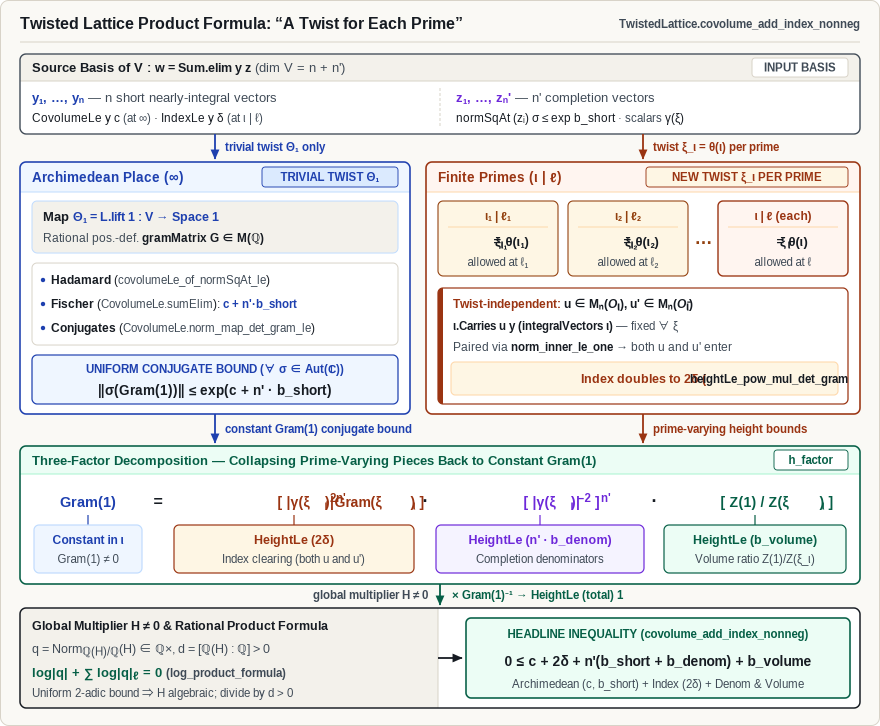
As an immediate corollary (HeightLe.neg_le_of_norm_map_le), if a nonzero complex number HeightLe c (fun _ => z) and nonneg_of_one to TwistedLattice.lean, heightLe_pow_mul_det_gram establishes HeightLe (2 * δ) for the twisted family covolume_add_index_nonneg.
Level 3 — Formal Lean Contract
In skeleton/01_reduction/twisted_lattice.lean (extracted from upstream src/New/Reduction/Lattices/TwistedLattice.lean, building on New.HeightLe and New.log_product_formula in src/New/Reduction/Lattices/Heights.lean), the valuation ring, twisted Gram-determinant height lemma, and final product-formula inequality have the following signatures:
01_reduction/twisted_lattice.lean#New.PrimePadicIso.integers(upstreamsrc/New/Reduction/Lattices/TwistedLattice.lean:61-62):leanabbrev New.PrimePadicIso.integers : ValuationSubring ℂ01_reduction/twisted_lattice.lean#New.TwistedLattice.heightLe_pow_mul_det_gram(upstreamsrc/New/Reduction/Lattices/TwistedLattice.lean:421-440):leanlemma New.TwistedLattice.heightLe_pow_mul_det_gram {n n' : ℕ} {y : Fin n → V} {z : Fin n' → V} {δ : ℝ} (hδ : L.IndexLe y δ) {θ : PrimePadicIso → T} (hθ : ∀ ι : PrimePadicIso, L.IsAllowed ι.prime (θ ι)) {γ : PrimePadicIso → ℂ} (hz : ∀ (ι : PrimePadicIso) (i : Fin n'), γ ι • L.lift (θ ι) (z i) ∈ L.lattice (θ ι) ι) (hz' : ∀ (ι : PrimePadicIso) (i : Fin n'), γ ι • L.lift (θ ι) (z i) ∈ L.lattice (θ ι) ι.conj) : HeightLe (2 * δ) fun ι : PrimePadicIso ↦ ((‖γ ι‖ : ℂ) ^ 2) ^ n' * (gram ℂ (L.lift (θ ι) ∘ Sum.elim y z)).det01_reduction/twisted_lattice.lean#New.TwistedLattice.covolume_add_index_nonneg(upstreamsrc/New/Reduction/Lattices/TwistedLattice.lean:444-485):leantheorem New.TwistedLattice.covolume_add_index_nonneg {n n' : ℕ} {y : Fin n → V} {z : Fin n' → V} (h_inj : ∀ ξ : T, Function.Injective (L.lift ξ)) (h_indep : LinearIndependent ℂ (Sum.elim y z)) (h_card : finrank ℂ V = n + n') {θ : PrimePadicIso → T} (hθ : ∀ ι : PrimePadicIso, L.IsAllowed ι.prime (θ ι)) {c δ b_volume b_short b_denom : ℝ} (hc : L.CovolumeLe y c) (hδ : L.IndexLe y δ) {γ : T → ℂ} (hγ_ne : ∀ ξ : T, γ ξ ≠ 0) (hz_int : ∀ (i : Fin n') (ι : PrimePadicIso) (ξ : T), L.IsAllowed ι.prime ξ → γ ξ • L.lift ξ (z i) ∈ L.lattice ξ ι) (hz_short : ∀ (i : Fin n') (σ : ℂ ≃+* ℂ), L.normSqAt (z i) σ ≤ exp b_short) (hγ : HeightLe b_denom fun ι : PrimePadicIso ↦ ((‖γ (θ ι)‖ : ℂ) ^ 2)⁻¹) (hZ : HeightLe b_volume fun ι : PrimePadicIso ↦ L.volume 1 / L.volume (θ ι)) : 0 ≤ c + 2 * δ + n' * (b_short + b_denom) + b_volume
Here New.HeightLe (src/New/Reduction/Lattices/Heights.lean:45-52) carries the uniform nonzero multiplier H : ℂ, archimedean bound α : ℝ, and prime exponents h : ℕ → ℝ, while New.log_product_formula (Heights.lean:57-72) supplies the underlying rational conservation law used by HeightLe.nonneg_of_one (Heights.lean:195-225) and HeightLe.neg_le_of_norm_map_le (Heights.lean:229-234). See the page's live verification banner (audit/verification-status.json) for the currently pinned upstream snapshot and local Lean build status (build_status: unverified-locally).
Where this analogy breaks
Thinking of arithmetic height as the bit-length of a reduced fraction New.HeightLe, a single uniform nonzero multiplier
Formal Lean Anchors
lemma New.TwistedLattice.heightLe_pow_mul_det_gram — Upstream source (src/New/Reduction/Lattices/TwistedLattice.lean L421-L440)
/-- Let `L` be a twisted lattice with maps `Θ_ξ = L.lift ξ`. Let `y` have index at most `δ`, let
`ξ_ι = θ ι` be allowed at the prime of `ι`, and let the vectors `γ_ι Θ_{ξ_ι} z_i` be integral both
at `ι` and at `ῑ`, where `ῑ z = ι z̄`. Let `Gram(ξ)` be the Gram determinant of the images of
`y_1, …, y_n, z_1, …, z_n'` under `Θ_ξ`. Then the family `x_ι = |γ_ι| ^ (2 n') Gram(ξ_ι)` has height
at most `2 δ` (`New.HeightLe`): for some common `H ≠ 0`, the bounds for `log |σ H|` over
automorphisms `σ` of `ℂ` and for `log ‖ι (H x_ι)‖` at the primes add up to at most `2 δ`. -/
lemma New.TwistedLattice.heightLe_pow_mul_det_gram {n n' : ℕ} {y : Fin n → V} {z : Fin n' → V} {δ : ℝ}
    (hδ : L.IndexLe y δ) {θ : PrimePadicIso → T}
    (hθ : ∀ ι : PrimePadicIso, L.IsAllowed ι.prime (θ ι)) {γ : PrimePadicIso → ℂ}
    (hz : ∀ (ι : PrimePadicIso) (i : Fin n'), γ ι • L.lift (θ ι) (z i) ∈ L.lattice (θ ι) ι)
    (hz' : ∀ (ι : PrimePadicIso) (i : Fin n'), γ ι • L.lift (θ ι) (z i) ∈ L.lattice (θ ι) ι.conj) :
    HeightLe (2 * δ) fun ι : PrimePadicIso ↦
((‖γ ι‖ : ℂ) ^ 2) ^ n' * (gram ℂ (L.lift (θ ι) ∘ Sum.elim y z)).det := by
sorry -- [EXTRACTED_STUB upstream=src/New/Reduction/Lattices/TwistedLattice.lean:421-440 commit=41c2716658c42ba08eb0648994a2efe83082a95c body_lines=8 body_sha256=7145cfa2562dcdbf2e4a57d70480975bad4e036c0b260b8f429bada851fbee1a]theorem New.TwistedLattice.covolume_add_index_nonneg — Upstream source (src/New/Reduction/Lattices/TwistedLattice.lean L444-L485)
/-- **A twist for each prime.** Let `L` be a twisted lattice on `V` with maps `Θ_ξ = L.lift ξ`, all
injective. Let `y_1, …, y_n, z_1, …, z_n'` be a basis of `V`, and let `ξ_ι = θ ι` be allowed at the
prime of `ι`. Suppose that
* `y` has covolume at most `c` and index at most `δ`;
* `γ(ξ) ≠ 0`, and `γ(ξ) Θ_ξ z_i` is integral at all `ι ∣ l` for `ξ` allowed at `l`;
* `⟨σ Θ₁ z_i, σ Θ₁ z_i⟩ ≤ exp b_short` for all automorphisms `σ` of `ℂ`;
* the families `|γ(ξ_ι)| ^ (-2)` and `Z(1) / Z(ξ_ι)` have height at most `b_denom` and `b_volume`
respectively.
Then `c + 2 δ + n' (b_short + b_denom) + b_volume ≥ 0`. -/
theorem New.TwistedLattice.covolume_add_index_nonneg {n n' : ℕ} {y : Fin n → V} {z : Fin n' → V}
    (h_inj : ∀ ξ : T, Function.Injective (L.lift ξ))
    (h_indep : LinearIndependent ℂ (Sum.elim y z)) (h_card : finrank ℂ V = n + n')
    {θ : PrimePadicIso → T} (hθ : ∀ ι : PrimePadicIso, L.IsAllowed ι.prime (θ ι))
    {c δ b_volume b_short b_denom : ℝ} (hc : L.CovolumeLe y c) (hδ : L.IndexLe y δ)
    {γ : T → ℂ} (hγ_ne : ∀ ξ : T, γ ξ ≠ 0)
    (hz_int : ∀ (i : Fin n') (ι : PrimePadicIso) (ξ : T), L.IsAllowed ι.prime ξ →
      γ ξ • L.lift ξ (z i) ∈ L.lattice ξ ι)
    (hz_short : ∀ (i : Fin n') (σ : ℂ ≃+* ℂ), L.normSqAt (z i) σ ≤ exp b_short)
    (hγ : HeightLe b_denom fun ι : PrimePadicIso ↦ ((‖γ (θ ι)‖ : ℂ) ^ 2)⁻¹)
    (hZ : HeightLe b_volume fun ι : PrimePadicIso ↦ L.volume 1 / L.volume (θ ι)) :
0 ≤ c + 2 * δ + n' * (b_short + b_denom) + b_volume := by
sorry -- [EXTRACTED_STUB upstream=src/New/Reduction/Lattices/TwistedLattice.lean:444-485 commit=41c2716658c42ba08eb0648994a2efe83082a95c body_lines=21 body_sha256=72085c4de549567c0fa146627de0ac2e9bfd3fdb8f5111cc255cef9622ebec38]abbrev New.PrimePadicIso.integers — Upstream source (src/New/Reduction/Lattices/TwistedLattice.lean L61-L62)
/-- The valuation ring `𝒪_ι` of the valuation that `ι` induces on `ℂ`. -/
abbrev New.PrimePadicIso.integers : ValuationSubring ℂ := by
  sorry -- [EXTRACTED_STUB upstream=src/New/Reduction/Lattices/TwistedLattice.lean:61-62 commit=41c2716658c42ba08eb0648994a2efe83082a95c body_lines=1 body_sha256=31cabcccb0a35d8cab8dffa56fca2bc75cc8c302c64a689975594708a86bf0a0]
Related Concepts
- prime number — A whole number greater than 1 whose only positive whole-number divisors are 1 and itself; every integer above 1 factors uniquely into a product of them.
- complex plane — The two-dimensional coordinate plane of numbers s = σ + it, where the horizontal coordinate σ = Re(s) sets decay rate and the vertical coordinate t = Im(s) sets oscillation frequency.
- Gram determinant — The determinant of the matrix of pairwise inner products of a family of vectors, measuring the squared volume of the parallelotope they span and controlled by Hadamard's and Fischer's inequalities.
- twisted lattice — A family of linear lifts from one complex vector space into inner-product spaces—one per twist—equipped with prime-by-prime integrality lattices so each prime can pick its own allowed twist.
Referenced By
- Stage: Chain Determinant Factorization and Two-Grid Auxiliary Forms
- Stage: Crystalline Lifting, Kummer Charts, and Local Dual Defect
- Stage: First-Order Ribet Denominator Bounds and Existence of Regular Twist Families
- Stage: Formal Groups, Theta Normal Form & Prime-Counting Divisibility
- Stage: Full Proof Journey & Alpöge's 20-Step Map
- Stage: Galois Main Summands and the Anticyclotomic Selmer Twisting Theorem
- Stage: Prime-by-Prime Divisibility & Elementary Divisors of Edge Hecke Operators
- Stage: Regular Twist Families and the Assembly of Theorem C
- Stage: Sharpness: Proving the Valuation Bound Is Attained
- Stage: Short Ramified Columns & Archimedean Size Cancellation
- Stage: Stage 01 — The Theorem and Its Reduction
- Stage: Stage 02 — Derivatives of Theta Functions
- Stage: Stage 05 — Lower Bound: The Determinant (Theorem C, Part 1)
- Stage: Stage 06 — Lower Bound: One Lift (Theorem C, Part 2)
- Stage: Stage 07 — Lower Bound: Congruences & Galois Representations (Theorem C, Part 3)
- Stage: The Big-Cell Kloosterman Sieve and Remaining-Term Link Bounds
- Stage: The Lift Comparison Operator and Single-Lift Volume Height
- Stage: Twisted Lattices & A Twist for Each Prime
- Stage: Vanishing Periods of False Lifts and Negative Heights of Twisted L-Values
- Concept: anticyclotomic Selmer twisting
- Concept: auxiliary spanning form
- Concept: character theta lift
- Concept: complex multiplication
- Concept: crystalline dual defect
- Concept: elliptic theta function
- Concept: formal group law
- Concept: Frobenius cycle
- Concept: Gram determinant
- Concept: Hecke L-value ratio
- Concept: Hecke operator
- Concept: idle direction repayment
- Concept: Kloosterman sieve
- Concept: Kummer chart cup orthogonality
- Concept: link lattice
- Concept: regular twist family
- Concept: Schur jet
- Concept: seesaw duality
- Concept: Taylor–Wiles prime triangle
- Concept: theta correspondence
- Concept: theta normal form
- Concept: twisted lattice
- Concept: Weyl gauge
Authoritative Sources
- Heights in Diophantine Geometry (book) — E. Bombieri and W. Gubler, Cambridge University Press (2006), Chapter 1, §§1.4–1.5.
- Local Fields (book) — J.-P. Serre, Springer Graduate Texts in Mathematics 67 (1979).
- Pentes des fibrés vectoriels adéliques sur un corps global (paper) — É. Gaudron, Rendiconti del Seminario Matematico della Università di Padova 116 (2006), pp. 131–243.
Page Glossary
- prime number
- A whole number greater than 1 whose only positive whole-number divisors are 1 and itself; every integer above 1 factors uniquely into a product of them.
- complex plane
- The two-dimensional coordinate plane of numbers s = σ + it, where the horizontal coordinate σ = Re(s) sets decay rate and the vertical coordinate t = Im(s) sets oscillation frequency.
- Gram determinant
- The determinant of the matrix of pairwise inner products of a family of vectors, measuring the squared volume of the parallelotope they span and controlled by Hadamard's and Fischer's inequalities.
- twisted lattice
- A family of linear lifts from one complex vector space into inner-product spaces—one per twist—equipped with prime-by-prime integrality lattices so each prime can pick its own allowed twist.