elementary divisor
Also known as: Smith normal form, colength, near inverse.
The invariant prime-power factors diagonalizing a linear map between integral lattices—generalized over the non-noetherian valuation domain embValRing via determinant-divisibility colength and bounded for edge Hecke operators through a modulo-
near inverse.
Level 1 — First-Principles
Take an integer matrix
Stage 03 needs this exact notion of colength to prove that an averaging operator summing form values over neighboring sublatticesHecke operator does not crush the space of integral source forms into a tiny corner. Yet a subtle ring-theoretic twist forces a more flexible definition. The automorphic forms in Stage 03 take values in the two-dimensional number field embValRing—is a valuation domain: between any two elements, one always divides the other, so Smith normal form still works for finite matrices. Unlike embValRing is neither noetherian nor discrete: it contains arbitrary roots of New.ColengthDvd M N z): we say the colength of
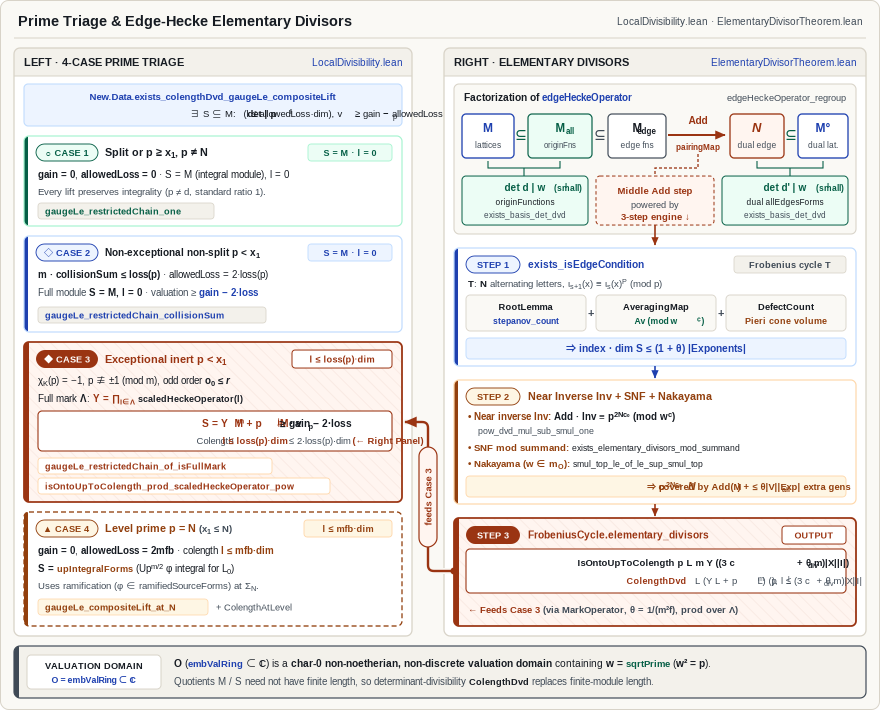
How do you bound the colength of a complicated operator when you cannot compute its Smith normal form by hand? Stage 03 uses a three-step near inverse strategy:
- Build a near inverse modulo
: Factor the operator through functions on edges as . Using a cyclic system of prime-power twisted embeddings with alternating actionsFrobenius cycle, construct an approximate right inverse—a near inverse Inv—satisfyingwhose outputs obey a tight module of congruences . - Factor out a direct summand and apply Nakayama: Apply elementary divisors relative to a split submodule (
exists_elementary_divisors_mod_summand) together with Nakayama's lemma (smul_top_le_of_le_sup_smul_top). Becauseleaves room for only a small fraction of extra generators modulo the maximal ideal, lies inside the span of plus at most extra vectors. - Multiply colengths along the factorization: Bound the determinant loss at the two outer inclusions (
and ) and multiply the three colength factors ( colengthDvd_mul_mul_of_smul_top_le). Truncating moduloproduces New.FrobeniusCycle.elementary_divisors, which in turn builds the small-colength submoduleon which the integral-kernel transform pairing automorphic forms between two dual symmetry groupstheta correspondence obeys its non-archimedean local size bound tracking divisibility at every adelic pointWeyl gauge at every prime ( exists_colengthDvd_gaugeLe_compositeLift).
Limits of the intuition
Thinking of elementary divisors through classical Smith normal form over embValRing inside sqrtPrime (New.ColengthDvd replaces length with determinant divisibility without even assuming New.FrobeniusCycle.elementary_divisors does not show that every elementary divisor is small: a tiny exceptional fraction
Level 2 — Undergrad Bridge
Let embValRing = {z : ℂ | ‖ιₚ z‖ ≤ 1} for a chosen place embValRing is non-noetherian and non-discrete, and sqrtPrime (New.Reduction.Lattices.Colength):
This predicate requires neither bases nor the inclusion ColengthDvd.trans), pushes forward and pulls back along linear maps, and reduces to classical relative length when ColengthDvd.relLength_le). An endomorphism IsOntoUpToColength p M n y c if
Elementary divisors modulo a direct summand (
New.exists_elementary_divisors_mod_summand): Over a valuation domain, let admit a left inverse ( ), so is a direct summand of , and let . Applying Smith normal form to yields and scalars such that whenever , and Near inverse, Nakayama, and multiplicative colength (
New.colengthDvd_mul_mul_of_smul_top_le): Supposewhere for a non-unit , both and take values in a congruence module at every , and . Applying exists_elementary_divisors_mod_summandtoand counts the nonzero dividing : by residue-field independence ( card_add_card_le_mul_finrank), at mostcolumns can survive modulo . Nakayama's lemma ( smul_top_le_of_le_sup_smul_top) removes theremainder, producing a finite set with and . Multiplying on the left and right by square matrices (representing the boundary inclusions and ) and adding gives Elementary divisors of the edge Hecke operator (
New.FrobeniusCycle.elementary_divisors): In the polynomial-representation setting on symmetric powers of(Green 1980), let be a Frobenius cycle with letters, prime , and residue field size . Under T.IsLargeDegree k n r θ(, , , ), take and with ( , so ). Each boundary inclusion contributes at most per dimension in -valuation (so in -valuation; together ), while contributes ( mul_multinomialExponent_le_divisorConstant). Thus any operatorintertwined with along satisfies Four-case local divisibility theorem (
New.Data.exists_colengthDvd_gaugeLe_compositeLift): At every prime, Stage 03 synthesizes a submodule over embValRingandwith such that every ramified source form lifts under compositeLift ϑ Ψ(for) to gauge : - Case 1 (
and , i.e., split or ): ( D.integralSourceForms),, . - Case 2 (non-exceptional small nonsplit
, including ramified ): , , collisions already absorbed into . - Case 3 (exceptional inert
): choose a full mark , set , and combine gaugeLe_compositeLift_of_isFullMarkwithisOntoUpToColength_prod_scaledHeckeOperator_pow(proved viaelementary_divisors), giving. - Case 4 (level prime
, where so ): is the pullback of D.upIntegralForms(integral for ), with ( exists_colengthDvd_upIntegralForms_pow) and level-prime budget.
- Case 1 (
Level 3 — Formal Lean Contract
Stage 03 extracts the abstract elementary-divisor machinery into skeleton/03_upper_bound/elementary_divisor_theorem.lean (from upstream src/New/UpperBound/ElementaryDivisors/ElementaryDivisorTheorem.lean) and its local-divisibility consumer into skeleton/03_upper_bound/local_divisibility.lean (from upstream src/New/UpperBound/Divisibility/LocalDivisibility.lean):
03_upper_bound/elementary_divisor_theorem.lean#New.exists_elementary_divisors_mod_summand(upstreamsrc/New/UpperBound/ElementaryDivisors/ElementaryDivisorTheorem.lean:63-102):leanlemma New.exists_elementary_divisors_mod_summand {O E : Type*} [CommRing O] [IsDomain O] [ValuationRing O] [Fintype E] [DecidableEq E] {K : Type*} [Fintype K] [DecidableEq K] {Q : Matrix K E O} {R : Matrix E K O} (hR : R * Q = 1) (A : Matrix K E O) : ∃ (U : GL K O) (t : K → O), (∀ j : K, t j ≠ 0 → R *ᵥ U.val.col j = 0) ∧ Q.mulVecLin.range ⊔ A.mulVecLin.range = Q.mulVecLin.range ⊔ span O (Set.range fun j : K ↦ t j • U.val.col j)03_upper_bound/elementary_divisor_theorem.lean#New.colengthDvd_mul_mul_of_smul_top_le(upstreamsrc/New/UpperBound/ElementaryDivisors/ElementaryDivisorTheorem.lean:233-253):leanlemma New.colengthDvd_mul_mul_of_smul_top_le (d' A d : Matrix E E O) {a : O} {s : Finset (E → O)} (h_le : a • (⊤ : Submodule O (E → O)) ≤ A.mulVecLin.range ⊔ span O (s : Set (E → O))) (z : O) : ColengthDvd ⊤ ((d' * A * d).mulVecLin.range ⊔ z • ⊤) (d'.det * (a ^ Fintype.card E * (d.det * z ^ #s)))03_upper_bound/elementary_divisor_theorem.lean#New.FrobeniusCycle.elementary_divisors(upstreamsrc/New/UpperBound/ElementaryDivisors/ElementaryDivisorTheorem.lean:1159-1215):leantheorem New.FrobeniusCycle.elementary_divisors {N k n : ℕ} {W O : Type} [NeZero N] [CommRing W] [IsLocalRing W] [CommRing O] [IsDomain O] [ValuationRing O] [CharZero O] (T : FrobeniusCycle N W O) {X : Type*} [Fintype X] (hp : ¬IsUnit (T.p : O)) {r : ℕ} {θ : ℝ} (h_large : T.IsLargeDegree k n r θ) {H : Type*} {I M : Type} [Fintype H] [DecidableEq H] [Fintype (ParahoricCosets W k r)] [Fintype I] [AddCommGroup M] [Module O M] (J : I ≃ Exponents N k n × H) (𝓔 : EdgeCoordinates W O k r X H) (f : (X → I → O) →ₗ[O] M) {Y : End O M} (hY : Y ∘ₗ f = f ∘ₗ T.edgeHeckeOperator n J 𝓔) (m : ℕ) : IsOntoUpToColength (T.p : O) f.range m Y ((3 * T.divisorConstant k n r + θ * m) * (Nat.card X * Nat.card I))03_upper_bound/local_divisibility.lean#New.Data.exists_colengthDvd_gaugeLe_compositeLift(upstreamsrc/New/UpperBound/Divisibility/LocalDivisibility.lean:404-481):leantheorem New.Data.exists_colengthDvd_gaugeLe_compositeLift {P : Parameters} {D : Data P} {p : ℕ} [hp : Fact p.Prime] [PadicPlace p] : ∃ (l : ℕ) (S : Submodule embValRing D.SourceForm), l ≤ D.allowedLoss p * finrank ℂ D.SourceForm ∧ ColengthDvd D.integralSourceForms S (p ^ l) ∧ ∀ (ϑ : D.Twist) (Ψ : D.Translations →₀ ℂ), IsChainDatum ϑ Ψ → p.Coprime ϑ.normQ → ∀ φ ∈ S, φ ∈ D.ramifiedSourceForms → GaugeLe 1 (p ^ (D.allowedLoss p - D.gain p)) (compositeLift ϑ Ψ φ)
Notice how the valuation-domain design keeps New.ColengthDvd completely uniform across non-noetherian embValRing and discrete valuation rings alike, allowing elementary_divisors to plug straight into exists_colengthDvd_gaugeLe_compositeLift. See the page's live verification banner (audit/verification-status.json) for the currently pinned upstream snapshot and local Lean build status (build_status: unverified-locally).
Where this analogy breaks
Picturing elementary divisors as the diagonal entries of Smith normal form over embValRing inside sqrtPrime (New.ColengthDvd; New.FrobeniusCycle.elementary_divisors does not bound every elementary divisor uniformly, allowing a small exceptional proportion New.nearInverse satisfying
Formal Lean Anchors
lemma New.exists_elementary_divisors_mod_summand — Upstream source (src/New/UpperBound/ElementaryDivisors/ElementaryDivisorTheorem.lean L63-L102)
/-- Let `O` be a valuation domain, let the matrix `Q` have the left inverse `R`, so that its image
is a direct summand of `O ^ K`, and let `A` be a matrix of the same shape as `Q`. There are an
invertible matrix `U` and scalars `t j` such that the images of `Q` and `A` span the same module as
the image of `Q` and the vectors `t j • U.col j`, and `R` kills the columns of `U` with
`t j ≠ 0`. -/
lemma New.exists_elementary_divisors_mod_summand {O E : Type*} [CommRing O] [IsDomain O]
    [ValuationRing O] [Fintype E] [DecidableEq E] {K : Type*} [Fintype K] [DecidableEq K]
    {Q : Matrix K E O} {R : Matrix E K O} (hR : R * Q = 1) (A : Matrix K E O) :
    ∃ (U : GL K O) (t : K → O),
      (∀ j : K, t j ≠ 0 → R *ᵥ U.val.col j = 0) ∧
      Q.mulVecLin.range ⊔ A.mulVecLin.range =
Q.mulVecLin.range ⊔ span O (Set.range fun j : K ↦ t j • U.val.col j) := by
sorry -- [EXTRACTED_STUB upstream=src/New/UpperBound/ElementaryDivisors/ElementaryDivisorTheorem.lean:63-102 commit=41c2716658c42ba08eb0648994a2efe83082a95c body_lines=29 body_sha256=a98b096e3a65717940d0ee72ebfeb07c239b3e189adf59d787491850ecbc795d]lemma New.colengthDvd_mul_mul_of_smul_top_le — Upstream source (src/New/UpperBound/ElementaryDivisors/ElementaryDivisorTheorem.lean L233-L253)
/-- The colengths add along a product. If `a • O ^ E` lies in the span of the image of `A` and of a
finite set `s`, then the colength of the image of `d' * A * d` plus `z • O ^ E` in `O ^ E` divides
`det d' * a ^ #E * det d * z ^ #s`. -/
lemma New.colengthDvd_mul_mul_of_smul_top_le (d' A d : Matrix E E O) {a : O} {s : Finset (E → O)}
    (h_le : a • (⊤ : Submodule O (E → O)) ≤ A.mulVecLin.range ⊔ span O (s : Set (E → O))) (z : O) :
    ColengthDvd ⊤ ((d' * A * d).mulVecLin.range ⊔ z • ⊤)
(d'.det * (a ^ Fintype.card E * (d.det * z ^ #s))) := by
sorry -- [EXTRACTED_STUB upstream=src/New/UpperBound/ElementaryDivisors/ElementaryDivisorTheorem.lean:233-253 commit=41c2716658c42ba08eb0648994a2efe83082a95c body_lines=15 body_sha256=c35428bb9d1f58a6542c3c201f4702676680caa46749758f99bd7f284a533bfa]theorem New.FrobeniusCycle.elementary_divisors — Upstream source (src/New/UpperBound/ElementaryDivisors/ElementaryDivisorTheorem.lean L1159-L1215)
/-- The theorem on elementary divisors. Let `O` be a valuation domain of characteristic zero and `T`
a Frobenius cycle with `N` letters, prime `p = T.p` and power `P = T.P` of `p`, so that the residue
field of `W` has `q = T.q = P ^ N` elements. Let `k` be the rank and `n` the degree in each letter,
and let `J` split the index set `I` into exponents and `H`. Let `p` be a non-unit of `O`, and let
`Y ∘ f = f ∘ A` for the edge Hecke operator `A` of the edges `𝓔` between the representatives `X`.
Let `0 < r ≤ k / 2`, `0 < θ ≤ 1`, `q ≥ n ^ 4` and `n ≥ (N k log q / θ) ^ 5 P ^ (3 r)`. Then `Y`
keeps the image `L` of `f`, and for every `m` the colength of `Y L + p ^ m L` in `L` divides `p ^ l`
for some `l ≤ (3 c_div + θ m) |X| |I|`, with `c_div = T.divisorConstant k n r`. -/
theorem New.FrobeniusCycle.elementary_divisors {N k n : ℕ} {W O : Type} [NeZero N] [CommRing W] [IsLocalRing W]
    [CommRing O] [IsDomain O] [ValuationRing O] [CharZero O] (T : FrobeniusCycle N W O)
    {X : Type*} [Fintype X] (hp : ¬IsUnit (T.p : O)) {r : ℕ} {θ : ℝ}
    (h_large : T.IsLargeDegree k n r θ) {H : Type*} {I M : Type} [Fintype H] [DecidableEq H]
    [Fintype (ParahoricCosets W k r)] [Fintype I] [AddCommGroup M] [Module O M]
    (J : I ≃ Exponents N k n × H) (𝓔 : EdgeCoordinates W O k r X H) (f : (X → I → O) →ₗ[O] M)
    {Y : End O M} (hY : Y ∘ₗ f = f ∘ₗ T.edgeHeckeOperator n J 𝓔) (m : ℕ) :
    IsOntoUpToColength (T.p : O) f.range m Y
((3 * T.divisorConstant k n r + θ * m) * (Nat.card X * Nat.card I)) := by
sorry -- [EXTRACTED_STUB upstream=src/New/UpperBound/ElementaryDivisors/ElementaryDivisorTheorem.lean:1159-1215 commit=41c2716658c42ba08eb0648994a2efe83082a95c body_lines=41 body_sha256=7a707d2bbb49198246422609a78905bec84efac3f7f0ac35fd0644611ab6a0a6]theorem New.Data.exists_colengthDvd_gaugeLe_compositeLift — Upstream source (src/New/UpperBound/Divisibility/LocalDivisibility.lean L404-L481)
/-- The divisibility at one prime. There are a natural number `l ≤ allowedLoss p * dim`, where `dim`
is the dimension of the space of source forms, and a module `S` of source forms whose integral
members have index dividing `p ^ l` in the integral source forms (`New.ColengthDvd`), such that for
every twist `ϑ` of level prime to `p` and every chain datum `Ψ` (`New.Data.IsChainDatum`) the
composite lift of a ramified source form in `S` has valuation at least `gain p - allowedLoss p`. -/
theorem New.Data.exists_colengthDvd_gaugeLe_compositeLift {P : Parameters} {D : Data P} {p : ℕ}
    [hp : Fact p.Prime] [PadicPlace p] :
    ∃ (l : ℕ) (S : Submodule embValRing D.SourceForm),
      l ≤ D.allowedLoss p * finrank ℂ D.SourceForm ∧
      ColengthDvd D.integralSourceForms S (p ^ l) ∧
      ∀ (ϑ : D.Twist) (Ψ : D.Translations →₀ ℂ), IsChainDatum ϑ Ψ → p.Coprime ϑ.normQ →
        ∀ φ ∈ S, φ ∈ D.ramifiedSourceForms →
GaugeLe 1 (p ^ (D.allowedLoss p - D.gain p)) (compositeLift ϑ Ψ φ) := by
sorry -- [EXTRACTED_STUB upstream=src/New/UpperBound/Divisibility/LocalDivisibility.lean:404-481 commit=41c2716658c42ba08eb0648994a2efe83082a95c body_lines=66 body_sha256=37a6f65f8d17418fbe0e266aac2401fb58a33d1bc6d0b1a47c581e0341a45656]Related Concepts
- prime number — A whole number greater than 1 whose only positive whole-number divisors are 1 and itself; every integer above 1 factors uniquely into a product of them.
- complex plane — The two-dimensional coordinate plane of numbers s = σ + it, where the horizontal coordinate σ = Re(s) sets decay rate and the vertical coordinate t = Im(s) sets oscillation frequency.
- Hecke operator — An averaging operator that sums values of an automorphic form over neighboring sublattices—indexed by cosets of a parahoric subgroup—which Stage 03 scales by powers of a prime to eliminate collision losses in the composite theta lift.
- Frobenius cycle — A cyclic ring of
Frobenius-twisted embeddings alternating between standard and contragredient actions of , whose Stepanov zero counts and Levi-invariant averaging yield low-dimension edge conditions modulo . - Weyl gauge — The p-adic coordinate norm of an algebraic modular form measured in the g-twisted Weyl lattice, paired with Galois-conjugate archimedean bounds to define B-short spanning sets and ramified source forms.
- theta correspondence — An integral transform built from a two-variable theta kernel that carries automorphic forms from one unitary group to another, iterated along a ladder of Hermitian spaces and packaged via admissible chain data.
Referenced By
- Stage: Prime-by-Prime Divisibility & Elementary Divisors of Edge Hecke Operators
- Stage: Stage 03 — Upper Bound: A Composite Theta Lift (Theorem A)
- Concept: Frobenius cycle
- Concept: Hecke operator
- Concept: Weyl gauge
Authoritative Sources
- Algebra, Chapter VII (book) — N. Bourbaki, Springer.
- Tag 07ZA — Fitting ideals and lengths (reference) — The Stacks Project Authors, Stacks Project.
- Polynomial Representations of GL_n (book) — J. A. Green, Lecture Notes in Mathematics 830, Springer (1980).
Page Glossary
- Hecke operator
- An averaging operator that sums values of an automorphic form over neighboring sublattices—indexed by cosets of a parahoric subgroup—which Stage 03 scales by powers of a prime to eliminate collision losses in the composite theta lift.
- complex plane
- The two-dimensional coordinate plane of numbers s = σ + it, where the horizontal coordinate σ = Re(s) sets decay rate and the vertical coordinate t = Im(s) sets oscillation frequency.
- prime number
- A whole number greater than 1 whose only positive whole-number divisors are 1 and itself; every integer above 1 factors uniquely into a product of them.
- Frobenius cycle
- A cyclic ring of $N$ Frobenius-twisted embeddings $W \to O$ alternating between standard and contragredient actions of $\mathrm{GL}_k(W)$, whose Stepanov zero counts and Levi-invariant averaging yield low-dimension edge conditions modulo $w^c$.
- theta correspondence
- An integral transform built from a two-variable theta kernel that carries automorphic forms from one unitary group to another, iterated along a ladder of Hermitian spaces and packaged via admissible chain data.
- Weyl gauge
- The p-adic coordinate norm of an algebraic modular form measured in the g-twisted Weyl lattice, paired with Galois-conjugate archimedean bounds to define B-short spanning sets and ramified source forms.