Hilbert–Schmidt norm
Also known as: Hilbert-Schmidt norm, near isometry, Welch bound, spreading property, greedy covering.
The Frobenius-style root-sum-of-squares norm on linear maps whose second moment over group translates, paired with near-isometry on the good subspace, proves Welch-style spreading and Wolsey greedy covering for Theorem B.
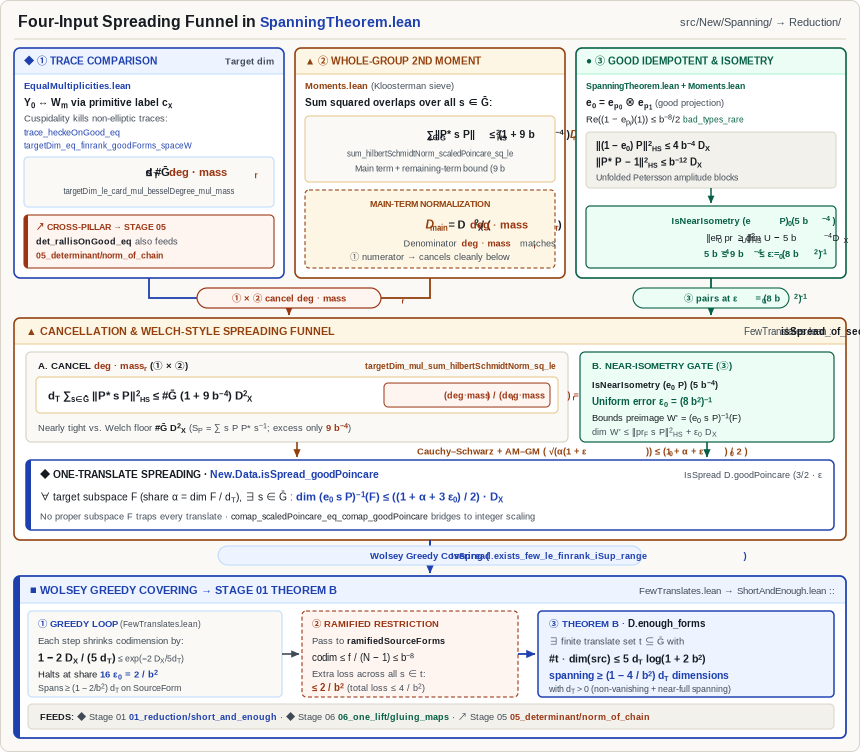
Level 1 — First-Principles
Given an
In Stage 04, this norm powers a three-step geometric funnel proving that a small batch of group translates of the Poincaré map
- Near isometry (
IsNearIsometry): Ifstays close to the identity matrix in squared Hilbert–Schmidt norm ( ) and cutting down to good target forms via a orthogonal projection selecting well-behaved cuspidal types from a finite group algebracentral idempotent loses at most , then the projected map preserves the squared energy of every subspace up to a tiny error: . This is the near isometry condition—it guarantees that never collapses large subspaces to zero. - Welch-type second moment and spreading (
IsSpread): Suppose a finite groupmoves the image of around unitarily. By Cauchy–Schwarz applied in the space of Hilbert–Schmidt operators, the sum has a universal floor—the matrix analogue of the Welch bound from signal processing and balanced overcomplete systems of vectors whose pairwise inner products minimize total squared overlaptight frame theory—equal to , where is the target dimension bounded by matching traces across spaces with different archimedean signaturestrace comparison. Stage 04 proves via unfolded Petersson block amplitudes over double cosetsBessel orbital integral that the actual second moment overshoots that theoretical floor by at most a factor . That near-tightness forces the spreading property: against any already-covered subspace occupying a fraction of the target space, at least one translate has preimage of of dimension at most , meaning it adds at least roughly brand-new dimensions outside . - Greedy covering (
FewTranslatesTheorem B): Once every partial subspace can be enlarged by a fixed fraction of its remaining codimension using a single translate, picking translates one by one—greedy covering—shrinks the missing dimension exponentially fast. Only about translates suffice to span all but a tiny fraction of the target space, feeding directly into Stage 01's squared parallelotope volume controlling the covolume of the target latticeGram determinant argument.
Limits of the intuition
Picturing the Hilbert–Schmidt norm second moment as spreading unit vectors evenly on a sphere so no hyperplane traps too many of them captures the exact Cauchy–Schwarz tension behind the Welch bound, but misses two architectural details of the Lean formalization. First, Stage 04 never spreads individual vectors: it spreads whole New.Data.isSpread_goodPoincare; the greedy covering loop New.IsSpread.exists_few_le_finrank_iSup_range lives in upstream FewTranslates.lean and is invoked in Stage 01 (ShortAndEnough.lean::New.Data.enough_forms), where restricting from SourceForm to ramifiedSourceForms adds an extra
Level 2 — Undergrad Bridge
For finite-dimensional complex inner-product spaces New.hilbertSchmidtVector A embeds a linear map
For any orthogonal projection
1. From Gram defect to near isometry (FewTranslates.lean, Moments.lean)
A map IsNearIsometry A ε if for every subspace
If IsNearIsometry A ε (isNearIsometry_of_hilbertSchmidtNorm_le). In Stage 04:
Moments.lean::hilbertSchmidtNorm_sub_one_sq_lebounds, giving IsNearIsometry P b⁻⁶(a fortiorib⁻⁴);Moments.lean::hilbertSchmidtNorm_one_sub_piTensorElem_comp_sq_lebounds; IsNearIsometry.proj_compadds the two errors to giveNew.Data.isNearIsometry_e₀_comp_scaledPoincare:IsNearIsometry (e₀ ∘ₗ P) (5 * b⁻⁴).
2. Welch-type Cauchy–Schwarz and one good translate (isSpread_of_second_moment)
Let inner_hilbertSchmidtVector_translate), the squared Hilbert–Schmidt norm of sq_sum_hilbertSchmidtNorm_orthoProj_comp_le):
Note the Welch-type floor (Welch 1974; Benedetto & Fickus 2003): taking
Letting IsNearIsometry (pr₀ ∘ₗ B) ε gives
Setting New.Data.isSpread_goodPoincare with spreading error
3. Wolsey greedy covering (FewTranslates.lean ShortAndEnough.lean)
By finrank_sup_range_add_finrank_comap, adding the image of
Level 3 — Formal Lean Contract
Stage 04 extracts the near-isometry, second-moment, and spreading theorems into skeleton/04_spanning/moments.lean and skeleton/04_spanning/spanning_theorem.lean:
04_spanning/moments.lean#New.Filling.HasAmplitudeBlocks.hilbertSchmidtNorm_sub_one_sq_le(upstreamsrc/New/Spanning/Unfolding/Moments.lean:473-512):leantheorem New.Filling.HasAmplitudeBlocks.hilbertSchmidtNorm_sub_one_sq_le [HasPrimitiveRoot5040 E] (hP : S.HasAmplitudeBlocks ρ P) : hilbertSchmidtNorm (P.adjoint ∘ₗ P - 1) ^ 2 ≤ S.sourceDim / S.b ^ 1204_spanning/spanning_theorem.lean#New.Data.isNearIsometry_e₀_comp_scaledPoincare(upstreamsrc/New/Spanning/SecondMoment/SpanningTheorem.lean:247-259):leantheorem New.Data.isNearIsometry_e₀_comp_scaledPoincare : IsNearIsometry ((D.principalRep (D.spaceY 0)).asAlgebraHom D.e₀ ∘ₗ D.scaledPoincare) (5 * (D.b ^ 4)⁻¹)04_spanning/spanning_theorem.lean#New.Data.sum_hilbertSchmidtNorm_scaledPoincare_sq_le(upstreamsrc/New/Spanning/SecondMoment/SpanningTheorem.lean:261-276):leantheorem New.Data.sum_hilbertSchmidtNorm_scaledPoincare_sq_le [Fintype D.chosenGL] : ∑ s : D.chosenGL, hilbertSchmidtNorm (D.scaledPoincare.adjoint ∘ₗ D.principalRep (D.spaceY 0) s ∘ₗ D.scaledPoincare) ^ 2 ≤ (1 + 9 / D.b ^ 4) * D.filling.mainSecondMoment04_spanning/spanning_theorem.lean#New.Data.isSpread_goodPoincare(upstreamsrc/New/Spanning/SecondMoment/SpanningTheorem.lean:327-359):leantheorem New.Data.isSpread_goodPoincare : IsSpread D.goodPoincare (3 / 2 * (8 * D.b ^ 2)⁻¹)
See the page's live <VerificationBanner /> (audit/verification-status.json) for the pinned upstream commit and local Lean build status (build_status: unverified-locally).
Where this analogy breaks
Picturing the Hilbert–Schmidt second moment as scattering unit vectors uniformly on a sphere so no hyperplane traps too many of them captures the exact Cauchy–Schwarz tension behind the Welch bound, but hides two structural details: Stage 04 spreads subspaces rather than single vectors—tracking the operator norm of P* s P across the finite product group Ḡ = G_{p_0} × G_{p_1}—and the greedy covering step (IsSpread.exists_few_le_finrank_iSup_range) lives in FewTranslates.lean and is consumed in Stage 01 (ShortAndEnough.lean::enough_forms), where restricting from SourceForm to ramifiedSourceForms costs an extra 2 / b^2 share on top of the 16 ε₀ = 2 / b^2 greedy miss.
Formal Lean Anchors
theorem New.Data.isNearIsometry_e₀_comp_scaledPoincare — Upstream source (src/New/Spanning/SecondMoment/SpanningTheorem.lean L247-L259)
/-- **Good forms.** The composite `e₀ P` of the scaled Poincaré map `P = D.scaledPoincare` with the
projector `e₀ = D.e₀` onto the good forms on `Y₀` is almost an isometry in mean square
(`IsNearIsometry`): `‖e₀ P pr_U‖² ≥ dim U - 5 b⁻⁴ D_X` for every subspace `U` of the source. Here
`‖·‖` is the Hilbert–Schmidt norm, `pr_U` the orthogonal projection onto `U`, `b = D.b`, and `D_X`
is the dimension of the source. -/
theorem New.Data.isNearIsometry_e₀_comp_scaledPoincare :
IsNearIsometry ((D.principalRep (D.spaceY 0)).asAlgebraHom D.e₀ ∘ₗ D.scaledPoincare)
(5 * (D.b ^ 4)⁻¹) := by
sorry -- [EXTRACTED_STUB upstream=src/New/Spanning/SecondMoment/SpanningTheorem.lean:247-259 commit=41c2716658c42ba08eb0648994a2efe83082a95c body_lines=6 body_sha256=ca24fdea94ef6c1f242774fcdb2ba9ce3f730e20e2c39e32446fd7129fc7c783]theorem New.Data.sum_hilbertSchmidtNorm_scaledPoincare_sq_le — Upstream source (src/New/Spanning/SecondMoment/SpanningTheorem.lean L261-L276)
/-- **Second moment.** For the scaled Poincaré map `P = D.scaledPoincare`, the sum over `s` in
`Ḡ = D.chosenGL` of the squared Hilbert–Schmidt norm `hilbertSchmidtNorm` of `P* s P` is at most
`1 + 9 b⁻⁴` times `D.filling.mainSecondMoment = D_X² / (deg · mass_r)`, where `D_X` is the dimension
of the source. -/
theorem New.Data.sum_hilbertSchmidtNorm_scaledPoincare_sq_le [Fintype D.chosenGL] :
∑ s : D.chosenGL,
hilbertSchmidtNorm (D.scaledPoincare.adjoint ∘ₗ D.principalRep (D.spaceY 0) s ∘ₗ
D.scaledPoincare) ^ 2 ≤
(1 + 9 / D.b ^ 4) * D.filling.mainSecondMoment := by
sorry -- [EXTRACTED_STUB upstream=src/New/Spanning/SecondMoment/SpanningTheorem.lean:261-276 commit=41c2716658c42ba08eb0648994a2efe83082a95c body_lines=8 body_sha256=7831b805982044ba2ea62fac0567986c480e11de56c059ca341e0c375a29a2d8]theorem New.Data.isSpread_goodPoincare — Upstream source (src/New/Spanning/SecondMoment/SpanningTheorem.lean L327-L359)
/-- **One translate.** For `s` in the finite group `Ḡ = D.chosenGL`, the map `D.goodPoincare s` is
`#Ḡ · e₀ s Π`: the unscaled Poincaré map `Π = D.poincare` from the source forms `D.SourceForm` to
the forms on `Y₀`, then the translation by `s`, then the projector `e₀ = D.e₀` onto the target
forms. These maps spread (`IsSpread`): for every space `F` of target forms, with share `α` of the
dimension of the target, the preimage of `F` under one of them has dimension at most
`(1 + α + 3 ε₀) / 2 · D_X`, where `ε₀ = b⁻² / 8`. Here `b = D.b` is the weight at the places
`D.bPlaces`, and `D_X` is the dimension of `D.SourceForm`. -/
theorem New.Data.isSpread_goodPoincare : IsSpread D.goodPoincare (3 / 2 * (8 * D.b ^ 2)⁻¹) := by
sorry -- [EXTRACTED_STUB upstream=src/New/Spanning/SecondMoment/SpanningTheorem.lean:327-359 commit=41c2716658c42ba08eb0648994a2efe83082a95c body_lines=26 body_sha256=af0fb7810d379fd82e20ac4ced3abb6d23a04dd111d7df57e41007f4b0ca3cf3]theorem New.Filling.HasAmplitudeBlocks.hilbertSchmidtNorm_sub_one_sq_le — Upstream source (src/New/Spanning/Unfolding/Moments.lean L473-L512)
/-- **Near isometry.** Let `S` be admissible filling data for a unitary group `G` over the CM field
`E`, which contains a primitive `5040`-th root of unity, and let `Ḡ = S.ResidueGL` be the product of
the general linear groups over the residue fields at the chosen places above the two level primes
`p₀`, `p₁`. The source is the Euclidean space with coordinates `(c, i)`, where `c` is a class (a
double coset of the definite unitary group `U(X₀)` for the level) and `i` is a coordinate of the
Bessel function `W` at the infinite places. Let `ρ` be a representation of `Ḡ` on `V` and `P` a
linear map from the source to `V`. Suppose `HasAmplitudeBlocks`: the block `(c, c')` of
`P_s = P* ρ(s) P` is the conjugate of `A(c, s, c') / ν`, where `ν = S.unipotentCovolume > 0` and
`A(c, s, c')` is the sum, over the rational `γ` in `G` such that `h_c⁻¹ γ h_c'` is integral with
reduction `s`, of an integral of `W(y) ⊗ W(γ⁻¹ y)^*` against cutoffs (`h_c` represents the class
`c`). Then `‖P* P - 1‖² ≤ b⁻¹² D_X` in Hilbert–Schmidt norm, where `D_X = S.sourceDim` is the
dimension of the source and `b = S.b ≥ 1000` is the size parameter of `S`. -/
theorem New.Filling.HasAmplitudeBlocks.hilbertSchmidtNorm_sub_one_sq_le [HasPrimitiveRoot5040 E]
    (hP : S.HasAmplitudeBlocks ρ P) :
hilbertSchmidtNorm (P.adjoint ∘ₗ P - 1) ^ 2 ≤ S.sourceDim / S.b ^ 12 := by
sorry -- [EXTRACTED_STUB upstream=src/New/Spanning/Unfolding/Moments.lean:473-512 commit=41c2716658c42ba08eb0648994a2efe83082a95c body_lines=26 body_sha256=0a619e16d586335958b521a133657dfbdaebb8cc36083a34d8f49bf9d7b2bafc]Related Concepts
- tight frame — A balanced, possibly overcomplete family of vectors with integer multiplicities whose projections reconstruct the exact standard inner product—allowing integral root-of-unity spokes to pull back one-dimensional elliptic theta sections into high-dimensional integral theta functions.
- Gram determinant — The determinant of the matrix of pairwise inner products of a family of vectors, measuring the squared volume of the parallelotope they span and controlled by Hadamard's and Fischer's inequalities.
- central idempotent — A class-function element of a finite group algebra satisfying z² = z that acts as a G-equivariant orthogonal projection, splitting good cuspidal types from rare bad types across two level primes.
- trace comparison — Matching traces of spherical Hecke operators between an indefinite unitary group and its definite inner form via a cuspidal local test function—proving equal eigensystem multiplicities, Rallis determinant equality, and the target-dimension bound.
- Bessel orbital integral — An archimedean correlation integral ∫ β_c(y) β_{c'}(γ⁻¹ y) W(y) ⊗ W(γ⁻¹ y)* dy unfolding Petersson inner products P* ρ(s) P into class-indexed amplitude blocks.
Referenced By
- Stage: Relative-Trace Unfolding, Bessel Translates, and the Two Moment Bounds
- Stage: Stage 04 — Spanning: Second Moment (Theorem B)
- Stage: Target Dimension, Multiplicity Equality, and One Good Translate
- Concept: Bessel orbital integral
- Concept: central idempotent
- Concept: trace comparison
Authoritative Sources
- Lower bounds on the maximum cross correlation of signals (paper) — L. R. Welch, IEEE Trans. Inform. Theory 20 (1974), 397–399.
- An analysis of the greedy algorithm for the submodular set covering problem (paper) — L. A. Wolsey, Combinatorica 2 (1982), 385–393.
- Finite normalized tight frames (paper) — J. J. Benedetto & M. Fickus, Adv. Comput. Math. 18 (2003), 357–385.
Page Glossary
- central idempotent
- A class-function element of a finite group algebra satisfying z² = z that acts as a G-equivariant orthogonal projection, splitting good cuspidal types from rare bad types across two level primes.
- tight frame
- A balanced, possibly overcomplete family of vectors with integer multiplicities whose projections reconstruct the exact standard inner product—allowing integral root-of-unity spokes to pull back one-dimensional elliptic theta sections into high-dimensional integral theta functions.
- trace comparison
- Matching traces of spherical Hecke operators between an indefinite unitary group and its definite inner form via a cuspidal local test function—proving equal eigensystem multiplicities, Rallis determinant equality, and the target-dimension bound.
- Bessel orbital integral
- An archimedean correlation integral ∫ β_c(y) β_{c'}(γ⁻¹ y) W(y) ⊗ W(γ⁻¹ y)* dy unfolding Petersson inner products P* ρ(s) P into class-indexed amplitude blocks.
- Gram determinant
- The determinant of the matrix of pairwise inner products of a family of vectors, measuring the squared volume of the parallelotope they span and controlled by Hadamard's and Fischer's inequalities.