Hecke L-value ratio
Also known as: critical pair, ramified pair, main pair, quotient ratio, turn ratio, partial Hecke L-value.
The ratio |L^S(z, (nu * theta^s)^-1)| / |L^S(z, nu^-1)| of twisted to untwisted partial Hecke L-values at a critical pair (nu, z), tracking how Siegel–Weil exchange constants scale under twisting across chain quotients and grid turns.
Level 1 — First-Principles
Earlier in the proof, Stage 00 introduced global
To isolate how a twist
Two subclasses of critical pairs govern Theorem C:
- Ramified pairs (
IsRamified): Those whose tame part is nontrivial at every chosen place (and trivial off the chosen places). Under a regular twist familyregular twist family, every ramified pair's inverse ratio at( ) has global arithmetic heightarithmetic height at most . - Main pairs (
IsMainPair j): A sharper subset for each liftwith , tame part equal to (so every main pair is automatically a ramified pair, IsMainPair.isRamified), and weight close to the-th lift weight. These are the pairs whose rank-one theta lifts into a definite space of rank control the -value heights in Stage 06.
Why do these ratios appear twice in Stage 05?
- Quotient ratios in
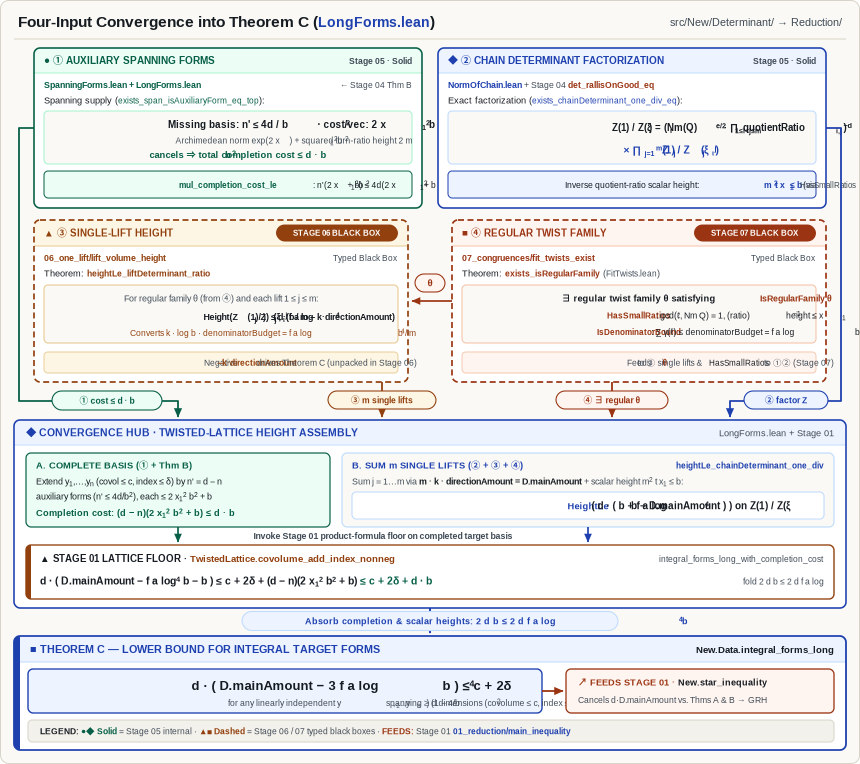
NormOfChain.lean: Slidinglifts past descents in the triangle of liftsRallis inner product formula multiplies quotient ratios D.quotientRatio i j(), each a product of critical ratios for at . Their inverse product has height at most . - Turn ratios in
LongForms.lean/SpanningForms.lean: Moving periods acrosssquares of the two-grid pathauxiliary spanning form multiplies turn ratios D.turnRatio i j(). Their inverse product also has height at most , and after squaring ( ) contributes at most to each auxiliary form's completion cost.
Limits of the intuition
Calling CriticalPair.ratio a simple ratio of two values of the same lValueProd. Second, Stage 05 bounds the height of the inverse ratio TwistedLattice.covolume_add_index_nonneg.
Level 2 — Undergrad Bridge
In Shimura (1978), Coates–Wiles (1977), and Harris (1997), critical values of Hecke
- Exact definition (
FitTwists.lean:78-84):CriticalPair.ratio p ϑ sis defined as the complex coercion of the real quotientInverting the character in the denominator does not change the modulus ( CriticalPair.L_inv). - Ramified pairs vs. main pairs (
IsRamified,IsMainPair,IsMainPair.isRamified): ACriticalPairhasand weight with . IsRamifiedrequires the tame partto be nontrivial iff is a chosen place (dividing D.piMof norm). IsMainPair jadds:HasLiftRank (RankOneIndex p.z)(splitting rankinto blocks with ); and ; p.tamePart = D.chiMLocal ^ (j : ℤ)(sinceD.chiMLocalhas orderat each chosen place, raising to stays nontrivial, proving IsMainPair.isRamified);at every infinite place .
- Height aggregation across
factors ( heightLe_inv_rpow_mul_prod_quotientRatio,heightLe_inv_rpow_mul_prod_turnRatio): BecauseHeightLeis additive under products and any integer powercontributes to the height at primes (it is an -adic unit at every with , and archimedean powers cancel with the coprime norm), each quotientRatio i j(, at most pairs) and each turnRatio i j(, exactly pairs) is a product of ramified ratios of height . Summing heights yields for both inverse products. Because while and , the scale inequality D.le_of_hasLogBoundcrushes both(for the chain determinant scalar in heightLe_chainDeterminant_one_div) and(for the squared auxiliary scalar in integral_forms_long_with_completion_cost).
Level 3 — Formal Lean Contract
Stage 05 anchors the critical-pair ratio contract across fit_twists.lean, norm_of_chain.lean, and long_forms.lean (all 5 anchors below extract untruncated):
05_determinant/fit_twists.lean#New.Data.CriticalPair.ratio(upstreamFitTwists.lean:78-84):leannoncomputable def New.Data.CriticalPair.ratio (p : D.CriticalPair) (ϑ : D.TameChar) (s : ℤˣ := 1) : ℂ05_determinant/fit_twists.lean#New.Data.CriticalPair.IsRamified(upstreamFitTwists.lean:116-120) and05_determinant/fit_twists.lean#New.Data.CriticalPair.IsMainPair(upstreamFitTwists.lean:122-140).05_determinant/norm_of_chain.lean#New.Data.HasSmallRatios.heightLe_inv_rpow_mul_prod_quotientRatio(upstreamNormOfChain.lean:437-453):leanlemma New.Data.HasSmallRatios.heightLe_inv_rpow_mul_prod_quotientRatio {D : Data P} {θ : PrimePadicIso → D.MFoldTwist} (hθ : D.HasSmallRatios θ) (e : ℤ) : HeightLe (D.m * D.m * (D.t * D.x₁)) fun ι : PrimePadicIso ↦ ((((θ ι).normQ : ℝ) ^ (e / 2 : ℝ) * ∏ i ∈ Ioc 0 D.m, ∏ j ∈ Ioc i D.m, D.quotientRatio i j (θ ι) : ℝ) : ℂ)⁻¹05_determinant/long_forms.lean#New.Data.HasSmallRatios.heightLe_inv_rpow_mul_prod_turnRatio(upstreamLongForms.lean:107-119):leanlemma New.Data.HasSmallRatios.heightLe_inv_rpow_mul_prod_turnRatio {θ : PrimePadicIso → D.MFoldTwist} (hθ : D.HasSmallRatios θ) (e : ℤ) : HeightLe (D.m * D.m * (D.t * D.x₁)) fun ι : PrimePadicIso ↦ ((((θ ι).normQ : ℝ) ^ (e / 2 : ℝ) * ∏ i ∈ Finset.range D.m, ∏ j ∈ Finset.range D.m, D.turnRatio i j (θ ι) : ℝ) : ℂ)⁻¹
See the page's live <VerificationBanner /> (audit/verification-status.json) for the pinned upstream commit and local Lean build status (build_status: unverified-locally).
Where this analogy breaks
Treating a Hecke L-value ratio as a quotient of two ordinary Dirichlet L-values at the same Euler product hides an asymmetric omission of Euler factors: the denominator omits the chosen places and their conjugates, whereas the numerator omits BOTH the chosen places and the twist places Q (and their conjugates). Moreover, Stage 05 never bounds the ratio at a single prime in isolation; it bounds the global arithmetic height of the INVERSE ratio across all prime embeddings iota via HasSmallRatios.
Formal Lean Anchors
def New.Data.CriticalPair.ratio — Upstream source (src/New/Determinant/Twist/FitTwists.lean L78-L84)
/-- For a pair `p = (ν, z)`, a tame character `ϑ` and a sign `s` (by default `1`), the ratio
`|L(z, (ν ϑ^s)⁻¹)| / |L(z, ν⁻¹)|`, as a complex number. Both L-functions omit the Euler factors at
the chosen places and their conjugates. The numerator also omits those at the places `Q` of `ϑ` and
their conjugates. -/
noncomputable def New.Data.CriticalPair.ratio (p : D.CriticalPair) (ϑ : D.TameChar) (s : ℤˣ := 1) : ℂ := by
sorry -- [EXTRACTED_STUB upstream=src/New/Determinant/Twist/FitTwists.lean:78-84 commit=41c2716658c42ba08eb0648994a2efe83082a95c body_lines=2 body_sha256=8e4f4d61bb709f370996ea32e985b78c3e692fd48b17dae6f42a5a35b0737728]def New.Data.CriticalPair.IsRamified — Upstream source (src/New/Determinant/Twist/FitTwists.lean L116-L120)
/-- A pair `p = (ν, z)` is ramified if the tame part `ψ` of `ν`, a character `ψ_w` of the residue
field at each finite place `w` of `E`, is nontrivial exactly at the chosen places, those dividing
the integer `D.piM` of norm `p₀ p₁` of the imaginary quadratic field `K`. -/
def New.Data.CriticalPair.IsRamified {D : Data P} (p : D.CriticalPair) : Prop := by
sorry -- [EXTRACTED_STUB upstream=src/New/Determinant/Twist/FitTwists.lean:116-120 commit=41c2716658c42ba08eb0648994a2efe83082a95c body_lines=1 body_sha256=9180177fc0714e936a99adb7f6b182029182ca8841eee4ec6fd8c956f74c4f5e]structure New.Data.CriticalPair.IsMainPair — Upstream source (src/New/Determinant/Twist/FitTwists.lean L122-L140)
/-- The pair `p = (ν, z)`, with `ν` of weight `-c`, is a main pair for `j`: the type
`RankOneIndex z` has `2 z` elements and `2 ≤ z` (`HasLiftRank`), `m < z ≤ r`, `1 ≤ j ≤ m`, the tame
part of `ν` is `D.chiMLocal ^ j`, and `w_j + r - t ≤ c ≤ w_j` at every infinite place. Here
`m = D.m` is the number of lifts, `r = D.r` the rank of the spaces `W_j` and `t = D.t = 5 r`;
`D.chiMLocal` is the fixed family of residue characters that is trivial off the chosen places, and
`w_j = D.liftWeight j` is minus the weight of the character of the `j`-th lift. -/
structure New.Data.CriticalPair.IsMainPair {D : Data P} (p : D.CriticalPair) (j : ℕ) : Prop where
/-- The type `RankOneIndex z` has `2 z` elements, and `2 ≤ z`. -/
hasLiftRank : p.HasLiftRank (RankOneIndex p.z)
/-- The point satisfies `m < z ≤ r`. -/
z_mem : p.z ∈ Ioc D.m D.r
/-- The index satisfies `1 ≤ j ≤ m`. -/
j_mem : j ∈ D.LiftIndex
/-- The tame part of `ν` is `ω ^ j`, with `ω = D.chiMLocal`. -/
tamePart_eq : p.tamePart = D.chiMLocal ^ (j : ℤ)
/-- The upper bound `c ≤ w_j` at each infinite place. -/
negWeight_le (v : D.Φ) : p.negWeight v ≤ D.liftWeight j v
/-- The lower bound `w_j + r - t ≤ c` at each infinite place, written without subtraction. -/
le_negWeight (v : D.Φ) : D.liftWeight j v + D.r ≤ p.negWeight v + D.tlemma New.Data.HasSmallRatios.heightLe_inv_rpow_mul_prod_quotientRatio — Upstream source (src/New/Determinant/Chain/NormOfChain.lean L437-L453)
/-- Let `θ` be a family of twists indexed by the isomorphisms `ι : ℂ ≃ ℚ̄_l` for primes `l`, with
small ratios: `normQ (θ ι)`, the product of the norms of the places of the twist, is prime to `l`,
and for every ramified pair the inverse ratios of L-values at the powers `(θ ι) ^ (±j)`,
`1 ≤ j ≤ m`, have height at most `D.x₁`, the second cut-off of the data. Then the inverses of `normQ
^ (e / 2) * ∏_{1 ≤ i < j ≤ m} quotientRatio i j` at the `θ ι` form a family of height at most
`m² * D.t * D.x₁`. -/
lemma New.Data.HasSmallRatios.heightLe_inv_rpow_mul_prod_quotientRatio {D : Data P}
    {θ : PrimePadicIso → D.MFoldTwist} (hθ : D.HasSmallRatios θ) (e : ℤ) :
    HeightLe (D.m * D.m * (D.t * D.x₁)) fun ι : PrimePadicIso ↦
      ((((θ ι).normQ : ℝ) ^ (e / 2 : ℝ) *
∏ i ∈ Ioc 0 D.m, ∏ j ∈ Ioc i D.m, D.quotientRatio i j (θ ι) : ℝ) : ℂ)⁻¹ := by
sorry -- [EXTRACTED_STUB upstream=src/New/Determinant/Chain/NormOfChain.lean:437-453 commit=41c2716658c42ba08eb0648994a2efe83082a95c body_lines=7 body_sha256=315809a0804c6ac3ced4687eae63fb58f626676af9efb5abc708168f1051afe4]lemma New.Data.HasSmallRatios.heightLe_inv_rpow_mul_prod_turnRatio — Upstream source (src/New/Determinant/Twist/LongForms.lean L107-L119)
/-- Let `ξ_ι = θ ι` be a family of `m`-fold twists, one for each `ι : ℂ ≃ ℚ̄_l`. Assume the family
has small ratios: `Nm Q(ξ_ι) = (θ ι).normQ` is prime to `l`, and the inverse ratios of Hecke
L-values have height at most `x₁`. Let `e` be an integer. Then the inverse of the product of
`Nm Q(ξ_ι) ^ (e / 2)` and the `m²` numbers `D.turnRatio i j ξ_ι` (for `i, j < m`) has height at most
`m² t x₁`. -/
lemma New.Data.HasSmallRatios.heightLe_inv_rpow_mul_prod_turnRatio {θ : PrimePadicIso → D.MFoldTwist}
    (hθ : D.HasSmallRatios θ) (e : ℤ) :
    HeightLe (D.m * D.m * (D.t * D.x₁)) fun ι : PrimePadicIso ↦
      ((((θ ι).normQ : ℝ) ^ (e / 2 : ℝ) *
∏ i ∈ Finset.range D.m, ∏ j ∈ Finset.range D.m, D.turnRatio i j (θ ι) : ℝ) : ℂ)⁻¹ := by
sorry -- [EXTRACTED_STUB upstream=src/New/Determinant/Twist/LongForms.lean:107-119 commit=41c2716658c42ba08eb0648994a2efe83082a95c body_lines=4 body_sha256=5a80fbb9ca052bd9f6aee644f53b84f4dbc89d438fdf6e8bac9f8c2ca9eb4fed]Related Concepts
- Dirichlet L-function — The meromorphic continuation of ∑ χ(n) n⁻ˢ associated to a Dirichlet character χ, generalizing ζ(s) to track primes across residue classes modulo N.
- arithmetic height — A logarithmic measure combining ordinary archimedean size with prime-by-prime p-adic divisibility, locked together by the product formula so a nonzero algebraic quantity cannot be simultaneously small at every place.
- Siegel–Weil exchange — Comparing theta integrals to U(W) from two complementary-rank spaces V and V' on matched ramified matrix functions modulo m—agreeing up to a nonzero scalar c with |c|^2 = C * L_*(e).
- regular twist family — A prime-by-prime family of m-fold anticyclotomic twists theta(iota) with modulus coprime to l, inverse L-value ratios of height at most x_1, and lift/projection denominators summing within fa(log b)^3 / (m*k).
- Rallis inner product formula — Relating the squared norm (and Gram determinant) of a theta lift or m-step chain of lifts to spherical Hecke operators and single-lift determinants—factoring Z(theta)/Z(1) across m lifts up to quotient L-value ratios.
- auxiliary spanning form — A target form whose m-step lifts stay p-integral (after a shared twist scalar) and bounded in archimedean norm by exp(2x_1^2b^2), completing an almost-spanning family to a full basis of Y_0 at total cost at most d*b.
Referenced By
- Stage: Chain Determinant Factorization and Two-Grid Auxiliary Forms
- Stage: First-Order Ribet Denominator Bounds and Existence of Regular Twist Families
- Stage: Galois Main Summands and the Anticyclotomic Selmer Twisting Theorem
- Stage: Regular Twist Families and the Assembly of Theorem C
- Stage: Siegel–Weil Exchange and the Commuting Theta Square
- Stage: Stage 05 — Lower Bound: The Determinant (Theorem C, Part 1)
- Stage: Stage 06 — Lower Bound: One Lift (Theorem C, Part 2)
- Stage: Stage 07 — Lower Bound: Congruences & Galois Representations (Theorem C, Part 3)
- Stage: Three Exchanges, the Carrier Form, and Divided-Lattice Gluing
- Stage: Vanishing Periods of False Lifts and Negative Heights of Twisted L-Values
- Concept: anticyclotomic Selmer twisting
- Concept: auxiliary spanning form
- Concept: carrier form
- Concept: character theta lift
- Concept: Galois main summand
- Concept: idle direction repayment
- Concept: Rallis inner product formula
- Concept: regular twist family
- Concept: Siegel–Weil exchange
Authoritative Sources
- The special values of the zeta functions associated with Hilbert modular forms (paper) — G. Shimura, Duke Math. J. 45 (1978), 637–679.
- L-functions and periods of polarized regular motives (paper) — M. Harris, J. Reine Angew. Math. 483 (1997), 75–161.
- On the conjecture of Birch and Swinnerton-Dyer (paper) — J. Coates & A. Wiles, Invent. Math. 39 (1977), 223–251.
Page Glossary
- Dirichlet L-function
- The meromorphic continuation of ∑ χ(n) n⁻ˢ associated to a Dirichlet character χ, generalizing ζ(s) to track primes across residue classes modulo N.
- Siegel–Weil exchange
- Comparing theta integrals to U(W) from two complementary-rank spaces V and V' on matched ramified matrix functions modulo m—agreeing up to a nonzero scalar c with |c|^2 = C * L_*(e).
- regular twist family
- A prime-by-prime family of m-fold anticyclotomic twists theta(iota) with modulus coprime to l, inverse L-value ratios of height at most x_1, and lift/projection denominators summing within f*a*(log b)^3 / (m*k).
- arithmetic height
- A logarithmic measure combining ordinary archimedean size with prime-by-prime p-adic divisibility, locked together by the product formula so a nonzero algebraic quantity cannot be simultaneously small at every place.
- Rallis inner product formula
- Relating the squared norm (and Gram determinant) of a theta lift or m-step chain of lifts to spherical Hecke operators and single-lift determinants—factoring Z(theta)/Z(1) across m lifts up to quotient L-value ratios.
- auxiliary spanning form
- A target form whose m-step lifts stay p-integral (after a shared twist scalar) and bounded in archimedean norm by exp(2*x_1^2*b^2), completing an almost-spanning family to a full basis of Y_0 at total cost at most d*b.