Full Proof Journey & Alpöge's 20-Step Map
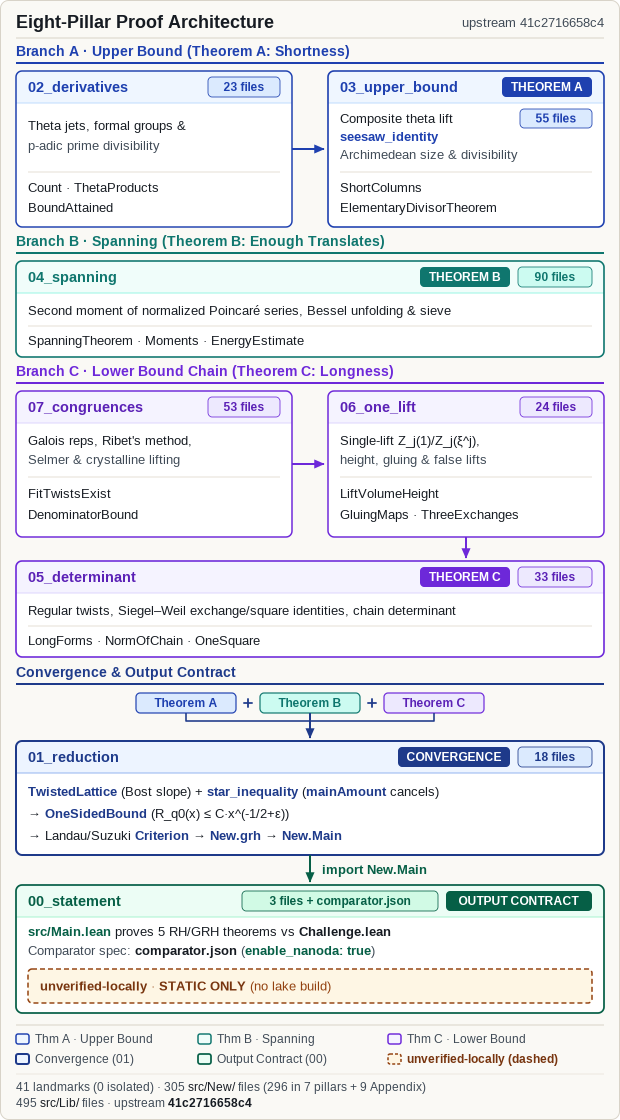
This guide maps the complete architecture of the Lean 4 formalization in leanprover-community/riemann-hypothesis (main@41c2716658c4, the November 25, 2026 condensed readable edition). It bridges the formal statement contracts of Stage 00 to the seven proof pillars (01_reduction through 07_congruences) in src/New/, and reconciles the condensed eight-pillar layout with Levent Alpöge's original 20-step development roadmap (alpo.ge/remark.pdf). Local Lean compilation remains unverified-locally; every theorem name and dependency edge below is extracted statically from the pinned upstream commit.
Level 1 — First-Principles
To settle the Riemann Hypothesis and the Generalized Riemann Hypothesis, the formalization does not hunt for individual zeros of the global function
A classical one-sided principle connects prime deviations to zeros in the two-dimensional grid of points
How can a proof force an upper bound on a prime-counting error term? The core engine constructs a finite-dimensional grid of algebraic objects — a matrix whose entries record both geometric sizes and prime-power divisibility — and traps the prime deviation inside a three-way tension between three theorems:
- Theorem A — Shortness (Upper Bound): A family of carefully chosen "source" functions is lifted through a chain of
steps into a target space. Each derivative along the chain picks up guaranteed divisibility by prime powers proportional to the prime-counting sum, while its overall geometric size stays controlled. Dividing out that guaranteed prime divisibility shrinks the lifted vectors: the more primes pile up above expectation (making the remainder large), the shorter these lifted vectors become. - Theorem B — Enough Translates (Spanning): A handful of short vectors alone could all point in nearly the same direction and hide inside a tiny subspace. Theorem B proves that a small number of shifted copies of the lifted source functions spread out cleanly and span almost the entire target space, leaving almost no room for degenerate collapse.
- Theorem C — Longness (Lower Bound): A basic arithmetic law — the balance law saying that a nonzero integer cannot simultaneously be tiny in ordinary size and divisible by huge prime powersarithmetic height — sets a rigid floor on the combined volume (determinant) of any spanning set of integral vectors. Theorem C proves that any spanning family of integral target functions has total volume at least a baseline called the "main amount."
When Theorems A, B, and C meet inside the main inequality, the large baseline ("main amount") cancels out on both sides. What survives is an upper ceiling on
To build those three ingredients without undefined gaps, the formalization relies on four deeper machines treated here as honestly typed input/output black boxes (unpacked stage by stage in Stages 01–07):
- Theta derivatives and formal groups (
02_derivatives): Input: a cyclotomic CM fieldand derivative orders up to . Output: exact -adic divisibility bounds on Taylor coefficients ("jets") of theta functions that count inert primes weighted by . - Composite theta lifts and seesaw identities (
03_upper_bound,04_spanning): Input: algebraic modular forms on definite unitary groups and Poincaré series translates. Output: an-step chain map whose divisibility and archimedean size establish Theorem A, paired with a second-moment estimate establishing Theorem B. - Single-lift volume heights and gluing (
05_determinant,06_one_lift): Input: regular families of anticyclotomic twists of the-step chain. Output: exact determinant factorization and height bounds for the cost of one lift, overcoming a naive exponent barrier via twist averaging and gluing maps. - Galois representations, Selmer groups, and
-adic lifting ( 07_congruences): Input: Hecke eigensystems and congruence data at auxiliary primes. Output: existence of regular-fold twist families whose congruence denominators stay small enough to keep Theorem C's lower bound sharp.
Together with the Stage 00 contract checked by machine-checking every logical step in a computer kernel against explicit axiomsformal verification, these eight pillars form one funnel from prime-counting mechanics at the bottom to the five headline theorems at the top.
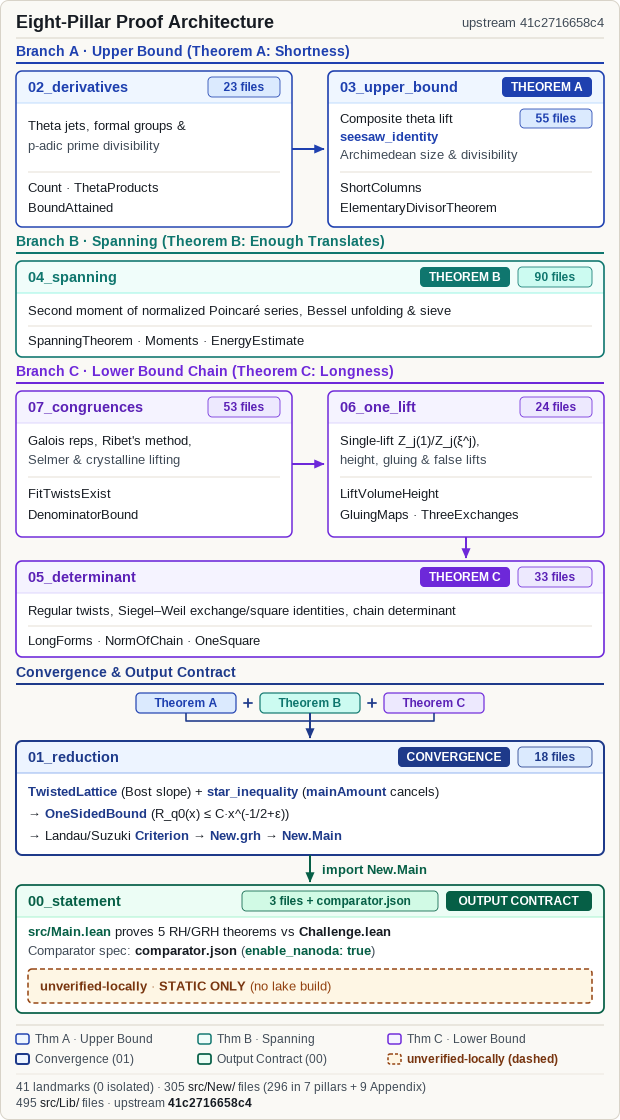
View full resolution: Open eight-pillar architecture diagram (SVG).
Where this analogy breaks
Thinking of Theorems A, B, and C as packing short sticks into a box whose volume cannot shrink below an arithmetic floor captures the exact cancellation logic of star_inequality. The analogy breaks in two decisive ways. First, there is no single Euclidean box: the "shortness" and "longness" bounds live simultaneously across ordinary complex norms (archimedean places) and 05–07, the "cost" of each lift would stall at an exponent of
Level 2 — Undergrad Bridge
The Eight Mathematical Pillars (src/New/)
In the November 25, 2026 condensed readable edition (riemann-hypothesis@41c2716658c4), the proof argument lives across 305 files in src/New/ (organized into 7 proof pillars plus a 9-file discrete-series supplement in src/New/Appendix/), sitting atop 495 background-theory files in src/Lib/ and feeding the 3 Stage 00 entry files (src/Statements.lean, Challenge.lean, src/Main.lean). As GUIDE.md notes, folders track the order of the mathematical argument rather than strict acyclic layers, while the extracted 41-landmark DAG in dag/dag.json projects dependencies to an acyclic cross-pillar graph with zero isolated nodes.
| Order | Stage ID | Upstream Scope | Files | Role & Verified Headline Theorems (41c2716658c4) | Explainer Coverage |
|---|---|---|---|---|---|
| 0 | 00_statement | src/Statements.lean, Challenge.lean, src/Main.lean | 3 | Locks the Mathlib-only RH/GRH contracts and discharges all 5 entry theorems (riemannHypothesis, riemannZeta_eq_zero_re, LFunction_ne_zero_of_half_lt_re, LFunction_eq_zero_re, LFunction_eq_zero_re_of_isPrimitive) via New.Main. | Live in Stage 00 |
| 1 | 01_reduction | src/New/Main.lean + src/New/Reduction/ | 18 | Fixes admissible parameters (TwistedLattice.covolume_add_index_nonneg), states Theorems A & B (D.span_short_integralRamified_eq_top, D.indexLe_normalizedPoincare, D.enough_forms), combines them with Theorem C in star_inequality, proves the one-sided bound New.eventually_primeRemainder_le_mul_rpow, and derives New.grh via Landau/Suzuki's criterion (New.LFunction_ne_zero_of_primeRemainder_le) and functional-equation reflection (New.zeros_on_line, New.zeta_zeros_on_line). | Live in Stage 01 |
| 2 | 02_derivatives | src/New/Derivatives/ | 23 | Develops CM-field prime decomposition, formal-group Frobenius congruences, tight frames, the integral vacuum exists_hasNormalForm, norm_jet_minorProd_le_of_hasNormalForm, exists_norm_schurJet_le_norm_jet_minorProd, isVacuumScale_vacuumScale, exists_rpow_neg_localPrimeSumTotal_le_norm_coeff). | Live in Stage 02 |
| 3 | 03_upper_bound | src/New/UpperBound/ | 55 | Builds definite unitary theta kernels, source/target forms, the iterated seesaw identity (D.seesaw_identity), prime-by-prime divisibility (LocalDivisibility), elementary-divisor bounds via Stepanov's count (ElementaryDivisorTheorem), and archimedean size estimates (ArchimedeanSize, ShortColumns) feeding Theorem A. | Live in Stage 03 |
| 4 | 04_spanning | src/New/Spanning/ | 90 | Proves multiplicity equality between spaces differing at infinity (EqualMultiplicities), Bessel cut-tail bounds, Petersson second-moment unfolding (Moments), main-term sieve (EnergyEstimate), and remaining-term bounds (Sum) yielding Theorem B (D.isSpread_goodPoincare, SpanningTheorem). | Live in Stage 04 |
| 5 | 05_determinant | src/New/Determinant/ | 33 | Defines regular FitTwists), Siegel–Weil exchange and square-commutation identities (TheoremForPartners, OneSquare), chain determinant factorization (NormOfChain), auxiliary spanning forms (SpanningForms), and Theorem C (D.integral_forms_long). | Live in Stage 05 |
| 6 | 06_one_lift | src/New/OneLift/ | 24 | Bounds the height cost of a single lift D.heightLe_liftDeterminant_ratio in LiftVolumeHeight), using three exchanges (ThreeExchanges), gluing maps (GluingMaps), periods of false lifts (PeriodsOfFalseLifts), and rank-one theta-lift heights of twisted Hecke TwistedValueHeights). | Live in Stage 06 |
| 7 | 07_congruences | src/New/Congruences/ | 53 | Proves regular twist families exist (New.exists_isRegularFamily in FitTwistsExist): attaches conjugate self-dual Galois representations (RowsFromEigensystems), applies first-order Ribet's method (DenominatorBound), bounds anticyclotomic Selmer groups (TwistingTheorem), and controls local crystalline loss (CrystallineDefect, CupOrthogonalityBounds). | Live in Stage 07 |
(Outside the 7 primary src/New/ pillars sit 9 files in src/New/Appendix/DiscreteSeries/ proving Laplace-method lower bounds for steep discrete-series periods, and 495 literature-background files in src/Lib/ covering class field theory, étale/Hodge cohomology,
Alpöge's 20-Step Historical Journey Mapped to the 7 Condensed Pillars
Levent Alpöge's November 20, 2026 announcement (alpo.ge/remark.pdf, pp. 2–3) sketched the proof as 20 chronological milestones (from 01_stepanov_determinant through 20_grh). When the proof was condensed into the readable src/New/ architecture (41c2716658c4), most ideas carried over directly, while several early analytic and automorphic detours were simplified or replaced. The table below maps every original step honestly onto the live pillars:
| Step | Original Date | Alpöge's Original Step (remark.pdf, pp. 2–3) | Live Condensed Pillar(s) | Honest Alignment & Changes in 41c2716658c4 |
|---|---|---|---|---|
| 01 | 2026-10-06 | Stepanov determinant (01_stepanov_determinant) | 01_reduction, 03_upper_bound | Preserved & reframed: determinant size-vs-divisibility argument in TwistedLattice.lean and MainInequality.lean, plus Stepanov's polynomial count in UpperBound/ElementaryDivisors/RootLemma.lean. |
| 02 | 2026-10-09 | 02_derivatives | Preserved directly: Derivatives/FormalGroup/ThetaProducts.lean, Divisibility/Count.lean, Vacuum/IntegralVacuum.lean, and Sharpness/BoundAttained.lean. | |
| 03 | 2026-10-19+ | 03_upper_bound, 04_spanning (role only) | Replaced / Simplified: the sixfold cover of GUIDE.md, INDEX.md, CONTENTS.md). Automorphic construction runs directly via unitary dual-pair theta kernels and Poincaré series. | |
| 04 | 2026-10-06+ | Guinand–Weil variance positivity | 01_reduction | Replaced: no src/New/; replaced by TwistedLattice.covolume_add_index_nonneg feeding star_inequality. |
| 05 | 2026-10-20 | Switch to | 01_reduction | Partially replaced: retains the smoothed von Mangoldt prime sum weighted by PrimeSums.lean, Zeros/PrimeError.lean), while dropping the Guinand–Weil variance functional and Mehta-like integral in favor of the one-sided remainder |
| 06 | 2026-10-08 | Variance test function | 01_reduction | Replaced: replaced by the smoothed one-sided prime remainder Zeros/Criterion.lean::New.LFunction_ne_zero_of_primeRemainder_le) plus quadratic-twist zero avoidance (Lib/Analytic/QuadraticTwist.lean). |
| 07 | 2026-10-14 | Determinants containing GGP periods with interlacing or up to | 03_upper_bound, 04_spanning, 05_determinant (+ Appendix/) | Preserved & distributed: Bessel/GGP periods and branching weights across UpperBound/Objects/Weights.lean, Spanning/{Bessel,Unfolding}/, Determinant/AuxiliaryForms/LastPath.lean, and Appendix/DiscreteSeries/Periods.lean. |
| 08 | 2026-11-15 | Iterated theta lifts | 01_reduction, 03_upper_bound, 05_determinant | Preserved directly: Reduction/Data/Sizes.lean), definite upper chain UpperBound/Objects/Columns.lean), and lower chain Determinant/Chain/NormOfChain.lean). |
| 09 | 2026-11-15 | Lift norms, level | 01_reduction, 03_upper_bound (+ Lib/) | Preserved directly: exact cancellations of PrimeSums.lean, MainInequality.lean, UpperBound/Size/ArchimedeanSize.lean, and Lib/CM/ChowlaSelberg.lean. |
| 10 | 2026-11-15 | Sufficient | 03_upper_bound | Preserved directly: UpperBound/Divisibility/LocalDivisibility.lean, ElementaryDivisors/ElementaryDivisorTheorem.lean, and Size/ShortColumns.lean feeding Theorem A. |
| 11 | 2026-10-06 | Iwasawa tower by analogy with pigeonhole on | 01_reduction | Merged (with Step 19): folded into the cyclotomic tower data Reduction/Data/{FieldsAndPlaces,AdmissibleData,Existence}.lean. |
| 12 | 2026-11-15 | Seesaw identity: period of the iterated lift is a twist-independent Bessel period; Rallis formula | 03_upper_bound, 05_determinant | Preserved directly: UpperBound/Seesaw/SeesawIdentity.lean (D.seesaw_identity, constant Determinant/Chain/NormOfChain.lean. |
| 13 | 2026-10-06 | Bost slope inequality | 01_reduction | Preserved directly: Reduction/Lattices/{Heights,TwistedLattice}.lean (TwistedLattice.covolume_add_index_nonneg, citing Bost 2001 and Laurent 1994) and MainInequality.lean. |
| 14 | 2026-11-15 | Exact cost of each lift (breaking the a priori | 06_one_lift, 05_determinant | Preserved directly: OneLift/LiftVolumeHeight.lean (D.heightLe_liftDeterminant_ratio for HeckeValues/TwistedValueHeights.lean, and FalseLifts/PeriodsOfFalseLifts.lean. |
| 15 | 2026-11-15 | Gluing an integral structure across Hecke characters for a cross-twist gcd | 06_one_lift, 01_reduction, 03_upper_bound | Preserved directly: comparison operators and gluing maps in OneLift/ComparisonOperator/{GluingMaps,ThreeExchanges}.lean, twist-independent clearing matrices in TwistedLattice.lean, and UpperBound/Seesaw/GluedLevel.lean. |
| 16 | 2026-10-14 | Relative trace formula and Cauchy–Schwarz second moment on projected Poincaré series | 04_spanning | Simplified (no Spanning/SecondMoment/SpanningTheorem.lean, Unfolding/Moments.lean, MainTerm/EnergyEstimate.lean, RemainingTerms/Sum.lean, and Multiplicities/EqualMultiplicities.lean (Theorem B). |
| 17 | 2026-11-15 | Bounding untwisted classes in | 07_congruences (+ Lib/Cyclotomic/) | Preserved directly: Congruences/Selmer/TwistingTheorem.lean, LocalLoss/CrystallineDefect.lean, and Lifting/CupOrthogonalityBounds.lean, backed by Lib/Cyclotomic/OddSha.lean (exists_length_shaOdd_le). |
| 18 | 2026-11-15 | Covolumes, theta-series index, and congruences between lifts and forms | 05_determinant, 06_one_lift, 07_congruences | Preserved across Theorem C: exchange/square identities (Determinant/), single-lift comparison operators (OneLift/), and attached Galois representations plus Ribet's method (Congruences/{GaloisRepresentations/RowsFromEigensystems,FirstOrder/DenominatorBound,FitTwistsExist}.lean). |
| 19 | 2026-10-19 | Precise choice of the Iwasawa tower using Behrend's progression-free construction | 01_reduction (consumed by 07_congruences) | Merged (with Step 11): Behrend-type sphere construction (exists_three_term_free in Reduction/Data/Existence.lean, Parameters.IsSparse in AdmissibleData.lean) creates sparse Congruences/Lifting/CutExponentBounds.lean. |
| 20 | 2026-11-16 | Generalized Riemann Hypothesis (20_grh) | 01_reduction, 00_statement | Preserved directly: New.grh (Reduction/OneSidedBound.lean), functional-equation reflection (New/Main.lean), and the 5 public entry theorems in src/Main.lean against Challenge.lean and src/Statements.lean. |
Level 3 — Formal Lean Contract
Extracted 41-Landmark Proof Skeleton (41c2716658c4)
At pinned upstream commit 41c2716658c42ba08eb0648994a2efe83082a95c, dag/stage-map.json maps 41 landmark Lean files across all 8 stages — the 3 Stage 00 contract/entry files plus 38 central src/New/ proof landmarks (preserve_defs: false on all 38 proof files; preserve_defs: true retained on src/Statements.lean and root Challenge.lean):
00_statement(3):src/Statements.lean,Challenge.lean,src/Main.lean.01_reduction(6):src/New/Main.lean,OneSidedBound.lean,MainInequality.lean,ShortAndEnough.lean,Lattices/TwistedLattice.lean,Zeros/Criterion.lean.02_derivatives(5):Divisibility/Count.lean,FormalGroup/ThetaProducts.lean,Vacuum/TightFrames.lean,Vacuum/IntegralVacuum.lean,Sharpness/BoundAttained.lean.03_upper_bound(5):Seesaw/SeesawIdentity.lean,Divisibility/LocalDivisibility.lean,Size/ArchimedeanSize.lean,Size/ShortColumns.lean,ElementaryDivisors/ElementaryDivisorTheorem.lean.04_spanning(5):SecondMoment/SpanningTheorem.lean,Multiplicities/EqualMultiplicities.lean,Unfolding/Moments.lean,MainTerm/EnergyEstimate.lean,RemainingTerms/Sum.lean.05_determinant(6):Twist/LongForms.lean,Twist/FitTwists.lean,Chain/NormOfChain.lean,Exchange/TheoremForPartners.lean,Exchange/OneSquare.lean,AuxiliaryForms/SpanningForms.lean.06_one_lift(5):LiftVolumeHeight.lean,ComparisonOperator/GluingMaps.lean,ComparisonOperator/ThreeExchanges.lean,FalseLifts/PeriodsOfFalseLifts.lean,HeckeValues/TwistedValueHeights.lean.07_congruences(6):FitTwistsExist.lean,GaloisRepresentations/RowsFromEigensystems.lean,FirstOrder/DenominatorBound.lean,Selmer/TwistingTheorem.lean,LocalLoss/CrystallineDefect.lean,Lifting/CupOrthogonalityBounds.lean.
Every edge in dag/dag.json arises strictly from nearest-landmark import projection over actual upstream import / public import headers (never from matching symbol names across files), yielding an acyclic 41-node proof graph with 0 isolated nodes.
Stage 01 Reduction Dependency Mini-Map
All six Stage 01 reduction landmarks are now live across Stage 01 — The Theorem and Its Reduction; nodes in the auto-generated mini-map below link directly to their landmark essays:
- Main (landmark) —
src/New/Main.lean(depends on:01_reduction/one_sided_bound) - OneSidedBound (landmark) —
src/New/Reduction/OneSidedBound.lean(depends on:00_statement/statements,01_reduction/criterion,01_reduction/main_inequality,02_derivatives/integral_vacuum) - MainInequality (landmark) —
src/New/Reduction/MainInequality.lean(depends on:01_reduction/short_and_enough,05_determinant/long_forms) - ShortAndEnough (landmark) —
src/New/Reduction/ShortAndEnough.lean(depends on:01_reduction/twisted_lattice,03_upper_bound/archimedean_size,03_upper_bound/local_divisibility,03_upper_bound/seesaw_identity,04_spanning/spanning_theorem,05_determinant/norm_of_chain) - TwistedLattice (landmark) —
src/New/Reduction/Lattices/TwistedLattice.lean(depends on: none) - Criterion (landmark) —
src/New/Reduction/Zeros/Criterion.lean(depends on: none)
Upstream Documentation & Scope Boundary
- Upstream Reading Guide:
GUIDE.md - Results & Literature Index:
INDEX.md(Note:INDEX.mdrefers toeventually_primeRemainder_le_rpow, while the Lean declaration insrc/New/Reduction/OneSidedBound.lean:204isNew.eventually_primeRemainder_le_mul_rpow.) - File-by-File Contents:
CONTENTS.md - Citation Comparison Table:
REFERENCES.md
Out-of-map upstream subtrees: src/New/Appendix/ (9 files, including src/New/Appendix/DiscreteSeries/Periods.lean) and src/Lib/ (495 literature files) sit outside the 41 primary landmarks in dag/stage-map.json and will be cited directly where consumed by Stages 01–07. Verification status: build_status remains unverified-locally; local automation verifies commit provenance, closed-world Lean parsing across all 305 src/New/ files, entry-file static scans, and DAG integrity without running lake build.
Page Glossary
- Riemann zeta function
- The meromorphic function ζ(s) extending ∑ n⁻ˢ to all of ℂ ∖ {1}, linking prime numbers via its Euler product to zeros in the complex plane.
- Dirichlet L-function
- The meromorphic continuation of ∑ χ(n) n⁻ˢ associated to a Dirichlet character χ, generalizing ζ(s) to track primes across residue classes modulo N.
- prime number
- A whole number greater than 1 whose only positive whole-number divisors are 1 and itself; every integer above 1 factors uniquely into a product of them.
- complex plane
- The two-dimensional coordinate plane of numbers s = σ + it, where the horizontal coordinate σ = Re(s) sets decay rate and the vertical coordinate t = Im(s) sets oscillation frequency.
- critical line
- The vertical line Re(s) = 1/2 bisecting the critical strip—the axis of mirror symmetry s ↦ 1 − s where the Riemann Hypothesis asserts all nontrivial zeros lie.
- critical strip
- The open vertical band 0 < Re(s) < 1 in the complex plane that contains every nontrivial zero of ζ(s) and of every Dirichlet L-function.
- arithmetic height
- A logarithmic measure combining ordinary archimedean size with prime-by-prime p-adic divisibility, locked together by the product formula so a nonzero algebraic quantity cannot be simultaneously small at every place.
- formal verification
- Checking every logical step of a mathematical proof by a small computer kernel against explicit axioms, paired with statement-equivalence checks ensuring the proved theorem matches the intended conjecture.