theta correspondence
Also known as: theta kernel, iterated theta lift, chain datum.
An integral transform built from a two-variable theta kernel that carries automorphic forms from one unitary group to another, iterated along a ladder of Hermitian spaces and packaged via admissible chain data.
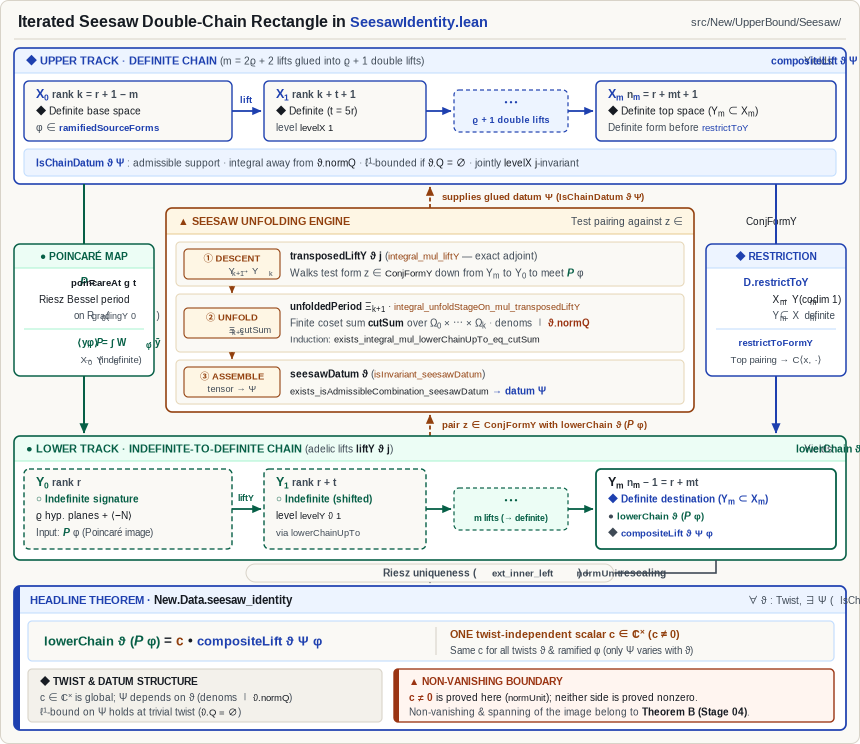
Level 1 — First-Principles
In analysis, an integral kernel
A basic symmetry of any integral kernel is transposition: integrating out the second variable instead of the first produces the adjoint (or descent) map running backward from transposedLiftY) given by the exact same theta kernel weighted by a finite level index, so pairing a conjugate form integral_mul_liftY).
Stage 03 does not stop at one step. Instead, it chains together
To make the
Limits of the intuition
Picturing the theta correspondence as an ordinary scalar integral operator captures how a two-variable kernel transfers functions between groups, but breaks down in three concrete ways. First, the theta kernel is not an arbitrary function of rankTwist), which dictates how level subgroups and central characters transform across each step. Second, on definite unitary groups the algebraic lift acts simultaneously across all infinite places jetMap) between finite-dimensional Weyl modules, whose operator norm grows exponentially with half the sum of derivative sizes rowSizeSum j / 2; a single step looks too large on its own, and only composing all
Level 2 — Undergrad Bridge
Let rankTwist (D.chainChar ϑ (j + 1)), built from
Lift and transposed descent (
transposedLiftY_apply,integral_mul_liftY): For a tame character, step , level subgroup , and Schwartz datum on , the transposed lift (descent) sends a conjugate form to a conjugate form on : By Fubini's theorem on the compact/rapidly decreasing quotient integrals (
isRapid_conjFormY), lift and descent are exact formal transposes:Algebraic lifts on definite groups and one-kernel size (
sqrt_weylNormSq_jetMap_le): Along the upper chain, every is definite, so automorphic forms become algebraic modular forms (Gross 1999)—functions on the finite adelic unitary group taking values in the Weyl module indexed by WeylIndex (D.X j) D.columnCount. For the trivial twist (TameChar.one), a translation tupleshifts the normalized vacuum function at step to D.translateDatum t j, and the theta kernel induces a linear map(D.liftKernel TameChar.one j).jetMapbetween the Weyl modules ofand . For every automorphism , , , , and , where
sums ( D.jetSize) over the row lengthsof the Young diagrams at all infinite places for step . Chain data and composite-lift archimedean bound (
weylNormSq_compositeLift_le): A chain datumsatisfying D.IsChainDatum ϑ Ψspecifies a finitely supported linear combination of translated glued vacuum tensors whose support lies in the admissible level translations, whose coefficients are integral away from(and satisfy an conjugate bound when ), and whose glued tensor is jointly invariant under the levels D.levelX j. The iterated theta liftcompositeLift ϑ Ψ φpasses a source formthrough all lifts using this glued tensor and restricts the final form to . Summing the one-kernel bounds over
gives ( sum_rowSizeSum_le), whereand . Restricting to contributes the level- saving , and chainSize_sub_leconverts the remainder into prime sums:Consequently, if every value of
has squared Weyl norm at most , then for every ,
Level 3 — Formal Lean Contract
Stage 03 extracts the transpose/descent kernel identities into skeleton/03_upper_bound/seesaw_identity.lean (from upstream src/New/UpperBound/Seesaw/SeesawIdentity.lean) and the one-kernel and composite-lift archimedean bounds into skeleton/03_upper_bound/archimedean_size.lean (from upstream src/New/UpperBound/Size/ArchimedeanSize.lean):
03_upper_bound/seesaw_identity.lean#New.Data.transposedLiftY_apply(upstreamsrc/New/UpperBound/Seesaw/SeesawIdentity.lean:183-200):leanlemma New.Data.transposedLiftY_apply (ϑ : D.TameChar) {j : ℕ} (hj : j < D.m) (z : D.ConjFormY (j + 1)) (g : New.G D.E (D.signsY j)) : transposedLiftY ϑ j z g = stdLevelIndex (levelY ϑ j) * ∫ h : New.G D.E (D.signsY (j + 1)), θ ((D.spaceY j).hom (D.spaceY (j + 1))) (twistedPairWeil (rankTwist (D.chainChar ϑ (j + 1))) (g, h) (datumY ϑ j)) * z h ∂(D.spaceY (j + 1)).quotMeasure03_upper_bound/seesaw_identity.lean#New.Data.integral_mul_liftY(upstreamsrc/New/UpperBound/Seesaw/SeesawIdentity.lean:202-228):leanlemma New.Data.integral_mul_liftY (ϑ : D.TameChar) {j : ℕ} (hj : j < D.m) (z : D.ConjFormY (j + 1)) (f : D.FormY j) : ∫ h : New.G D.E (D.signsY (j + 1)), z h * liftY ϑ j f h ∂(D.spaceY (j + 1)).quotMeasure = ∫ g : New.G D.E (D.signsY j), transposedLiftY ϑ j z g * f g ∂(D.spaceY j).quotMeasure03_upper_bound/archimedean_size.lean#New.Data.sqrt_weylNormSq_jetMap_le(upstreamsrc/New/UpperBound/Size/ArchimedeanSize.lean:221-262):leanlemma New.Data.sqrt_weylNormSq_jetMap_le {P : Parameters} (D : Data P) (σ : ℂ ≃+* ℂ) (t : D.Translations) {j : ℕ} (hj : j < D.m) (g : Gf D.E (D.X j)) (g' : Gf D.E (D.X (j + 1))) (ξ : WeylIndex (D.X j) D.columnCount → ℂ) : √(weylNormSq (σ ∘ (D.liftKernel TameChar.one j).jetMap ((D.liftKernel TameChar.one j).ω (g, g') (D.translateDatum t j)) ξ)) ≤ exp (D.x ^ 50 + D.rowSizeSum j / 2) * √(weylNormSq (σ ∘ ξ))03_upper_bound/archimedean_size.lean#New.Data.weylNormSq_compositeLift_le(upstreamsrc/New/UpperBound/Size/ArchimedeanSize.lean:430-451):leantheorem New.Data.weylNormSq_compositeLift_le {P : Parameters} {D : Data P} {Ψ : D.Translations →₀ ℂ} (hΨ : D.IsChainDatum 1 Ψ) {σ : ℂ ≃+* ℂ} {φ : D.SourceForm} {B : ℝ} (hB : ∀ g : Gf D.E (D.X 0), weylNormSq (σ ∘ (φ : D.FormX 0).val g) ≤ exp B) (y : Gf D.E (D.Y D.m)) : weylNormSq (σ ∘ (compositeLift TameChar.one Ψ φ).val y) ≤ exp (B + (D.mainAmount - D.m * D.totalRemainder + 2 * ∑ p ∈ D.smallNonsplitPrimes, D.gain p * log p + D.errorUnit))
Together, transposedLiftY_apply and integral_mul_liftY supply the adjoint step needed to unfold the lower chain, while sqrt_weylNormSq_jetMap_le feeds directly into weylNormSq_compositeLift_le to bound the archimedean size of the upper composite lift. See the page's live <VerificationBanner /> (audit/verification-status.json) for the currently pinned upstream snapshot and local Lean build status (build_status: unverified-locally).
Where this analogy breaks
Thinking of a theta lift as an ordinary matrix-vector multiplication or integral operator captures how a two-variable kernel transports functions between spaces, but misses three layers: the theta kernel is built from the Weil representation of a dual reductive pair rankTwist), not an arbitrary scalar kernel; on definite unitary groups the algebraic lift acts simultaneously across all infinite places as a linear map (jetMap) between Weyl modules whose archimedean operator norm grows exponentially with the Young-diagram row sizes (rowSizeSum j / 2), and only the
Formal Lean Anchors
lemma New.Data.transposedLiftY_apply — Upstream source (src/New/UpperBound/Seesaw/SeesawIdentity.lean L183-L200)
/-- The descent as a theta integral. Let `ϑ` be a tame character, let `j < m`, and let `z` be a
conjugate form on `Y_(j+1)`. The descent of `z` at `g` is the index of the level `levelY ϑ j` in the
lattice stabiliser `stdLevel` of `Y_j`, times the integral over `h ∈ [G_(j+1)]` of `z h` times
`θ (ω (g, h) (datumY ϑ j))`. Here `datumY ϑ j` is the Schwartz function on `Hom(Y_j, Y_(j+1))` that
defines the lift, `θ` is the theta functional, `G_j = U(Y_j)`, and `ω` is the Weil representation of
`G_j × G_(j+1)` whose character on a space of rank `n` is `rankTwist` of `D.chainChar ϑ (j + 1)`:
this character of `U(1)`, formed from `ϑ ^ (j + 1)`, times `υ ^ ⌊n / 2⌋`, with `υ` the fixed
character `upsilonU1`. -/
lemma New.Data.transposedLiftY_apply (ϑ : D.TameChar) {j : ℕ} (hj : j < D.m) (z : D.ConjFormY (j + 1))
    (g : New.G D.E (D.signsY j)) :
    transposedLiftY ϑ j z g = stdLevelIndex (levelY ϑ j) *
      ∫ h : New.G D.E (D.signsY (j + 1)),
        θ ((D.spaceY j).hom (D.spaceY (j + 1)))
          (twistedPairWeil (rankTwist (D.chainChar ϑ (j + 1))) (g, h) (datumY ϑ j)) * z h
∂(D.spaceY (j + 1)).quotMeasure := by
sorry -- [EXTRACTED_STUB upstream=src/New/UpperBound/Seesaw/SeesawIdentity.lean:183-200 commit=41c2716658c42ba08eb0648994a2efe83082a95c body_lines=4 body_sha256=e66cccbaa221e3f5ea3f00b975692088ca9d6ee3632ac7cc84e259951fc90ddc]lemma New.Data.integral_mul_liftY — Upstream source (src/New/UpperBound/Seesaw/SeesawIdentity.lean L202-L228)
/-- Lift and descent are transposes of each other. Let `ϑ` be a tame character, which twists both
maps, let `j < m`, and let `f` be a form on `Y_j` and `z` a conjugate form on `Y_(j+1)`. Then the
integral over `[G_(j+1)]` of `z` times the lift `liftY ϑ j f` is the integral over `[G_j]` of the
descent `transposedLiftY ϑ j z` times `f`. Here `G_j` is the unitary group of `Y_j`. -/
lemma New.Data.integral_mul_liftY (ϑ : D.TameChar) {j : ℕ} (hj : j < D.m) (z : D.ConjFormY (j + 1))
    (f : D.FormY j) :
    ∫ h : New.G D.E (D.signsY (j + 1)), z h * liftY ϑ j f h ∂(D.spaceY (j + 1)).quotMeasure =
∫ g : New.G D.E (D.signsY j), transposedLiftY ϑ j z g * f g ∂(D.spaceY j).quotMeasure := by
sorry -- [EXTRACTED_STUB upstream=src/New/UpperBound/Seesaw/SeesawIdentity.lean:202-228 commit=41c2716658c42ba08eb0648994a2efe83082a95c body_lines=20 body_sha256=85d712b3b4417ff59df3d0671da35ccf7dd0bed95597b9c2fd6069ab591a9196]lemma New.Data.sqrt_weylNormSq_jetMap_le — Upstream source (src/New/UpperBound/Size/ArchimedeanSize.lean L221-L262)
/-- **One kernel.** Let `j < m`, let `X_j` be the definite hermitian space over `E = D.E` with basis
`D.X j`, and let `Gf` denote the finite adelic points of its unitary group. The theta kernel
`D.liftKernel TameChar.one j` of the lift from `X_j` to `X_{j+1}`, for the trivial twisting
character, acts through the Weil representation `ω` on Schwartz functions. Apply `ω (g, g')` to the
translate `D.translateDatum t j` by `t` of the normalised vacuum function; `jetMap` turns the result
into a linear map between the Weyl modules with column numbers `D.columnCount`, whose coordinates
are indexed by `WeylIndex`. For `σ ∈ Aut ℂ`, this map multiplies the norm √`weylNormSq` of
`σ`-conjugates by at most `exp (x ^ 50 + rowSizeSum j / 2)`. Here `x = D.x` is the scale and
`rowSizeSum j` is the sum of `D.jetSize` over the row lengths of the weight. -/
lemma New.Data.sqrt_weylNormSq_jetMap_le {P : Parameters} (D : Data P) (σ : ℂ ≃+* ℂ) (t : D.Translations)
    {j : ℕ} (hj : j < D.m) (g : Gf D.E (D.X j)) (g' : Gf D.E (D.X (j + 1)))
    (ξ : WeylIndex (D.X j) D.columnCount → ℂ) :
    √(weylNormSq (σ ∘ (D.liftKernel TameChar.one j).jetMap
        ((D.liftKernel TameChar.one j).ω (g, g') (D.translateDatum t j)) ξ)) ≤
exp (D.x ^ 50 + D.rowSizeSum j / 2) * √(weylNormSq (σ ∘ ξ)) := by
sorry -- [EXTRACTED_STUB upstream=src/New/UpperBound/Size/ArchimedeanSize.lean:221-262 commit=41c2716658c42ba08eb0648994a2efe83082a95c body_lines=28 body_sha256=a8cc759d3eaa5ab2ded39f4083f5f094f2fc87d638bf56c0e4c0d923c5ebc335]theorem New.Data.weylNormSq_compositeLift_le — Upstream source (src/New/UpperBound/Size/ArchimedeanSize.lean L430-L451)
/-- **Size of the composite lift.** Let `Ψ` be a chain datum for the trivial twist and `σ` an
automorphism of `ℂ`. `compositeLift TameChar.one Ψ φ` lifts the form `φ` from the hermitian space
`X_0` over `E = D.E` to `X_m` by `m = D.m` theta lifts, with the glued tensor as Schwartz data, and
restricts to `Y_m`; `Gf` denotes finite adelic points. If the values of `σ φ` have squared norm at
most `exp B`, then those of the `σ`-conjugate of the lift have squared norm at most `exp (B + β)`,
where `β = h_main - m rem + 2 ∑ gain_p log p + f a log³ b`. Here `h_main = D.mainAmount` is a
difference of archimedean sizes and prime sums, and `rem = D.totalRemainder` one of prime sums and
their expected mean `D.mainPrimeSum`, `gain_p` is the divisibility asked at a prime `p < D.x₁` that
does not split in `ℚ(√-d)`, `f` is the number of infinite places of `E`, and `a = x b` for the
scales `x`, `b`. -/
theorem New.Data.weylNormSq_compositeLift_le {P : Parameters} {D : Data P}
    {Ψ : D.Translations →₀ ℂ} (hΨ : D.IsChainDatum 1 Ψ) {σ : ℂ ≃+* ℂ} {φ : D.SourceForm} {B : ℝ}
    (hB : ∀ g : Gf D.E (D.X 0), weylNormSq (σ ∘ (φ : D.FormX 0).val g) ≤ exp B)
    (y : Gf D.E (D.Y D.m)) :
    weylNormSq (σ ∘ (compositeLift TameChar.one Ψ φ).val y) ≤
      exp (B + (D.mainAmount - D.m * D.totalRemainder +
2 * ∑ p ∈ D.smallNonsplitPrimes, D.gain p * log p + D.errorUnit)) := by
sorry -- [EXTRACTED_STUB upstream=src/New/UpperBound/Size/ArchimedeanSize.lean:430-451 commit=41c2716658c42ba08eb0648994a2efe83082a95c body_lines=6 body_sha256=5d3c32ca5082f00251e18e224c6b579170b5c980af7563d87f84173b5fe86895]Related Concepts
- elliptic theta function — A quasi-periodic entire function on a CM lattice normalized at the origin, whose finite products along tight-frame projections build integral multi-variable theta functions and collapse p-adically into exponential normal forms.
- Schur jet — The evaluation at the origin of a symmetry-adapted Schur differential operator on a theta function's multivariate Taylor expansion, whose prime-by-prime divisibility is controlled through minor products and matched by an explicit sharpness construction.
- Weyl gauge — The p-adic coordinate norm of an algebraic modular form measured in the g-twisted Weyl lattice, paired with Galois-conjugate archimedean bounds to define B-short spanning sets and ramified source forms.
- seesaw duality — A dual-pair adjunction identity that trades an iterated lower-chain theta lift of a Poincaré series for a nonzero twist-independent scalar times the restriction of an upper-chain composite theta lift.
- prime number — A whole number greater than 1 whose only positive whole-number divisors are 1 and itself; every integer above 1 factors uniquely into a product of them.
- arithmetic height — A logarithmic measure combining ordinary archimedean size with prime-by-prime p-adic divisibility, locked together by the product formula so a nonzero algebraic quantity cannot be simultaneously small at every place.
Referenced By
- Stage: Galois Main Summands and the Anticyclotomic Selmer Twisting Theorem
- Stage: Prime-by-Prime Divisibility & Elementary Divisors of Edge Hecke Operators
- Stage: Short Ramified Columns & Archimedean Size Cancellation
- Stage: Siegel–Weil Exchange and the Commuting Theta Square
- Stage: Stage 03 — Upper Bound: A Composite Theta Lift (Theorem A)
- Stage: Stage 07 — Lower Bound: Congruences & Galois Representations (Theorem C, Part 3)
- Stage: Target Dimension, Multiplicity Equality, and One Good Translate
- Stage: The Iterated Seesaw Identity
- Stage: Three Exchanges, the Carrier Form, and Divided-Lattice Gluing
- Stage: Vanishing Periods of False Lifts and Negative Heights of Twisted L-Values
- Concept: carrier form
- Concept: character theta lift
- Concept: elementary divisor
- Concept: false-lift period
- Concept: Galois main summand
- Concept: Hecke operator
- Concept: Rallis inner product formula
- Concept: seesaw duality
- Concept: Siegel–Weil exchange
- Concept: theta square law
- Concept: trace comparison
- Concept: Weyl gauge
Authoritative Sources
- Transcending classical invariant theory (paper) — R. Howe, J. Amer. Math. Soc. 2 (1989).
- Langlands' functoriality and the Weil representation (paper) — S. Rallis, Amer. J. Math. 104 (1982).
- Algebraic modular forms (paper) — B. H. Gross, Israel J. Math. 113 (1999).
Page Glossary
- elliptic theta function
- A quasi-periodic entire function on a CM lattice normalized at the origin, whose finite products along tight-frame projections build integral multi-variable theta functions and collapse p-adically into exponential normal forms.
- Schur jet
- The evaluation at the origin of a symmetry-adapted Schur differential operator on a theta function's multivariate Taylor expansion, whose prime-by-prime divisibility is controlled through minor products and matched by an explicit sharpness construction.
- prime number
- A whole number greater than 1 whose only positive whole-number divisors are 1 and itself; every integer above 1 factors uniquely into a product of them.
- arithmetic height
- A logarithmic measure combining ordinary archimedean size with prime-by-prime p-adic divisibility, locked together by the product formula so a nonzero algebraic quantity cannot be simultaneously small at every place.
- Weyl gauge
- The p-adic coordinate norm of an algebraic modular form measured in the g-twisted Weyl lattice, paired with Galois-conjugate archimedean bounds to define B-short spanning sets and ramified source forms.
- seesaw duality
- A dual-pair adjunction identity that trades an iterated lower-chain theta lift of a Poincaré series for a nonzero twist-independent scalar times the restriction of an upper-chain composite theta lift.