link lattice
Also known as: common link, pair discriminant, frame-meeting norm, weighted Schur test, Siegel's lemma.
The Hermitian sublattice shared by two rational filling terms over one reduction block, whose discriminant and Bombieri–Vaaler Siegel's lemma counts crush cross-link and non-open terms via a weighted Schur test.
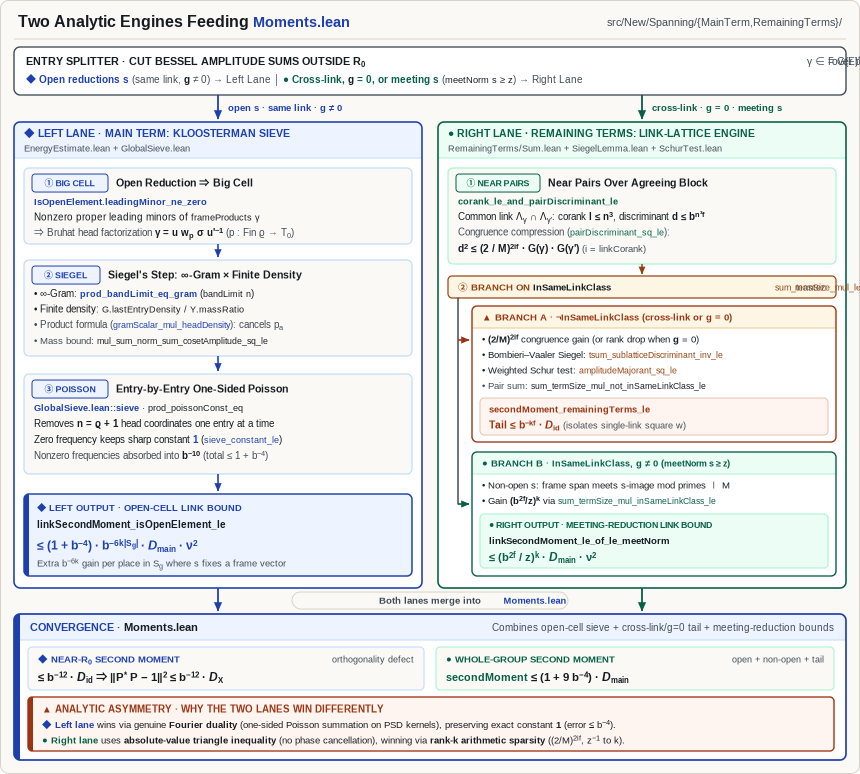
Level 1 — First-Principles
The one-sided Poisson summation sieve on the big Bruhat cellKloosterman sieve handles the main term of Stage 04 only one link at a time and only on generic open reductions. When we square the full sum of archimedean overlap amplitudesBessel orbital integral over all rational elements
- Cross-terms and degenerate terms (
): Pairs whose links differ—or for which the term discriminant vanishes—must be shown to add almost nothing when we expand . - Non-open reductions (
): Reductions where the frame span and its image under collide modulo some prime above the level (so fails to lie in the big cell), quantified by the frame-meeting norm .
To crush both families, Stage 04 attaches to every rational element
Why does a pair of terms over the same block stay tiny? Two mechanisms multiply together:
- Analytic bound (weighted Schur test): Applying Cauchy–Schwarz with an asymmetric geometric weight that inverts when
and trade places—a weighted Schur test—bounds the amplitude of each orbit by an explicit termSizedecaying likein the level gauge of . - Arithmetic sparsity (Siegel's lemma): Because
and reduce to the same matrix , their common link satisfies congruence constraints that compress its pair discriminant by whenever the links intersect in codimension , or by the frame-meeting norm when both terms share a non-degenerate link over a meeting reduction . Counting all Hermitian sublattices of bounded discriminant via Siegel's lemma—which cuts out every codimension- subspace by short integral vectors—forces the entire sum of termSize γ * termSize γ'over all cross-link pairs to fall belowand over all same-link meeting pairs to fall below , controlled by the global balance between discriminant size and congruence levelarithmetic height.
Limits of the intuition
Picturing pairs RemainingTerms/Sum.lean obtains zero phase cancellation between distinct links: enorm_amplitudeSum_mul_le applies the triangle inequality and bounds each pair by the positive product termSize γ * termSize γ'. The huge saving pairDiscriminant_sq_le raised to the large power
Level 2 — Undergrad Bridge
The remaining-term engine (src/New/Spanning/RemainingTerms/, 22 files ending in Sum.lean) adapts classical density/counting methods for automorphic periods (Kowalski, Saha & Tsimerman 2012; Blomer 2023) using an explicit Bombieri–Vaaler Siegel's lemma over CM number fields (Bombieri & Vaaler 1983, formalized in RemainingTerms/SiegelLemma.lean).
1. Links, near pairs, and the pair-discriminant gain (Sum.lean, lines 59–147)
Let link γ is the New.Filling.InSameLinkClass) iff S.termDisc γ ≠ 0, S.termDisc γ' ≠ 0, and link γ = link γ'.
A near pair over an agreeing block (IsNearPairOverAgreeingBlock c c' (γ, γ')) consists of two chosen double-coset representatives over the same block boxedPoints). For every such pair:
one_le_pairDiscriminant:. pairDiscriminant_sq_le: Lettingbe the codimension of commonLink γ γ'inside each link and, corank_le_and_pairDiscriminant_le: The coranksatisfies , and .
2. Weighted Schur test and the unified pair-sum template (SchurTest.lean, SiegelLemma.lean, Sum.lean:149–305)
- Orbit bound via weighted Schur test (
SchurTest.lean,Size.lean): For each term, amplitudeMajorant_sq_leapplies Cauchy–Schwarz with the weightschurWeightcarrying powers ofvolumeRatio⁻¹that invert under. Integrating over unipotent orbits yields termSize_sq_le:where , , and . - Summing over sublattices via Siegel's lemma (
sum_termSize_mul_le): Whenever a set of near pairs satisfiesand , each pair contributes at most ( ofReal_termSize_mul_le). Summingover all pairs of corank uses SiegelLemma.lean::tsum_sublatticeDiscriminant_inv_le(cutting out each sublattice by short vectors and packing lattice points) andcube_add_one_le_tailScale() to conclude that the entire sum of termSize γ * termSize γ'over all classesis at most .
3. Branching on InSameLinkClass and the two headline bounds (Sum.lean:307–837)
Splitting each block into pieces (Piece: one piece per link enorm_amplitudeSum_sq_le):
- Not in the same link class (
sum_termSize_mul_not_inSameLinkClass_le): Either(distinct links, gaining from pairDiscriminant_sq_leand crushed bypow_mul_mainSecondMoment_div_le) or(degenerate determinant, where the cell rank drops and cellRankSecondMomentis tiny). Summing viasum_termSize_mul_lebounds all such pairs by. Substituting into enorm_amplitudeSum_sq_legivesNew.Filling.secondMoment_remainingTerms_le: - Same link class with meeting reduction (
sum_termSize_mul_inSameLinkClass_lelinkSecondMoment_le_of_le_meetNorm): Whenshare a non-degenerate link over a reduction whose frame span meets its -image at places of norm product , the common-link discriminant gains a factor proportional to , yielding In Moments.lean, combiningsecondMoment_remainingTerms_le,linkSecondMoment_le_of_le_meetNorm(for non-open reductions whereor ), and EnergyEstimate.lean::linkSecondMoment_isOpenElement_le(for open reductions) closes both the near-and whole-group second-moment bounds.
Level 3 — Formal Lean Contract
Stage 04 extracts the remaining-term link bounds into skeleton/04_spanning/remaining_terms_sum.lean (26 declarations, 0 stub truncations):
04_spanning/remaining_terms_sum.lean#New.Filling.InSameLinkClass(upstreamsrc/New/Spanning/RemainingTerms/Sum.lean:307-311):leandef New.Filling.InSameLinkClass {E : Type} [Field E] [CMType E] {𝔰 : Shape} (S : Filling E 𝔰) (γ γ' : S.G E) : Prop04_spanning/remaining_terms_sum.lean#New.Filling.sum_termSize_mul_not_inSameLinkClass_le(upstreamsrc/New/Spanning/RemainingTerms/Sum.lean:377-446):leantheorem New.Filling.sum_termSize_mul_not_inSameLinkClass_le {E : Type} [Field E] [CMType E] {𝔰 : Shape} {S : Filling E 𝔰} [HasPrimitiveRoot5040 E] [S.IsAdmissible] : ∑ c : S.Classes, ∑ c' : S.Classes, ∑' q : {q : S.G E × S.G E | S.IsNearPairOverAgreeingBlock c c' q ∧ ¬S.InSameLinkClass q.1 q.2}, ENNReal.ofReal (S.termSize c c' (q : S.G E × S.G E).1 * S.termSize c c' (q : S.G E × S.G E).2) ≤ .ofReal (S.identitySecondMoment / S.b ^ (𝔰.k * numInfPlaces E))04_spanning/remaining_terms_sum.lean#New.Filling.sum_termSize_mul_inSameLinkClass_le(upstreamsrc/New/Spanning/RemainingTerms/Sum.lean:448-491):leantheorem New.Filling.sum_termSize_mul_inSameLinkClass_le {E : Type} [Field E] [CMType E] {𝔰 : Shape} {S : Filling E 𝔰} [HasPrimitiveRoot5040 E] [S.IsAdmissible] {z : ℕ} (hz : z ≠ 0) : ∑ c : S.Classes, ∑ c' : S.Classes, ∑' q : {q : S.G E × S.G E | S.IsNearPairOverAgreeingBlock c c' q ∧ S.InSameLinkClass q.1 q.2 ∧ ∃ s : S.ResidueGL, z ≤ S.meetNorm s ∧ q.1 ∈ S.termsOver c s c'}, ENNReal.ofReal (S.termSize c c' (q : S.G E × S.G E).1 * S.termSize c c' (q : S.G E × S.G E).2) ≤ .ofReal ((S.b ^ (2 * numInfPlaces E) / z) ^ 𝔰.k * S.mainSecondMoment)04_spanning/remaining_terms_sum.lean#New.Filling.secondMoment_remainingTerms_le(upstreamsrc/New/Spanning/RemainingTerms/Sum.lean:678-744):leantheorem New.Filling.secondMoment_remainingTerms_le {E : Type} [Field E] [CMType E] {𝔰 : Shape} {S : Filling E 𝔰} [HasPrimitiveRoot5040 E] [S.IsAdmissible] {w : ℝ} {Ω : Set S.ResidueGL} (hw : 0 ≤ w) (h_linkMoment : linkSecondMoment {γ : S.G E | S.termDisc γ ≠ 0} Ω ≤ ENNReal.ofReal (w * S.unipotentCovolume ^ 2)) : secondMoment (S.amplitudeSum .cut S.remainingTerms) Ω ≤ w + S.identitySecondMoment / S.b ^ (𝔰.k * numInfPlaces E)04_spanning/remaining_terms_sum.lean#New.Filling.linkSecondMoment_le_of_le_meetNorm(upstreamsrc/New/Spanning/RemainingTerms/Sum.lean:746-837):leantheorem New.Filling.linkSecondMoment_le_of_le_meetNorm {E : Type} [Field E] [CMType E] {𝔰 : Shape} {S : Filling E 𝔰} [HasPrimitiveRoot5040 E] [S.IsAdmissible] {Ω : Set S.ResidueGL} {z : ℕ} (hz : z ≠ 0) (h_meet : ∀ s ∈ Ω, z ≤ S.meetNorm s) : linkSecondMoment {γ : S.G E | S.termDisc γ ≠ 0} Ω ≤ ENNReal.ofReal ((S.b ^ (2 * numInfPlaces E) / z) ^ 𝔰.k * S.mainSecondMoment * S.unipotentCovolume ^ 2)
See the page's live <VerificationBanner /> (audit/verification-status.json) for the pinned upstream commit and local Lean build status (build_status: unverified-locally).
Where this analogy breaks
Picturing two rational terms γ, γ' with different links as almost orthogonal vectors whose cross-term cancels ignores that RemainingTerms/Sum.lean does NOT get cancellation in the cross-terms: it bounds every cross-link pair by absolute value (termSize γ * termSize γ'), winning purely from arithmetic sparsity—because forcing γ and γ' to share the same mod-M reduction s shrinks the common-link discriminant by (2 / M)^{2if}, which after raising to the k-th power beats the entire height zeta sum over sublattices of corank at most n³.
Formal Lean Anchors
def New.Filling.InSameLinkClass — Upstream source (src/New/Spanning/RemainingTerms/Sum.lean L307-L311)
/-- Two terms lie in the same link class if `𝗀 = S.termDisc` vanishes for neither and their links
(`New.link`) are equal. -/
def New.Filling.InSameLinkClass {E : Type} [Field E] [CMType E] {𝔰 : Shape} (S : Filling E 𝔰)
(γ γ' : S.G E) : Prop := by
sorry -- [EXTRACTED_STUB upstream=src/New/Spanning/RemainingTerms/Sum.lean:307-311 commit=41c2716658c42ba08eb0648994a2efe83082a95c body_lines=1 body_sha256=e093af84c10014efc350d4892c8fdbca474621789edd1c82b70e5c4ca8ed0e0f]theorem New.Filling.sum_termSize_mul_not_inSameLinkClass_le — Upstream source (src/New/Spanning/RemainingTerms/Sum.lean L377-L446)
/-- **Remaining terms, pairs that do not lie in the same link class.** Let `E` be a CM field with a
primitive root of unity of order 5040, and let `S` be data of the filling theorem over `E` that
satisfy the standing hypotheses `S.IsAdmissible`. Sum over all classes `c`, `c'` and all near pairs
over them whose links (`New.link`) differ or for one of which `𝗀 = S.termDisc` vanishes. The
products of the sizes of the two terms add up to at most `b ^ (-k f) 𝒟_id`. -/
theorem New.Filling.sum_termSize_mul_not_inSameLinkClass_le {E : Type} [Field E] [CMType E]
    {𝔰 : Shape} {S : Filling E 𝔰} [HasPrimitiveRoot5040 E] [S.IsAdmissible] :
    ∑ c : S.Classes, ∑ c' : S.Classes,
      ∑' q : {q : S.G E × S.G E |
        S.IsNearPairOverAgreeingBlock c c' q ∧ ¬S.InSameLinkClass q.1 q.2},
        ENNReal.ofReal
          (S.termSize c c' (q : S.G E × S.G E).1 * S.termSize c c' (q : S.G E × S.G E).2) ≤
.ofReal (S.identitySecondMoment / S.b ^ (𝔰.k * numInfPlaces E)) := by
sorry -- [EXTRACTED_STUB upstream=src/New/Spanning/RemainingTerms/Sum.lean:377-446 commit=41c2716658c42ba08eb0648994a2efe83082a95c body_lines=58 body_sha256=a4d4a6336df890b5c790afb8e3ecb5437f191f8bbec2d7d817f1067384a8a181]theorem New.Filling.sum_termSize_mul_inSameLinkClass_le — Upstream source (src/New/Spanning/RemainingTerms/Sum.lean L448-L491)
/-- **Remaining terms, pairs in the same link class.** Let `E` be a CM field with a primitive root
of unity of order 5040, and let `S` be data of the filling theorem over `E` that satisfy the
standing hypotheses `S.IsAdmissible`. Let `z ≠ 0`. Sum over all classes `c`, `c'` and all near pairs
over them with equal links (`New.link`), with `𝗀 = S.termDisc ≠ 0` for both terms, and whose
reduction `s` has `z ≤ S.meetNorm s`. The products of the sizes `S.termSize` of the two terms add up
to at most `(b ^ (2 f) / z) ^ k 𝒟_main`. -/
theorem New.Filling.sum_termSize_mul_inSameLinkClass_le {E : Type} [Field E] [CMType E]
    {𝔰 : Shape} {S : Filling E 𝔰} [HasPrimitiveRoot5040 E] [S.IsAdmissible] {z : ℕ} (hz : z ≠ 0) :
    ∑ c : S.Classes, ∑ c' : S.Classes,
      ∑' q : {q : S.G E × S.G E | S.IsNearPairOverAgreeingBlock c c' q ∧
        S.InSameLinkClass q.1 q.2 ∧ ∃ s : S.ResidueGL, z ≤ S.meetNorm s ∧ q.1 ∈ S.termsOver c s c'},
        ENNReal.ofReal
          (S.termSize c c' (q : S.G E × S.G E).1 * S.termSize c c' (q : S.G E × S.G E).2) ≤
.ofReal ((S.b ^ (2 * numInfPlaces E) / z) ^ 𝔰.k * S.mainSecondMoment) := by
sorry -- [EXTRACTED_STUB upstream=src/New/Spanning/RemainingTerms/Sum.lean:448-491 commit=41c2716658c42ba08eb0648994a2efe83082a95c body_lines=31 body_sha256=9323043c0a11612a26bd9c0c66096998696184ac5dc4ad6f30ff5dd524f05928]theorem New.Filling.secondMoment_remainingTerms_le — Upstream source (src/New/Spanning/RemainingTerms/Sum.lean L678-L744)
/-- **Remaining terms, reduction to one link.** Let `E` be a CM field with a primitive root of unity
of order 5040, and let `S` be data of the filling theorem over `E` that satisfy the standing
hypotheses `S.IsAdmissible`. Let `Ω` be a set of reductions, `w ≥ 0` and `ν = S.unipotentCovolume`.
Suppose that the terms with `𝗀 = S.termDisc ≠ 0`, taken link by link, have sum of squared norms of
amplitude sums (`linkSecondMoment`) at most `w ν²` over `Ω`. Then the second moment over `Ω` of
`Γ* = S.remainingTerms`, for the cut Bessel function, is at most `w + b ^ (-k f) 𝒟_id`. -/
theorem New.Filling.secondMoment_remainingTerms_le {E : Type} [Field E] [CMType E] {𝔰 : Shape} {S : Filling E 𝔰}
    [HasPrimitiveRoot5040 E] [S.IsAdmissible] {w : ℝ} {Ω : Set S.ResidueGL} (hw : 0 ≤ w)
    (h_linkMoment : linkSecondMoment {γ : S.G E | S.termDisc γ ≠ 0} Ω ≤
      ENNReal.ofReal (w * S.unipotentCovolume ^ 2)) :
    secondMoment (S.amplitudeSum .cut S.remainingTerms) Ω ≤
w + S.identitySecondMoment / S.b ^ (𝔰.k * numInfPlaces E) := by
sorry -- [EXTRACTED_STUB upstream=src/New/Spanning/RemainingTerms/Sum.lean:678-744 commit=41c2716658c42ba08eb0648994a2efe83082a95c body_lines=56 body_sha256=3c2af6c1bdc63690d9b604f16733a02541b507b06fdfcdae71de19bef9e095aa]theorem New.Filling.linkSecondMoment_le_of_le_meetNorm — Upstream source (src/New/Spanning/RemainingTerms/Sum.lean L746-L837)
/-- **Remaining terms, one link at a time.** Let `E` be a CM field with a primitive root of unity of
order 5040, and let `S` be data of the filling theorem over `E` that satisfy the standing hypotheses
`S.IsAdmissible`. Let `Ω` be a set of reductions, that is, of elements of `S.ResidueGL`, the product
of the general linear groups over the residue fields at the chosen places above the level `M = S.M`.
A reduction `s` meets at a place above `M` if, modulo that place, the span of the frame and its
image under `s` share a nonzero vector; `S.meetNorm s` is the norm of the product of the places at
which `s` meets. Let `z ≠ 0` be a natural number with `z ≤ S.meetNorm s` for every `s ∈ Ω`.
Let `T` be the set of rational points `γ` of the unitary group with `S.termDisc γ ≠ 0`. For classes
`c`, `c'`, a reduction `s` and a submodule `Λ`, take the sum of the amplitudes of the `γ ∈ T` that
lie over `(c, s, c')` and have link `Λ`. The squared norms of these sums, added over all `c`, `c'`,
`s ∈ Ω` and `Λ`, give `linkSecondMoment T Ω`, and this is at most `(b ^ (2 f) / z) ^ k 𝒟_main ν²`.
Here `b = S.b` is the size parameter, `k = 𝔰.k` is the dimension of the definite space, `f` is the
number of infinite places of `E`, and `𝒟_main = S.mainSecondMoment` and the covolume
`ν = S.unipotentCovolume` are real constants attached to `S`. -/
theorem New.Filling.linkSecondMoment_le_of_le_meetNorm {E : Type} [Field E] [CMType E]
    {𝔰 : Shape} {S : Filling E 𝔰} [HasPrimitiveRoot5040 E] [S.IsAdmissible]
    {Ω : Set S.ResidueGL} {z : ℕ} (hz : z ≠ 0)
    (h_meet : ∀ s ∈ Ω, z ≤ S.meetNorm s) :
    linkSecondMoment {γ : S.G E | S.termDisc γ ≠ 0} Ω ≤
      ENNReal.ofReal ((S.b ^ (2 * numInfPlaces E) / z) ^ 𝔰.k * S.mainSecondMoment *
S.unipotentCovolume ^ 2) := by
sorry -- [EXTRACTED_STUB upstream=src/New/Spanning/RemainingTerms/Sum.lean:746-837 commit=41c2716658c42ba08eb0648994a2efe83082a95c body_lines=71 body_sha256=735a073c6fa733fa16111a4dff76e0205d67f61294b66fb7052772d763a46245]Related Concepts
- Bessel orbital integral — An archimedean correlation integral ∫ β_c(y) β_{c'}(γ⁻¹ y) W(y) ⊗ W(γ⁻¹ y)* dy unfolding Petersson inner products P* ρ(s) P into class-indexed amplitude blocks.
- Kloosterman sieve — A global entry-by-entry one-sided Poisson summation engine pairing archimedean band-limited Bessel Gram matrices with finite Kloosterman densities to bound the big-cell second moment by (1 + b⁻⁴) b⁻⁶ᵏ|S_g| D_main ν².
- Gram determinant — The determinant of the matrix of pairwise inner products of a family of vectors, measuring the squared volume of the parallelotope they span and controlled by Hadamard's and Fischer's inequalities.
- arithmetic height — A logarithmic measure combining ordinary archimedean size with prime-by-prime p-adic divisibility, locked together by the product formula so a nonzero algebraic quantity cannot be simultaneously small at every place.
Referenced By
- Stage: Relative-Trace Unfolding, Bessel Translates, and the Two Moment Bounds
- Stage: Stage 04 — Spanning: Second Moment (Theorem B)
- Stage: The Big-Cell Kloosterman Sieve and Remaining-Term Link Bounds
- Concept: Bessel orbital integral
- Concept: Kloosterman sieve
Authoritative Sources
- On Siegel's lemma (paper) — E. Bombieri & J. D. Vaaler, Invent. Math. 73 (1983), 11–32.
- Local spectral equidistribution for Siegel modular forms (paper) — E. Kowalski, A. Saha & J. Tsimerman, Compos. Math. 148 (2012), 335–384.
- Density theorems for GL(n) (paper) — V. Blomer, Invent. Math. 232 (2023), 1–48.
Page Glossary
- Kloosterman sieve
- A global entry-by-entry one-sided Poisson summation engine pairing archimedean band-limited Bessel Gram matrices with finite Kloosterman densities to bound the big-cell second moment by (1 + b⁻⁴) b⁻⁶ᵏ|S_g| D_main ν².
- Bessel orbital integral
- An archimedean correlation integral ∫ β_c(y) β_{c'}(γ⁻¹ y) W(y) ⊗ W(γ⁻¹ y)* dy unfolding Petersson inner products P* ρ(s) P into class-indexed amplitude blocks.
- Gram determinant
- The determinant of the matrix of pairwise inner products of a family of vectors, measuring the squared volume of the parallelotope they span and controlled by Hadamard's and Fischer's inequalities.
- arithmetic height
- A logarithmic measure combining ordinary archimedean size with prime-by-prime p-adic divisibility, locked together by the product formula so a nonzero algebraic quantity cannot be simultaneously small at every place.