twisted lattice
A family of linear lifts from one complex vector space into inner-product spaces—one per twist—equipped with prime-by-prime integrality lattices so each prime can pick its own allowed twist.
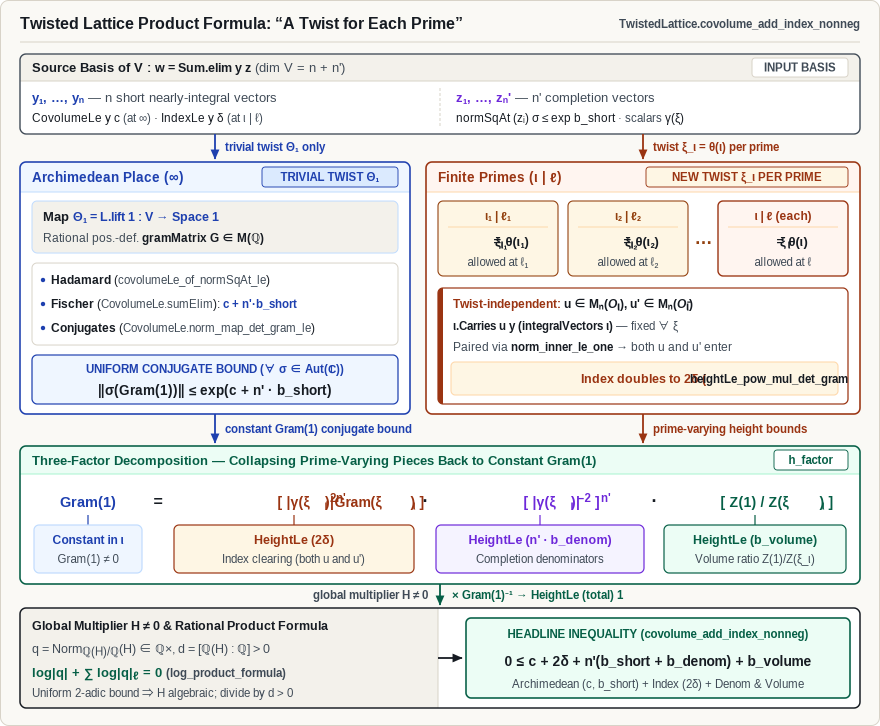
Level 1 — First-Principles
In ordinary geometry, take a grid of whole-number points inside Euclidean space. If you pick
A twisted lattice generalizes this volume-versus-divisibility balance to a whole family of views of the same vector space
This separation of duties is what gives the structure its leverage. You measure the geometric size of a family of vectors—its squared parallelotope volume computed from the determinant of pairwise inner productsGram determinant—once and for all in the single trivial twist
Limits of the intuition
Thinking of a twisted lattice as a fixed integer grid in
Level 2 — Undergrad Bridge
Let
- For each twist
, a complex inner product space and a -linear map . - An allowance relation
specifying which twists are permitted at each prime . - For each pair
consisting of a prime and a ring isomorphism (with valuation ring and conjugate ), an -submodule such that whenever is allowed at , - On the trivial twist space
, a finite coordinate map and a positive-definite rational matrix satisfying .
A vector
- Index at most
: there exist real numbers with over all finite sets of primes such that for every , some matrix satisfies and sends into (crucially, is independent of the twist ). - Covolume at most
: for every field automorphism , the Gram determinant of the coordinate-conjugated family under has absolute value at most . - Twist volume: once
carries an inner product, measures the squared volume distortion of ; for any basis of , , so the ratio is independent of the chosen basis.
Extending
The first factor has arithmetic height at most HeightLe.neg_le_of_norm_map_le) forces
In Arakelov geometry (Bost 2001, Gaudron 2006) and transcendence theory (Laurent 1994), this is the slope-inequality principle for evaluation/interpolation determinants, here enhanced by allowing the twist
Level 3 — Formal Lean Contract
Stage 01 extracts the twisted-lattice interface and its main global inequality into skeleton/01_reduction/twisted_lattice.lean from upstream src/New/Reduction/Lattices/TwistedLattice.lean:
01_reduction/twisted_lattice.lean#New.TwistedLattice(upstreamsrc/New/Reduction/Lattices/TwistedLattice.lean:109-138):leanstructure New.TwistedLattice (V T : Type) [AddCommGroup V] [Module ℂ V] [One T] where Space : T → Type [normedAddCommGroup (ξ : T) : NormedAddCommGroup (Space ξ)] [innerProductSpace (ξ : T) : InnerProductSpace ℂ (Space ξ)] lift (ξ : T) : V →ₗ[ℂ] Space ξ IsAllowed : ℕ → T → Prop lattice (ξ : T) (ι : PrimePadicIso) : Submodule ι.integers (Space ξ) norm_inner_le_one {ξ : T} (ι : PrimePadicIso) (hξ : IsAllowed ι.prime ξ) : ∀ φ ∈ lattice ξ ι.conj, ∀ φ' ∈ lattice ξ ι, ‖ι.iso ⟪φ, φ'⟫_ℂ‖ ≤ 1 Coord : Type [fintypeCoord : Fintype Coord] coord : Space 1 →ₗ[ℂ] Coord → ℂ gramMatrix : Matrix Coord Coord ℚ posDef_gramMatrix : (gramMatrix.map (↑) : Matrix Coord Coord ℂ).PosDef inner_eq (φ φ' : Space 1) : ⟪φ, φ'⟫_ℂ = star (coord φ) ⬝ᵥ gramMatrix.map (↑) *ᵥ coord φ'01_reduction/twisted_lattice.lean#New.TwistedLattice.covolume_add_index_nonneg(upstreamsrc/New/Reduction/Lattices/TwistedLattice.lean:444-485):leantheorem New.TwistedLattice.covolume_add_index_nonneg {n n' : ℕ} {y : Fin n → V} {z : Fin n' → V} (h_inj : ∀ ξ : T, Function.Injective (L.lift ξ)) (h_indep : LinearIndependent ℂ (Sum.elim y z)) (h_card : finrank ℂ V = n + n') {θ : PrimePadicIso → T} (hθ : ∀ ι : PrimePadicIso, L.IsAllowed ι.prime (θ ι)) {c δ b_volume b_short b_denom : ℝ} (hc : L.CovolumeLe y c) (hδ : L.IndexLe y δ) {γ : T → ℂ} (hγ_ne : ∀ ξ : T, γ ξ ≠ 0) (hz_int : ∀ (i : Fin n') (ι : PrimePadicIso) (ξ : T), L.IsAllowed ι.prime ξ → γ ξ • L.lift ξ (z i) ∈ L.lattice ξ ι) (hz_short : ∀ (i : Fin n') (σ : ℂ ≃+* ℂ), L.normSqAt (z i) σ ≤ exp b_short) (hγ : HeightLe b_denom fun ι : PrimePadicIso ↦ ((‖γ (θ ι)‖ : ℂ) ^ 2)⁻¹) (hZ : HeightLe b_volume fun ι : PrimePadicIso ↦ L.volume 1 / L.volume (θ ι)) : 0 ≤ c + 2 * δ + n' * (b_short + b_denom) + b_volume
Notice that New.TwistedLattice itself assumes no inner product or finite-dimensionality on V; those typeclasses (InnerProductSpace ℂ V, Module.Finite ℂ V) enter only in the Twist section defining L.volume ξ = (L.lift ξ).normDet ^ 2 and proving covolume_add_index_nonneg. See the page's live verification banner (audit/verification-status.json) for the currently pinned upstream snapshot and local Lean build status (build_status: unverified-locally).
Where this analogy breaks
Picturing a twisted lattice as a single tilted integer grid inside
Formal Lean Anchors
structure New.TwistedLattice — Upstream source (src/New/Reduction/Lattices/TwistedLattice.lean L109-L138)
/-- A twisted lattice on `V`, with twists `ξ : T` and trivial twist `1`: linear maps `Θ_ξ` to inner
product spaces, in each of them a module of vectors integral at `ι`, such that, if `ξ` is allowed at
the prime of `ι`, products of vectors integral at `ῑ` with vectors integral at `ι` are integral at
`ι`, and coordinates for the trivial twist in which the inner product has a rational matrix. -/
structure New.TwistedLattice (V T : Type) [AddCommGroup V] [Module ℂ V] [One T] where
/-- The inner product space for the twist `ξ`. -/
Space : T → Type
[normedAddCommGroup (ξ : T) : NormedAddCommGroup (Space ξ)]
[innerProductSpace (ξ : T) : InnerProductSpace ℂ (Space ξ)]
/-- The map `Θ_ξ`. -/
lift (ξ : T) : V →ₗ[ℂ] Space ξ
/-- The twist `ξ` is allowed at the prime `l`. -/
IsAllowed : ℕ → T → Prop
/-- The vectors for the twist `ξ` that are integral at `ι`. -/
lattice (ξ : T) (ι : PrimePadicIso) : Submodule ι.integers (Space ξ)
/-- For `ξ` allowed at the prime of `ι`, the product of a vector integral at `ῑ` and a vector
integral at `ι` is integral at `ι`. -/
norm_inner_le_one {ξ : T} (ι : PrimePadicIso) (hξ : IsAllowed ι.prime ξ) :
∀ φ ∈ lattice ξ ι.conj, ∀ φ' ∈ lattice ξ ι, ‖ι.iso ⟪φ, φ'⟫_ℂ‖ ≤ 1
/-- The set of coordinates on the space for the trivial twist. -/
Coord : Type
[fintypeCoord : Fintype Coord]
/-- The coordinates of a vector. -/
coord : Space 1 →ₗ[ℂ] Coord → ℂ
/-- The rational matrix of the inner product in these coordinates. -/
gramMatrix : Matrix Coord Coord ℚ
/-- The matrix defines an inner product on all coordinate vectors. -/
posDef_gramMatrix : (gramMatrix.map (↑) : Matrix Coord Coord ℂ).PosDef
/-- The inner product is the one induced from coordinate vectors. -/
inner_eq (φ φ' : Space 1) : ⟪φ, φ'⟫_ℂ = star (coord φ) ⬝ᵥ gramMatrix.map (↑) *ᵥ coord φ'theorem New.TwistedLattice.covolume_add_index_nonneg — Upstream source (src/New/Reduction/Lattices/TwistedLattice.lean L444-L485)
/-- **A twist for each prime.** Let `L` be a twisted lattice on `V` with maps `Θ_ξ = L.lift ξ`, all
injective. Let `y_1, …, y_n, z_1, …, z_n'` be a basis of `V`, and let `ξ_ι = θ ι` be allowed at the
prime of `ι`. Suppose that
* `y` has covolume at most `c` and index at most `δ`;
* `γ(ξ) ≠ 0`, and `γ(ξ) Θ_ξ z_i` is integral at all `ι ∣ l` for `ξ` allowed at `l`;
* `⟨σ Θ₁ z_i, σ Θ₁ z_i⟩ ≤ exp b_short` for all automorphisms `σ` of `ℂ`;
* the families `|γ(ξ_ι)| ^ (-2)` and `Z(1) / Z(ξ_ι)` have height at most `b_denom` and `b_volume`
respectively.
Then `c + 2 δ + n' (b_short + b_denom) + b_volume ≥ 0`. -/
theorem New.TwistedLattice.covolume_add_index_nonneg {n n' : ℕ} {y : Fin n → V} {z : Fin n' → V}
    (h_inj : ∀ ξ : T, Function.Injective (L.lift ξ))
    (h_indep : LinearIndependent ℂ (Sum.elim y z)) (h_card : finrank ℂ V = n + n')
    {θ : PrimePadicIso → T} (hθ : ∀ ι : PrimePadicIso, L.IsAllowed ι.prime (θ ι))
    {c δ b_volume b_short b_denom : ℝ} (hc : L.CovolumeLe y c) (hδ : L.IndexLe y δ)
    {γ : T → ℂ} (hγ_ne : ∀ ξ : T, γ ξ ≠ 0)
    (hz_int : ∀ (i : Fin n') (ι : PrimePadicIso) (ξ : T), L.IsAllowed ι.prime ξ →
      γ ξ • L.lift ξ (z i) ∈ L.lattice ξ ι)
    (hz_short : ∀ (i : Fin n') (σ : ℂ ≃+* ℂ), L.normSqAt (z i) σ ≤ exp b_short)
    (hγ : HeightLe b_denom fun ι : PrimePadicIso ↦ ((‖γ (θ ι)‖ : ℂ) ^ 2)⁻¹)
    (hZ : HeightLe b_volume fun ι : PrimePadicIso ↦ L.volume 1 / L.volume (θ ι)) :
0 ≤ c + 2 * δ + n' * (b_short + b_denom) + b_volume := by
sorry -- [EXTRACTED_STUB upstream=src/New/Reduction/Lattices/TwistedLattice.lean:444-485 commit=41c2716658c42ba08eb0648994a2efe83082a95c body_lines=21 body_sha256=72085c4de549567c0fa146627de0ac2e9bfd3fdb8f5111cc255cef9622ebec38]Related Concepts
- prime number — A whole number greater than 1 whose only positive whole-number divisors are 1 and itself; every integer above 1 factors uniquely into a product of them.
- complex plane — The two-dimensional coordinate plane of numbers s = σ + it, where the horizontal coordinate σ = Re(s) sets decay rate and the vertical coordinate t = Im(s) sets oscillation frequency.
- Gram determinant — The determinant of the matrix of pairwise inner products of a family of vectors, measuring the squared volume of the parallelotope they span and controlled by Hadamard's and Fischer's inequalities.
- arithmetic height — A logarithmic measure combining ordinary archimedean size with prime-by-prime p-adic divisibility, locked together by the product formula so a nonzero algebraic quantity cannot be simultaneously small at every place.
Referenced By
- Stage: Regular Twist Families and the Assembly of Theorem C
- Stage: Sharpness: Proving the Valuation Bound Is Attained
- Stage: Short Ramified Columns & Archimedean Size Cancellation
- Stage: Stage 00 — Formal Statements & Challenge Contracts
- Stage: Stage 01 — The Theorem and Its Reduction
- Stage: Stage 03 — Upper Bound: A Composite Theta Lift (Theorem A)
- Stage: Stage 05 — Lower Bound: The Determinant (Theorem C, Part 1)
- Stage: The Main Inequality & Theorems A and B
- Stage: Twisted Lattices & A Twist for Each Prime
- Concept: arithmetic height
- Concept: auxiliary spanning form
- Concept: Gram determinant
- Concept: regular twist family
Authoritative Sources
- Algebraic leaves of algebraic foliations over number fields (paper) — J.-B. Bost, Publications Mathématiques de l'IHÉS 93 (2001), pp. 161–221.
- Linear forms in two logarithms and interpolation determinants (paper) — M. Laurent, Acta Arithmetica 66 (1994), pp. 181–199.
- Pentes des fibrés vectoriels adéliques sur un corps global (paper) — É. Gaudron, Rendiconti del Seminario Matematico della Università di Padova 116 (2006), pp. 131–243.
Page Glossary
- complex plane
- The two-dimensional coordinate plane of numbers s = σ + it, where the horizontal coordinate σ = Re(s) sets decay rate and the vertical coordinate t = Im(s) sets oscillation frequency.
- prime number
- A whole number greater than 1 whose only positive whole-number divisors are 1 and itself; every integer above 1 factors uniquely into a product of them.
- Gram determinant
- The determinant of the matrix of pairwise inner products of a family of vectors, measuring the squared volume of the parallelotope they span and controlled by Hadamard's and Fischer's inequalities.
- arithmetic height
- A logarithmic measure combining ordinary archimedean size with prime-by-prime p-adic divisibility, locked together by the product formula so a nonzero algebraic quantity cannot be simultaneously small at every place.