Stage 05 — Lower Bound: The Determinant (Theorem C, Part 1)
Stage 05 supplies the lower-bound pillar of Stage 01's main cancellation inequality: Theorem C (New.Data.integral_forms_long). While Stage 03 (Theorem A) and Stage 04 (Theorem B) push the covolume plus twice the index of lifted target forms down from above, Stage 05 proves that any linearly independent family spanning at least 06_one_lift) and Stage 07 (07_congruences), Stage 05 plays a double architectural role: it builds the core theta-exchange, square-commutation, determinant-factorization, and twist-interface machinery exported to Stages 06–07, and it then brings Stage 06 and Stage 07 back together inside LongForms.lean to assemble Theorem C and hand it directly into Stage 01's New.star_inequality.
Level 1 — First-Principles
In Stage 01, the whole proof of GRH boils down to trapping the prime-counting error inside a balance scale. Theorems A and B (Stage 03 and Stage 04) produce
To push the floor up to the full baseline TwistedLattice.covolume_add_index_nonneg:
- Complementary exchange and commuting squares (
theorem_for_partners,one_square): Whenever two Hermitian spaces have complementary ranks summing to the rank of a middle spaceSiegel–Weil exchange, their theta integrals over matched finite-prime matrix data agree up to a nonzero scalar whose modulus is governed by partial Hecke L-valuesHecke L-value ratio. Doubling via seesaw pairingseesaw duality turns that exchange into the commuting theta squaretheta square law: going up-then-down through a larger space agrees with going down-then-up through a smaller space up to , where is independent of the twist. - Factoring the
-step chain volume ( norm_of_chain): The target space consists of good forms on the indefinite space, mapped into by an -step chain . Using the theta square law across a triangle of liftsRallis inner product formula, Stage 05 slides every lift past every descent until becomes a scalar multiple of a product of single-step Rallis inner product operators on . Borrowing Stage 04's signature transfer of Rallis determinantstrace comparison ( det_rallisOnGood_eq), Stage 05 factors the global chain Gram determinantGram determinant ratiointo the product of single-lift ratios times a controlled scalar built from quotient ratios. - Completing almost-spanning bases cleanly (
spanning_forms): Because Theorem B leaves up todimensions uncovered, Stage 05 constructs a spanning supply of auxiliary spanning formsauxiliary spanning form on . Sweeping a monotone two-grid path across squares transfers period integrals from the lower chain to explicit short deep-level forms on a definite space, where testing against dual-weight delta forms controls both p-adic integralityWeyl gauge and archimedean norm. Even though each auxiliary form costs , multiplying by cancels and caps the total completion cost at . - Contracting regular twists and assembling Theorem C (
fit_twists,long_forms): Stage 05 specifies the exact contract of a regular twist familyregular twist family—one m-fold twist for each primeprime number embedding , with modulus coprime to , small ratios of height at most , and lift/projection denominators summing within the denominator budget . Taking two typed black boxes unpacked in Stages 06 and 07— - Stage 06 (
06_one_lift/lift_volume_height): Input: a regular twist familyand lift index . Output: a sharp height bound on the single-lift determinant ratio ( heightLe_liftDeterminant_ratio). - Stage 07 (
07_congruences/fit_twists_exist): Input: admissible data. Output: existence of a regular twist family ( exists_isRegularFamily). —LongForms.leanadds thesingle-lift heights (so ), combines them with the auxiliary completion cost inside TwistedLattice.covolume_add_index_nonneg, and proves Theorem C (New.Data.integral_forms_long):
- Stage 06 (
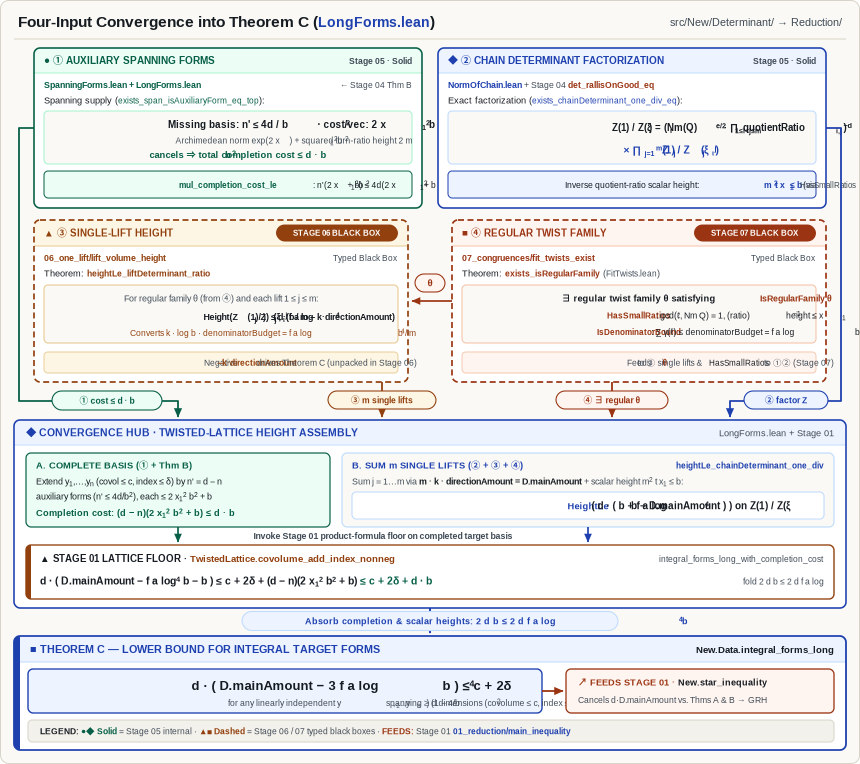
Double architectural role of Stage 05: As the upstream reading guide (GUIDE.md §1) emphasizes, folders in src/New/ follow the narrative order of the mathematical argument rather than strictly one-way layers, while the extracted 41-landmark graph dag/dag.json is strictly acyclic at the node level. Within that acyclic node graph, Stage 05 sits at both ends of Theorem C:
- Foundation exported downstream:
05_determinant/theorem_for_partnersexportsexchange_identityto Stage 06 (06_one_lift/three_exchanges);05_determinant/fit_twistsexports theIsRegularFamily/CriticalPair.ratiocontract to 7 consumers across Stages 05, Stage 06 (three_exchanges,twisted_value_heights), and Stage 07 (rows_from_eigensystems,denominator_bound,twisting_theorem); and05_determinant/norm_of_chainexportsD.Θ(andD.chainDeterminant/D.chainDeterminant_posviaIntegralTargetForms.lean) to Stage 01 (01_reduction/short_and_enough) andD.range_goodLift_le/liftDeterminantto Stages 06–07 (06_one_lift/gluing_maps,06_one_lift/lift_volume_height, and07_congruences/fit_twists_exist). - Top-level assembly of Theorem C:
05_determinant/long_formspulls back the completed Stage 06 (06_one_lift/lift_volume_height) and Stage 07 (07_congruences/fit_twists_exist) theorems alongsidenorm_of_chainandspanning_formsto dischargeNew.Data.integral_forms_longfor Stage 01 (01_reduction/main_inequality).
Explore Stage 05 across its three landmark essays, return to Stage 04 — Spanning (Theorem B) or Stage 01 — The Theorem and Its Reduction, or zoom out to the Full Proof Journey & Alpöge's 20-Step Map:
- Siegel–Weil Exchange and the Commuting Theta Square —
TheoremForPartnersandOneSquare: complementary-rank theta exchange (exchange_identity), constancy of the equal-rank theta ratio, the doubling square law (one_square_identity_of_isEdgeFamily), the honest caveat thatis not proved in OneSquare, and verbatim upstream statements for all 8let-type stub truncations across these two skeletons. - Chain Determinant Factorization and Two-Grid Auxiliary Forms —
NormOfChainandSpanningForms: the triangle of lifts, Rallis product factorization (exists_chainDeterminant_pos_and_div_chainDeterminant_one_eq) via Stage 04'sdet_rallisOnGood_eq, verbatim upstream signature for the 1 truncation innorm_of_chain.lean, and the two-grid-turn period transfer producing short auxiliary lifts ( exists_span_short_lifts_eq_top). - Regular Twist Families and the Assembly of Theorem C —
FitTwistsandLongForms: the 7-consumerIsRegularFamilyinterface (FitTwistsvs.IsRegularFamilynaming nuance), completion-cost cancellation (cost ), height assembly of , Theorem C ( New.Data.integral_forms_long), and its handoff into Stage 01'sNew.star_inequality.
Where this analogy breaks
Presenting Stage 05 as "factoring a chain determinant into LongForms.lean, but hides two profound difficulties. First, the chain TheoremForPartners.lean) and square commutation calculus (OneSquare.lean) just to slide lifts past descents across a triangle of spaces, and even then the square law allows
Level 2 — Undergrad Bridge
Stage 05 spans 33 upstream Lean files under src/New/Determinant/ organized into five subdirectories — Twist/ (2), Norms/ (2), Exchange/ (12), Chain/ (6), and AuxiliaryForms/ (11). In dag/dag.json, those 33 files condense into 6 landmark nodes totaling 138 declarations (with 9 let-type stub truncations across theorem_for_partners.lean [3], one_square.lean [5], and norm_of_chain.lean [1], all documented verbatim in the landmark essays).
Across the 6 landmarks, the quantitative chain runs in two halves that converge inside LongForms.lean:
- Complementary exchange (
Exchange/TheoremForPartners.lean, 27 decls, 3 truncations): For Hermitian spaces(rank , negative signs), (rank ), and (rank ) satisfying , New.Exchange.exchange_identityconstructsand a real Schwartz vector (before are chosen) such that on every tame and matched pair modulo , the theta integral over equals times the integral over , with . - Commuting theta square (
Exchange/OneSquare.lean, 32 decls, 5 truncations): Applyingexchange_identitytopaired against (rank ) and (rank ) yields one_square_identity_of_isEdgeFamily: up-then-downand down-then-up satisfy SquareLaw (χ i) σ (κ / c)withand independent of (possibly zero at this stage). - Chain determinant factorization (
Chain/NormOfChain.lean, 24 decls, 1 truncation): Tiling the triangle of lifts withOneSquaregives( exists_adjoint_chain_comp_eq_smul_rallisProduct), where positivitycomes from chainDeterminant_pos. Combiningexists_normDet_goodLift_sq_eqwith Stage 04'sdet_rallisOnGood_eqyieldsexists_chainDeterminant_pos_and_div_chainDeterminant_one_eq:while HasSmallRatios.heightLe_inv_rpow_mul_prod_quotientRatiobounds the inverse scalar's height by. - Two-grid auxiliary spanning forms (
AuxiliaryForms/SpanningForms.lean, 29 decls, 0 truncations): Executingturns across two square grids ( DiagonalTurns.lean) transfers first-path pairings tolastPathPeriod(exists_integral_lowerChainUpTo_eq_lastPathPeriod), whose denominators clear byand conjugates grow by at most . Reading values with dual-weight delta forms ( exists_dualPairing_eq_mul_lastPathPeriod) and lifting short deep-level forms (span_isShort_eq_top_gridLevelForms) producesexists_span_short_lifts_eq_top(bound). - Regular twist interface (
Twist/FitTwists.lean, 17 decls, 0 truncations): DefinesCriticalPair.ratio,IsRamified,IsMainPair,denominatorBudget(), ClearsProjection,HasDenominatorsLe,IsDenominatorBound,HasSmallRatios, andIsRegularFamily, serving 7 consumers across Stages 05, 06, and 07. - Theorem C assembly (
Twist/LongForms.lean, 9 decls, 0 truncations): Projectsexists_span_short_lifts_eq_toptoexists_span_isAuxiliaryForm_eq_top(size, squared turn-ratio scalar height ), combines Stage 07's exists_isRegularFamilyand Stage 06'sheightLe_liftDeterminant_ratioto getHeightLe (d (b + f a log⁴ b - mainAmount))on, applies TwistedLattice.covolume_add_index_nonneg, and usesmul_completion_cost_le() plus to prove New.Data.integral_forms_long:
Level 3 — Formal Lean Contract
Stage 05 covers 33 upstream files under src/New/Determinant/, represented in dag/dag.json by 6 extracted landmark skeletons totaling 138 declarations and 9 let-type stub truncations, derived from pinned upstream commit 41c2716658c42ba08eb0648994a2efe83082a95c (41c2716658c4, leanprover/lean4:v4.37.0-rc1, Mathlib rev 31ce06eaadf4a200c0e1407c5f10953cf606b8f8):
| Skeleton File | Upstream Path | Declarations (Truncations) | Alpöge 20-Step Alignment | Direct Landmark Dependencies (dag/dag.json) | Direct Landmark Consumers (dag/dag.json) | Headline Declarations |
|---|---|---|---|---|---|---|
05_determinant/theorem_for_partners.lean | src/New/Determinant/Exchange/TheoremForPartners.lean | 27 (3*) | Steps 12, 18 | (none — imports Lib/Weil/DualPair/Flip & local Exchange/) | 05_determinant/one_square, 06_one_lift/three_exchanges | New.Exchange.exchange_of_matches, New.Exchange.exists_equalRankThetaRatio_eq_const, New.Exchange.exchange_theorem, New.Exchange.exchange_identity |
05_determinant/one_square.lean | src/New/Determinant/Exchange/OneSquare.lean | 32 (5*) | Steps 12, 18 | 05_determinant/theorem_for_partners | 05_determinant/norm_of_chain, 05_determinant/spanning_forms | New.Exchange.IsSquare, New.Exchange.exists_sum_pairLift_comp_pairTransposedLift_eq_smul, New.Exchange.equivariant_and_exists_sum_eq_of_areMatched, New.Exchange.one_square_identity_of_isEdgeFamily |
05_determinant/norm_of_chain.lean | src/New/Determinant/Chain/NormOfChain.lean | 24 (1*) | Steps 8, 12, 14 | 02_derivatives/integral_vacuum, 04_spanning/equal_multiplicities, 05_determinant/fit_twists, 05_determinant/one_square | 01_reduction/short_and_enough, 05_determinant/long_forms, 06_one_lift/gluing_maps, 07_congruences/fit_twists_exist | New.Data.Θ, New.Data.chainDeterminant, New.Data.liftDeterminant, New.Data.exists_normDet_goodLift_sq_eq, New.Data.exists_adjoint_chain_comp_eq_smul_rallisProduct, New.Data.exists_chainDeterminant_pos_and_div_chainDeterminant_one_eq, New.Data.range_goodLift_le |
05_determinant/spanning_forms.lean | src/New/Determinant/AuxiliaryForms/SpanningForms.lean | 29 (0) | Steps 7, 18 | 02_derivatives/count, 02_derivatives/integral_vacuum, 03_upper_bound/short_columns, 05_determinant/fit_twists, 05_determinant/one_square | 05_determinant/long_forms | New.Data.exists_mul_lastPathPeriod_mem_embValRing, New.Data.norm_lastPathPeriod_le, New.Data.exists_integral_lowerChainUpTo_eq_lastPathPeriod, New.Data.exists_dualPairing_eq_mul_lastPathPeriod, New.Data.exists_span_short_lifts_eq_top |
05_determinant/fit_twists.lean | src/New/Determinant/Twist/FitTwists.lean | 17 (0) | Steps 14, 18 | 02_derivatives/integral_vacuum | 05_determinant/norm_of_chain, 05_determinant/spanning_forms, 06_one_lift/three_exchanges, 06_one_lift/twisted_value_heights, 07_congruences/rows_from_eigensystems, 07_congruences/denominator_bound, 07_congruences/twisting_theorem | New.Data.CriticalPair.ratio, New.Data.CriticalPair.IsRamified, New.Data.CriticalPair.IsMainPair, New.Data.denominatorBudget, New.Data.ClearsProjection, New.Data.HasDenominatorsLe, New.Data.IsDenominatorBound, New.Data.HasSmallRatios, New.Data.IsRegularFamily |
05_determinant/long_forms.lean | src/New/Determinant/Twist/LongForms.lean | 9 (0) | Steps 14, 18 | 01_reduction/twisted_lattice, 03_upper_bound/archimedean_size, 05_determinant/norm_of_chain, 05_determinant/spanning_forms, 06_one_lift/lift_volume_height, 07_congruences/fit_twists_exist | 01_reduction/main_inequality | New.Data.IsAuxiliaryForm, New.Data.exists_span_isAuxiliaryForm_eq_top, New.Data.mul_completion_cost_le, New.Data.heightLe_chainDeterminant_one_div, New.Data.integral_forms_long_with_completion_cost, New.Data.integral_forms_long |
* Stub-truncation honesty notice (9 let-type truncations total): Because rh-extract splits signatures from proof bodies at the first depth-0 := token, 9 declarations across three Stage 05 skeletons truncate at a let ... := binding inside their return type:
theorem_for_partners.lean(3):exchange_of_matches(L138),exists_quotMeasure_mul_eq_mul_integral_pairTheta(L248), andexchange_theorem(L368) — whileexchange_identity(L389) extracts untruncated.one_square.lean(5):exists_integrable_kernel_bound(L73),exists_norm_integral_upIntegrand_sub_le(L198), and all three headline square theorems (exists_sum_pairLift_comp_pairTransposedLift_eq_smulat L449,equivariant_and_exists_sum_eq_of_areMatchedat L505,one_square_identity_of_isEdgeFamilyat L544).norm_of_chain.lean(1):exists_inner_weightedChain_eq(L86) — while all 23 other declarations extract untruncated.
Every truncated declaration is quoted verbatim from the pinned upstream Lean files in Siegel–Weil Exchange and the Commuting Theta Square and Chain Determinant Factorization and Two-Grid Auxiliary Forms. All declarations in spanning_forms.lean (29), fit_twists.lean (17), and long_forms.lean (9) extract completely untruncated.
Verification status (audit/verification-status.json): Local Lean compilation and kernel replay remain build_status: unverified-locally at pinned upstream commit 41c2716658c42ba08eb0648994a2efe83082a95c (41c2716658c4, leanprover/lean4:v4.37.0-rc1, Mathlib rev 31ce06eaadf4a200c0e1407c5f10953cf606b8f8). Static token scanning currently has scan_scope: entry, covering only Challenge.lean, src/Main.lean, and src/Statements.lean (0 forbidden tokens in solution files and 5 expected sorry tokens in Challenge.lean). None of the 33 upstream Stage 05 proof files under src/New/Determinant/ have been locally compiled, kernel-checked, or statically scanned here; every theorem statement, truncation disclosure, and dependency edge above reflects direct inspection of the pinned upstream Lean source files and extracted skeletons.
- LongForms (landmark) —
src/New/Determinant/Twist/LongForms.lean(depends on:01_reduction/twisted_lattice,03_upper_bound/archimedean_size,05_determinant/norm_of_chain,05_determinant/spanning_forms,06_one_lift/lift_volume_height,07_congruences/fit_twists_exist) - FitTwists (landmark) —
src/New/Determinant/Twist/FitTwists.lean(depends on:02_derivatives/integral_vacuum) - NormOfChain (landmark) —
src/New/Determinant/Chain/NormOfChain.lean(depends on:02_derivatives/integral_vacuum,04_spanning/equal_multiplicities,05_determinant/fit_twists,05_determinant/one_square) - TheoremForPartners (landmark) —
src/New/Determinant/Exchange/TheoremForPartners.lean(depends on: none) - OneSquare (landmark) —
src/New/Determinant/Exchange/OneSquare.lean(depends on:05_determinant/theorem_for_partners) - SpanningForms (landmark) —
src/New/Determinant/AuxiliaryForms/SpanningForms.lean(depends on:02_derivatives/count,02_derivatives/integral_vacuum,03_upper_bound/short_columns,05_determinant/fit_twists,05_determinant/one_square)
Page Glossary
- arithmetic height
- A logarithmic measure combining ordinary archimedean size with prime-by-prime p-adic divisibility, locked together by the product formula so a nonzero algebraic quantity cannot be simultaneously small at every place.
- twisted lattice
- A family of linear lifts from one complex vector space into inner-product spaces—one per twist—equipped with prime-by-prime integrality lattices so each prime can pick its own allowed twist.
- Siegel–Weil exchange
- Comparing theta integrals to U(W) from two complementary-rank spaces V and V' on matched ramified matrix functions modulo m—agreeing up to a nonzero scalar c with |c|^2 = C * L_*(e).
- Hecke L-value ratio
- The ratio |L^S(z, (nu * theta^s)^-1)| / |L^S(z, nu^-1)| of twisted to untwisted partial Hecke L-values at a critical pair (nu, z), tracking how Siegel–Weil exchange constants scale under twisting across chain quotients and grid turns.
- seesaw duality
- A dual-pair adjunction identity that trades an iterated lower-chain theta lift of a Poincaré series for a nonzero twist-independent scalar times the restriction of an upper-chain composite theta lift.
- theta square law
- Commutation of theta lifts around a four-corner square (U_1, U_2, A, A'): summing down-then-up over matched matrix data equals (kappa / c) times summing up-then-down, with |c|^2 = C * L_*(t) != 0 and kappa independent of twist.
- Rallis inner product formula
- Relating the squared norm (and Gram determinant) of a theta lift or m-step chain of lifts to spherical Hecke operators and single-lift determinants—factoring Z(theta)/Z(1) across m lifts up to quotient L-value ratios.
- trace comparison
- Matching traces of spherical Hecke operators between an indefinite unitary group and its definite inner form via a cuspidal local test function—proving equal eigensystem multiplicities, Rallis determinant equality, and the target-dimension bound.
- Gram determinant
- The determinant of the matrix of pairwise inner products of a family of vectors, measuring the squared volume of the parallelotope they span and controlled by Hadamard's and Fischer's inequalities.
- auxiliary spanning form
- A target form whose m-step lifts stay p-integral (after a shared twist scalar) and bounded in archimedean norm by exp(2*x_1^2*b^2), completing an almost-spanning family to a full basis of Y_0 at total cost at most d*b.
- Weyl gauge
- The p-adic coordinate norm of an algebraic modular form measured in the g-twisted Weyl lattice, paired with Galois-conjugate archimedean bounds to define B-short spanning sets and ramified source forms.
- regular twist family
- A prime-by-prime family of m-fold anticyclotomic twists theta(iota) with modulus coprime to l, inverse L-value ratios of height at most x_1, and lift/projection denominators summing within f*a*(log b)^3 / (m*k).
- prime number
- A whole number greater than 1 whose only positive whole-number divisors are 1 and itself; every integer above 1 factors uniquely into a product of them.