Schur jet
Also known as: jet series, minor product, predicted divisibility.
The evaluation at the origin of a symmetry-adapted Schur differential operator on a theta function's multivariate Taylor expansion, whose prime-by-prime divisibility is controlled through minor products and matched by an explicit sharpness construction.
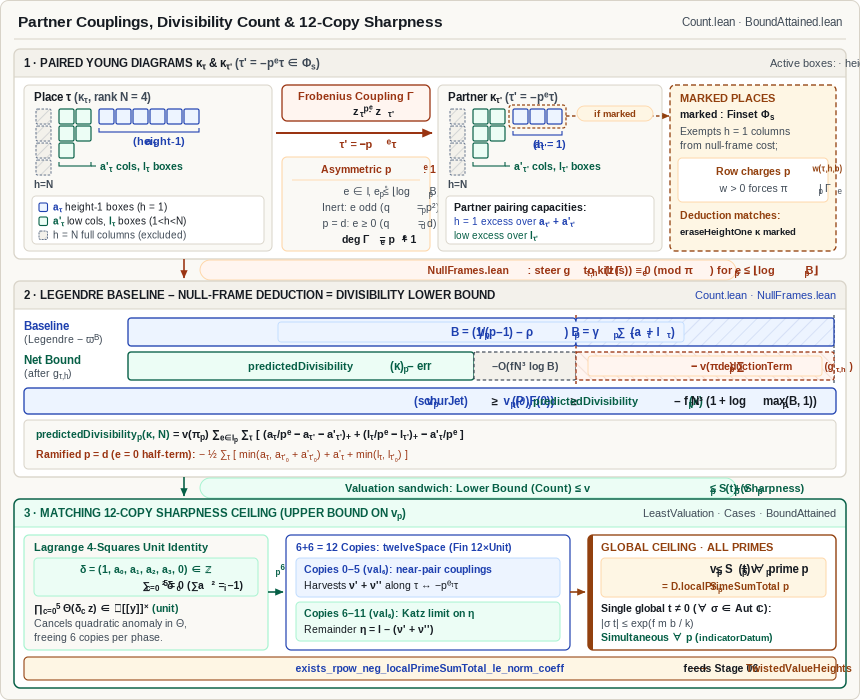
Level 1 — First-Principles
To probe a smooth multivariable function near the origin, you take partial derivatives and evaluate them at
Why does Stage 02 spend its entire climax measuring the divisibility of Schur jets? Because the global proof balances ordinary geometric size against divisibility at every indivisible whole number
Measuring that exact divisibility takes two conceptual leaps:
- From Schur jets to minor products: A general Schur polynomial is a tangled sum of determinants, hard to differentiate directly. Instead, Stage 02 expands a simpler minor product
—built by multiplying by an auxiliary test matrix and taking one determinant per column of the Young diagram—as a linear combination of Schur polynomials. Because the coefficient polynomials stay linearly independent even modulo , there is always an integral choice of that prevents cancellation and makes the jet along at least as large (in -adic size) as the target Schur jet. - From minor products to the predicted divisibility: Next, a tailored linear change of variables turns the jet along
into a clean determinant derivative while making every exponential coupling vanish modulo (or modulo when ). Once the exponential factor is integral, Legendre's classical formula for how many times divides a factorial yields an explicit lower bound on the divisibility exponent—the predicted divisibility—which depends purely on counting height- columns, taller columns, and boxes across paired embeddings.
Crucially, this divisibility bound is not merely a loose overestimate. A companion sharpness theorem constructs twelve-copy theta data using a balanced overcomplete system of integral directions reconstructing the inner producttight frame and shows that some Taylor coefficient actually attains the predicted exponent at every prime simultaneously (up to a tiny, globally bounded normalizing factor). That matching upper-and-lower divisibility ledger carries the exact prime-power weights—closely aligned with the step function assigning
Limits of the intuition
Thinking of a Schur jet as a single high-order derivative
Level 2 — Undergrad Bridge
Let
For a vector V.jetSeries a f is the multivariate Taylor expansion at
Now specialize the variable set to FitsRanks (no column height strictly between
Minor products and Schur jets (
minorProd,exists_norm_schurJet_le_norm_jet_minorProd): A standard Weyl fillingassigns a row to each box of column at place . Given auxiliary matrices of size , the minor product is By Schur–Weyl duality (Fulton & Harris 1991),
expands in row of the Schur matrix ( minorProd_eq_sum):Over
, the polynomials remain linearly independent after reduction to the residue field. Applying the linear-independence norm lemma ( exists_norm_le_norm_sum_mul_eval) to the numbersyields integral matrices over with Direction substitution and predicted divisibility (
predictedDivisibility,norm_jet_minorProd_le_of_hasNormalForm): Letbe non-split in ( ), satisfy , and suppose has normal form HasNormalFormforand partner map . Let count height- columns, count other columns below height , count boxes in those other columns, and be the total box count below height . Introducing at most
auxiliary variables ( , ), we substitute with . Choosing the row charges and integral transformation matrices so that all Frobenius couplings become divisible by ( dvd_subst_coupling_directionSubst_of_charges) rendersan integral power series over (echoing the -adic differential congruence mechanism of Katz 1981). Applying Legendre's bound to the homogeneous determinant product columnDetProdof degreeand dividing out the chain-rule factors , , and ( norm_jet_columnDetProd_subst) produces the predicted divisibility:where
, , , and . The main divisibility count then states: Global sharpness (
exists_rpow_neg_localPrimeSumTotal_le_norm_coeff): To verify that the local divisibility count gives up nothing essential, Stage 02 works ontwelveSpace=(twelve parallel copies of the one-column space). For admissible data and any degree vector in the window , lifting one-dimensional curve sections along a tight frame yields integral twelve-copy theta functions ( exists_integral_isThetaFunction_twelveTaylor_eq) whose coefficients are dominated by finite-modulus indicator vectorsindicatorDatum 𝔪 y₀(). Assembling the global denominator factor with all Galois conjugates bounded by gives, at every prime and place , a multi-index with and a class attaining where
is the predicted local divisibility total.
Level 3 — Formal Lean Contract
Stage 02 extracts the Schur-jet divisibility count into skeleton/02_derivatives/count.lean (from upstream src/New/Derivatives/Divisibility/Count.lean) and the matching sharpness theorem into skeleton/02_derivatives/bound_attained.lean (from upstream src/New/Derivatives/Sharpness/BoundAttained.lean):
02_derivatives/count.lean#New.minorProd(upstreamsrc/New/Derivatives/Divisibility/Count.lean:111-118):leannoncomputable def New.minorProd (i' : WeylIndex n' κ) (y : Φ → n → ℕ → R) : MvPolynomial (Φ × n' × n) R02_derivatives/count.lean#New.predictedDivisibility(upstreamsrc/New/Derivatives/Divisibility/Count.lean:411-428):leannoncomputable def New.predictedDivisibility [Fact d.Prime] : ℝ02_derivatives/count.lean#New.Parameters.norm_jet_minorProd_le_of_hasNormalForm(upstreamsrc/New/Derivatives/Divisibility/Count.lean:686-713): Stub truncation note: Because the upstream return type bindslet N : ℕ := card n', the automated extractor truncates the skeleton stub inskeleton/02_derivatives/count.leanatlet N : ℕ := by sorry. The full upstream statement (lines 703–710 ofsrc/New/Derivatives/Divisibility/Count.lean) is:leantheorem New.Parameters.norm_jet_minorProd_le_of_hasNormalForm [DecidableEq n'] (hp : chiK P.d p ≠ 1) (hϖ : ‖ϖ‖ = p ^ (-varpiValuation P.d p)) (hF : HasNormalForm (partnerExponents P.d p) (P.partner s p) ϖ l F) (i' : WeylIndex n' κ) (y : P.Φ s → n → ℕ → valRingCp p) : let N : ℕ := card n' ‖jet ℂ_[p] (minorProd i' fun (τ : P.Φ s) (a : n) (k : ℕ) ↦ (y τ a k : ℂ_[p])) F‖ ≤ p ^ (-(predictedDivisibility P.d p (P.partner s p) κ N - card (P.Φ s) * N ^ 3 * (1 + Real.logb p (max (boxes κ N) 1 : ℕ))) : ℝ)02_derivatives/count.lean#New.exists_norm_schurJet_le_norm_jet_minorProd(upstreamsrc/New/Derivatives/Divisibility/Count.lean:790-821):leanlemma New.exists_norm_schurJet_le_norm_jet_minorProd (hκ : FitsRanks (fun _ : Φ ↦ n) (fun _ : Φ ↦ n') κ) (F : MvPowerSeries (Φ × n' × n) ℂ_[p]) (i' : WeylIndex n' κ) (i : WeylIndex n κ) : ∃ y : Φ → n → ℕ → valRingCp p, ‖schurJet κ F i' i‖ ≤ ‖jet ℂ_[p] (minorProd i' fun (τ : Φ) (a : n) (k : ℕ) ↦ (y τ a k : ℂ_[p])) F‖02_derivatives/bound_attained.lean#New.Data.exists_rpow_neg_localPrimeSumTotal_le_norm_coeff(upstreamsrc/New/Derivatives/Sharpness/BoundAttained.lean:375-448):leantheorem New.Data.exists_rpow_neg_localPrimeSumTotal_le_norm_coeff {P : Parameters} (D : Data P) (l : D.Φ → ℕ) (hl : ∀ τ : D.Φ, (D.weight τ : ℝ) ≤ l τ ∧ l τ ≤ (D.weight τ : ℝ) + D.x ^ 42) : ∃ t : ℂ, t ≠ 0 ∧ (∀ σ : ℂ ≃+* ℂ, ‖σ t‖ ≤ exp (D.f * D.m / D.k * D.b)) ∧ ∀ 𝔪 : Modulus D.E, 𝔪.ideal = .span {D.piM} → ∀ (p : ℕ) [Fact p.Prime] [PadicPlace p], ∃ (γ : D.Φ × Fin 12 × Unit →₀ ℕ) (y₀ : Matrix (Fin 12) Unit 𝔪.ResidueRing), (∀ τ : D.Φ, ∑ b : Fin 12, γ (τ, b, ()) = l τ) ∧ p ^ (-D.localPrimeSumTotal p) ≤ ‖ιₚ (P.vacuumScale D.towerExp ^ 12 / t * (∏ τ : D.Φ, (l τ)!) * coeff γ (D.twelveTaylor (D.indicatorDatum 𝔪 y₀)))‖
Notice how exists_norm_schurJet_le_norm_jet_minorProd composes directly with norm_jet_minorProd_le_of_hasNormalForm (itself an immediate specialization of norm_jet_minorProd_le_of_charges with empty marked set and zero charges) to bound every Schur-jet entry, while exists_rpow_neg_localPrimeSumTotal_le_norm_coeff supplies the complementary sharpness lower bound at every prime simultaneously. See the page's live verification banner (audit/verification-status.json) for the currently pinned upstream snapshot and local Lean build status (build_status: unverified-locally).
Where this analogy breaks
Thinking of a Schur jet as a single high-order Taylor coefficient
Formal Lean Anchors
def New.minorProd — Upstream source (src/New/Derivatives/Divisibility/Count.lean L111-L118)
/-- The polynomial `P_y(z)` in the entries `X (τ, b, a)` of matrices `z_τ` of size `n' × n`. It is
the product, over the places `τ` and the columns `j` of height `h < card n'` of the diagram `κ τ`,
of the minor of `z_τ y_τ` on the rows `(i' τ).1 h j b` that the filling `i'` puts into the column
and on the first `h` columns. -/
noncomputable def New.minorProd (i' : WeylIndex n' κ) (y : Φ → n → ℕ → R) :
MvPolynomial (Φ × n' × n) R := by
sorry -- [EXTRACTED_STUB upstream=src/New/Derivatives/Divisibility/Count.lean:111-118 commit=41c2716658c42ba08eb0648994a2efe83082a95c body_lines=2 body_sha256=0ab04c46a15396ce309c7be3a56a7e7a972a730d28ad05102fb64fedb57808a3]def New.predictedDivisibility — Upstream source (src/New/Derivatives/Divisibility/Count.lean L411-L428)
/-- The predicted divisibility at a prime `p`. Let `a_τ` be the number of columns of
height one, `a'_τ` the number of the other columns and `l_τ` the number of boxes in these, all
among the heights below `N`. With `τ' = pr e τ` the predicted divisibility is
`v(π_p) ∑_e ∑_τ ((a_τ / p ^ e - a_τ' - a'_τ')₊ + (l_τ / p ^ e - l_τ')₊ - a'_τ / p ^ e)`. Here
`v(π_p) = piPrimeValuation d p`, and `e` runs over `I_p = positivePartnerExponents d p` (the odd
numbers if `p` is inert, all `e ≥ 1` if `p = d`, none if `p` splits). If `p = d`, half the sum of
`min (a_τ, a_τ' + a'_τ') + a'_τ + min (l_τ, l_τ')` with `τ' = pr 0 τ` is subtracted. -/
noncomputable def New.predictedDivisibility [Fact d.Prime] : ℝ := by
sorry -- [EXTRACTED_STUB upstream=src/New/Derivatives/Divisibility/Count.lean:411-428 commit=41c2716658c42ba08eb0648994a2efe83082a95c body_lines=10 body_sha256=b8deb5d6dda113a603683342daef0f97315f63a59241d41f41f88b9baa60f84a]theorem New.Parameters.norm_jet_minorProd_le_of_hasNormalForm — Upstream source (src/New/Derivatives/Divisibility/Count.lean L686-L713)
/-- **The count.** Here `P` fixes the prime `d` of `K = ℚ(√-d)`, `P.Φ s` is the set of infinite
places of the field of level `s`, and the instance `PadicPlace p` is an embedding of `ℂ` into
`ℂ_[p]`. Let `p` be non-split (`chiK P.d p ≠ 1`), and let `v(ϖ) = ρ_p`, where
`ρ_p = varpiValuation P.d p = v(π_p) / (q_p - 1)` for the norm `q_p` of a prime above `p`. Let `F`
have the normal form (`HasNormalForm`) for the exponents `e ∈ I_p°` (odd; all `e` if `p = d`):
`F(ϖ z)` is an integral series times the exponential of `ϖ ^ (p + 1) / p` times a combination of
powers `Γ_e ^ p ^ j` of couplings, with integral coefficients `l`. The filling `i'` puts a row into
each box of `κ` and, with the integral matrices `y_τ`, defines `P_y = minorProd i' y`, the product
over the columns of the minor of `z_τ y_τ` on the rows of the column and the first `h` columns, `h`
being its height. Then the valuation of the jet `P_y(∂)F(0)` of `F` along `P_y` is at least the
predicted divisibility of `κ`, less `f N ^ 3 (1 + log_p max (B, 1))`. Here `f` is the number of
infinite places, `N` the number of rows and `B` the number of boxes of `κ` in columns of height
below `N`. The predicted divisibility is
`v(π_p) ∑_e ∑_τ ((a_τ / p ^ e - a_τ' - a'_τ')₊ + (l_τ / p ^ e - l_τ')₊ - a'_τ / p ^ e)` over
positive `e ∈ I_p°`, where `τ' = P.partner s p e τ = -p ^ e τ` is the partner
of `τ` and `a`, `a'`, `l` count the columns of height one, the other columns and the boxes in these;
for `p = d` half a term for `e = 0` is subtracted (`predictedDivisibility`). -/
theorem New.Parameters.norm_jet_minorProd_le_of_hasNormalForm [DecidableEq n'] (hp : chiK P.d p ≠ 1)
(hϖ : ‖ϖ‖ = p ^ (-varpiValuation P.d p))
(hF : HasNormalForm (partnerExponents P.d p) (P.partner s p) ϖ l F)
(i' : WeylIndex n' κ) (y : P.Φ s → n → ℕ → valRingCp p) :
let N : ℕ := by
sorry -- [EXTRACTED_STUB upstream=src/New/Derivatives/Divisibility/Count.lean:686-713 commit=41c2716658c42ba08eb0648994a2efe83082a95c body_lines=7 body_sha256=24900ed018628d84e7d816b6a1583e00734d42549ffe68e94061840791766a50]lemma New.exists_norm_schurJet_le_norm_jet_minorProd — Upstream source (src/New/Derivatives/Divisibility/Count.lean L790-L821)
/-- An entry of the Schur matrix `schur κ z` may be replaced by a product of minors. Suppose
`card n ≤ card n'` and that `κ` has no column of height strictly between the two (`FitsRanks`). Take
a power series `F` and standard fillings `i'`, `i`. Let `P` be the polynomial entry of `schur κ z`
at `(i', i)`. Then there are matrices `y_τ` with entries in `valRingCp p` such that
`schurJet κ F i' i = (P(∂) F)(0)` has norm at most that of `(P_y(∂) F)(0)`, where
`P_y = minorProd i' y`. -/
lemma New.exists_norm_schurJet_le_norm_jet_minorProd
    (hκ : FitsRanks (fun _ : Φ ↦ n) (fun _ : Φ ↦ n') κ)
    (F : MvPowerSeries (Φ × n' × n) ℂ_[p]) (i' : WeylIndex n' κ) (i : WeylIndex n κ) :
    ∃ y : Φ → n → ℕ → valRingCp p,
      ‖schurJet κ F i' i‖ ≤ ‖jet ℂ_[p]
(minorProd i' fun (τ : Φ) (a : n) (k : ℕ) ↦ (y τ a k : ℂ_[p])) F‖ := by
sorry -- [EXTRACTED_STUB upstream=src/New/Derivatives/Divisibility/Count.lean:790-821 commit=41c2716658c42ba08eb0648994a2efe83082a95c body_lines=21 body_sha256=ada23d9656b3e76e27d98a949b39ec9268169aa843d377180748129911d97514]theorem New.Data.exists_rpow_neg_localPrimeSumTotal_le_norm_coeff — Upstream source (src/New/Derivatives/Sharpness/BoundAttained.lean L375-L448)
/-- Sharpness. Let `D` be admissible data for the parameters `P`, with `K = ℚ(√-d)` for the prime
`d = P.d` and `E = D.E = P.E D.towerExp` the extension of `K` by the roots of unity of order
`q₁ = D.q₁`. For degrees `l` with `κ ≤ l ≤ κ + x ^ 42` at the weights `κ = D.weight` there is a
number `t ≠ 0` with all conjugates at most `exp (f m b / k)` such that, at every prime `p` and
embedding `ιₚ : ℂ → ℂ_[p]`, for some exponent `γ` of degree `l` and some class `y₀` modulo
`𝔪 = (π_M)` the valuation of the coefficient at `γ` of `twelveTaylor (indicatorDatum 𝔪 y₀)`, times
`vacuumScale ^ 12 ∏ l!`, is at most `S_p + v(t)`.
The numbers `x`, `b` are scales and `m`, `r` ranks of `D`, `k = r + 1 - m`, and `π_M = D.piM` is an
integer of `K` of norm `D.M`. -/
theorem New.Data.exists_rpow_neg_localPrimeSumTotal_le_norm_coeff {P : Parameters} (D : Data P) (l : D.Φ → ℕ)
    (hl : ∀ τ : D.Φ, (D.weight τ : ℝ) ≤ l τ ∧ l τ ≤ (D.weight τ : ℝ) + D.x ^ 42) :
    ∃ t : ℂ, t ≠ 0 ∧
      (∀ σ : ℂ ≃+* ℂ, ‖σ t‖ ≤ exp (D.f * D.m / D.k * D.b)) ∧
      ∀ 𝔪 : Modulus D.E, 𝔪.ideal = .span {D.piM} → ∀ (p : ℕ) [Fact p.Prime] [PadicPlace p],
        ∃ (γ : D.Φ × Fin 12 × Unit →₀ ℕ) (y₀ : Matrix (Fin 12) Unit 𝔪.ResidueRing),
          (∀ τ : D.Φ, ∑ b : Fin 12, γ (τ, b, ()) = l τ) ∧
          p ^ (-D.localPrimeSumTotal p) ≤ ‖ιₚ
            (P.vacuumScale D.towerExp ^ 12 / t * (∏ τ : D.Φ, (l τ)!) *
coeff γ (D.twelveTaylor (D.indicatorDatum 𝔪 y₀)))‖ := by
sorry -- [EXTRACTED_STUB upstream=src/New/Derivatives/Sharpness/BoundAttained.lean:375-448 commit=41c2716658c42ba08eb0648994a2efe83082a95c body_lines=55 body_sha256=5153b21ddb2d145e2be16e77503f3cc137054458e02b43b8fc445dfcd6611597]Related Concepts
- prime number — A whole number greater than 1 whose only positive whole-number divisors are 1 and itself; every integer above 1 factors uniquely into a product of them.
- theta normal form — A p-adic factorization of rescaled multivariable theta products into an integral power series times an exponential of Frobenius-power couplings pairing each infinite place with its shifted partner place.
- elliptic theta function — A quasi-periodic entire function on a CM lattice normalized at the origin, whose finite products along tight-frame projections build integral multi-variable theta functions and collapse p-adically into exponential normal forms.
- tight frame — A balanced, possibly overcomplete family of vectors with integer multiplicities whose projections reconstruct the exact standard inner product—allowing integral root-of-unity spokes to pull back one-dimensional elliptic theta sections into high-dimensional integral theta functions.
- arithmetic height — A logarithmic measure combining ordinary archimedean size with prime-by-prime p-adic divisibility, locked together by the product formula so a nonzero algebraic quantity cannot be simultaneously small at every place.
- von Mangoldt function — The arithmetic weight Λ(n) equal to log p when n is a prime power pᵏ (k ≥ 1) and 0 otherwise, converting multiplicative prime factorizations into additive logarithms.
Referenced By
- Stage: Formal Groups, Theta Normal Form & Prime-Counting Divisibility
- Stage: Sharpness: Proving the Valuation Bound Is Attained
- Stage: Short Ramified Columns & Archimedean Size Cancellation
- Stage: Stage 02 — Derivatives of Theta Functions
- Stage: Stage 03 — Upper Bound: A Composite Theta Lift (Theorem A)
- Stage: Tight Frames, Chowla–Selberg Scaling & the Integral Vacuum
- Concept: theta correspondence
- Concept: theta normal form
- Concept: Weyl gauge
Authoritative Sources
- Divisibilities, congruences, and Cartier duality (paper) — N. M. Katz, J. Fac. Sci. Univ. Tokyo 28 (1981).
- Sur certains groupes d'opérateurs unitaires (paper) — A. Weil, Acta Math. 111 (1964).
- Representation Theory (book) — W. Fulton & J. Harris, Graduate Texts in Mathematics 129, Springer (1991).
Page Glossary
- prime number
- A whole number greater than 1 whose only positive whole-number divisors are 1 and itself; every integer above 1 factors uniquely into a product of them.
- arithmetic height
- A logarithmic measure combining ordinary archimedean size with prime-by-prime p-adic divisibility, locked together by the product formula so a nonzero algebraic quantity cannot be simultaneously small at every place.
- elliptic theta function
- A quasi-periodic entire function on a CM lattice normalized at the origin, whose finite products along tight-frame projections build integral multi-variable theta functions and collapse p-adically into exponential normal forms.
- theta normal form
- A p-adic factorization of rescaled multivariable theta products into an integral power series times an exponential of Frobenius-power couplings pairing each infinite place with its shifted partner place.
- tight frame
- A balanced, possibly overcomplete family of vectors with integer multiplicities whose projections reconstruct the exact standard inner product—allowing integral root-of-unity spokes to pull back one-dimensional elliptic theta sections into high-dimensional integral theta functions.
- von Mangoldt function
- The arithmetic weight Λ(n) equal to log p when n is a prime power pᵏ (k ≥ 1) and 0 otherwise, converting multiplicative prime factorizations into additive logarithms.